

A bit of good news
And an upcoming series you'll want to susbscribe for!

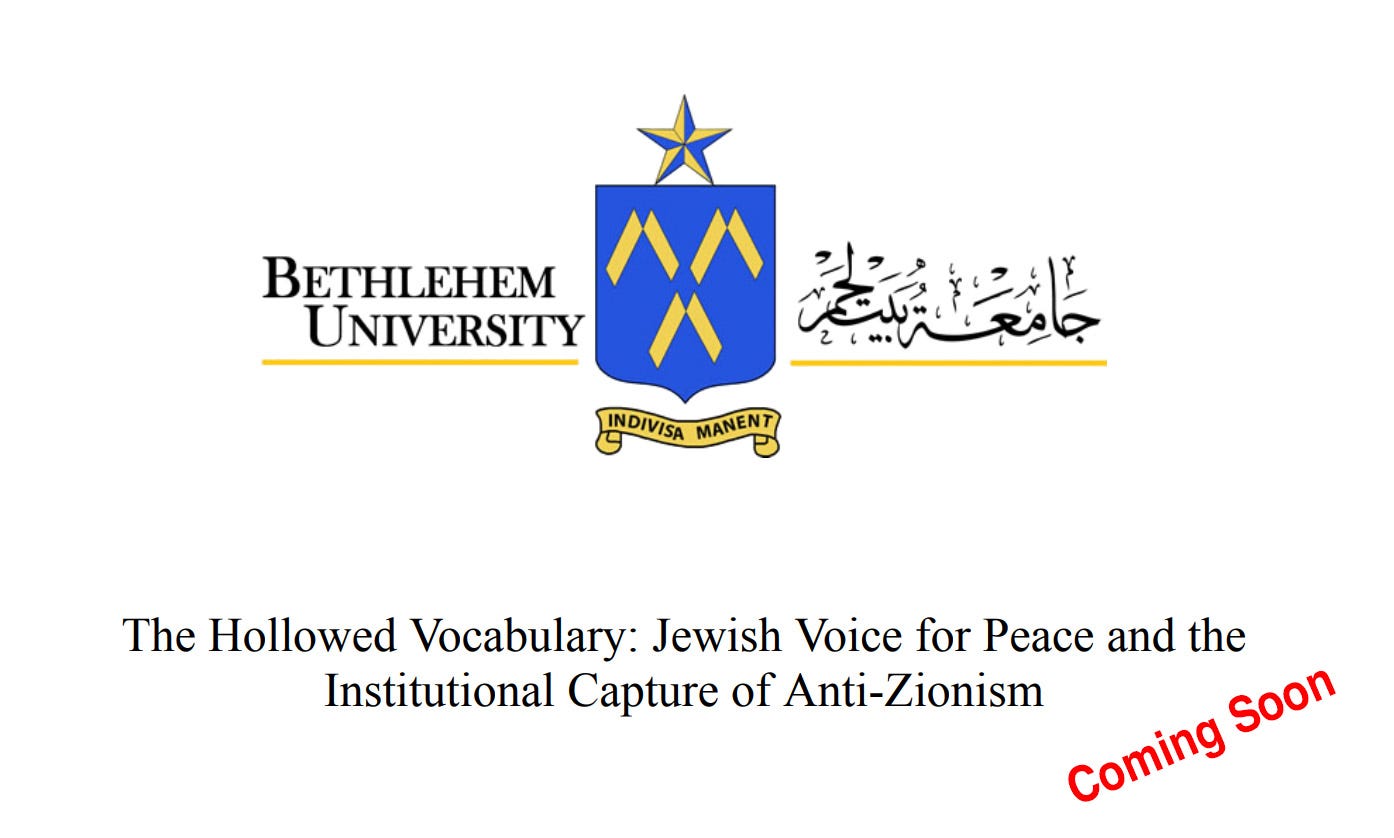
In this update, I’m bringing a bit of personal news. This past week, I graduated from Bethlehem University with a Master’s degree in International Cooperation and Development. I wanted to take a moment to share a few things I learned through the process and about what it means to study here in Palestine, and tell you about the work my thesis turned into.
Lessons learned often had nothing to do with the syllabus. Studying at a Palestinian university means studying despite Israeli-imposed conditions that are methodically engineered to make studying difficult. Some weeks there were no classes. Some weeks people were missing. Professors were restricted from traveling, students couldn’t reach campus due to random checkpoints, road closures, or neighborhoods blocked off, and the speculations and worries of zionist violence were routinely present. What I watched, again and again, was my colleagues, teachers and the administration adapting to that fluidity — not lowering the bar, but finding another way to keep the work moving forward. I owe particular thanks to the administrators of the program at Bethlehem University, who modeled what it looks like to keep a program running under conditions designed to break it. Stopping was never an option, and the way they supported each student was itself an education in how to resist.
Through their leadership, I came to understand more fully that education isn’t just about your own personal development, but it’s about the development of the people and community to which you belong. I appreciated the different ways we students challenged each other: the debates, the disagreements, the camaraderie of it all. But it was also about the ordinary, unglamorous work of helping one another through the assignments and the readings, sorting out together what actually deserved our attention. Some of the most valuable conversations weren’t in the scholarly texts at all; they were about which parts of the field were worth taking seriously in the first place, and discussions about what adds value and what doesn’t. Log frames, development indicators, the whole apparatus of “development goals”: we kept arriving at the same conclusion, that a good deal of it lives in a theoretical realm that isn’t always additive to Palestinian liberation and functions rather as a mechanism for institution building and pursuing grants. Learning to name what is actually deployed for the express purpose of challenging empire, and what is rolled out to advance an organization is critical, essential work.
That question is what my thesis grew out of, and it carried its own tension. That is because my thesis is, in the end, an analysis of anti-Zionism and specifically how one of the largest organizations in the U.S. Palestine solidarity movement, Jewish Voice for Peace, actually uses the term.
I want to be honest about why that’s uncomfortable terrain. For a lot of people, JVP is their only organizing home, the one place they feel safe showing Palestinian solidarity, and offering critique can mean getting pushed out of that space. That risk is close to universal in any group or workplace. For us at GSC, there are consequences too. The JVP ecosystem is also a pool of resources — financial, social, political. This is an organization whose combined revenue tripled to roughly $12 million in the year after October 2023, when millions of people were looking to invest in Palestinian solidarity, and turned to JVP to show support. Raising these questions carries a cost, and we at GSC understand that. When we’ve offered up other empirically based critiques, some folks have dropped their financial support. Nonetheless, the question we always have to answer is, is our understanding of anti-Zionism one that is in service of Palestinians?
The thesis does two things. First, it builds a definition. I worked through the historical and contemporary texts of people who were, and are, inside anti-colonial struggle. This included the political documents of the PFLP and the writing of Fanon and Cabral on the organizing side, and the theoretical work of Ali Kadri, Samir Amin, and Max Ajl, alongside Fayez Sayegh, Ghassan Kanafani, and George Habash among others. That literary work, coupled with the rigorous back-and-forth with my Bethlehem University supervisors and other intellectual contributions from the activists and members of the Good Shepherd Collective, allowed me to assemble a materialist definition of anti-Zionism. In broad strokes, I demonstrate how anti-Zionism must be anti-imperialist, anti-colonial, and focused on material decolonization. I unpack what each of those dimensions means in the context of Palestine. That composite is the yardstick I employ.
Second, the thesis tested JVP’s public discourse against that anti-Zionist yardstick. I assembled roughly 28,500 pieces of content JVP has produced over about thirteen years across its websites, its mass emails, its main social media accounts and measured how closely that discourse mimics the definition of anti-Zionism I compiled from the sources above. The short version of what I found is that JVP carries a hollowed-out vocabulary of anti-Zionism, one that is empty of its analytical work, and one that has real material implications for the broader movement to support Palestinian liberation.
It’s important that we continue to reflect on the work we’re doing as a movement, and whether our analysis meets the needs of the people with whom we purport to be solidarity. Over the next few months, I’m going to take this thesis and rework it into a series of essays here for the Good Shepherd Collective, which you can read on our Substack, The Call. I will break down the methodology I used, how the definition was assembled through the literature and conversations, and unpacked the data from reviewing the 28,500 pieces of content JVP has produced over the years, and outline the implications it has for Palestinian liberation.
In solidarity, Cody
Thank you for sharing your thought Cody!! Looking forward to reading your research, findings and analysis. Free Palestine.