

April 2026 demolition report
In 2026, 87 percent of Palestinian demolitions cite "lack of permit."

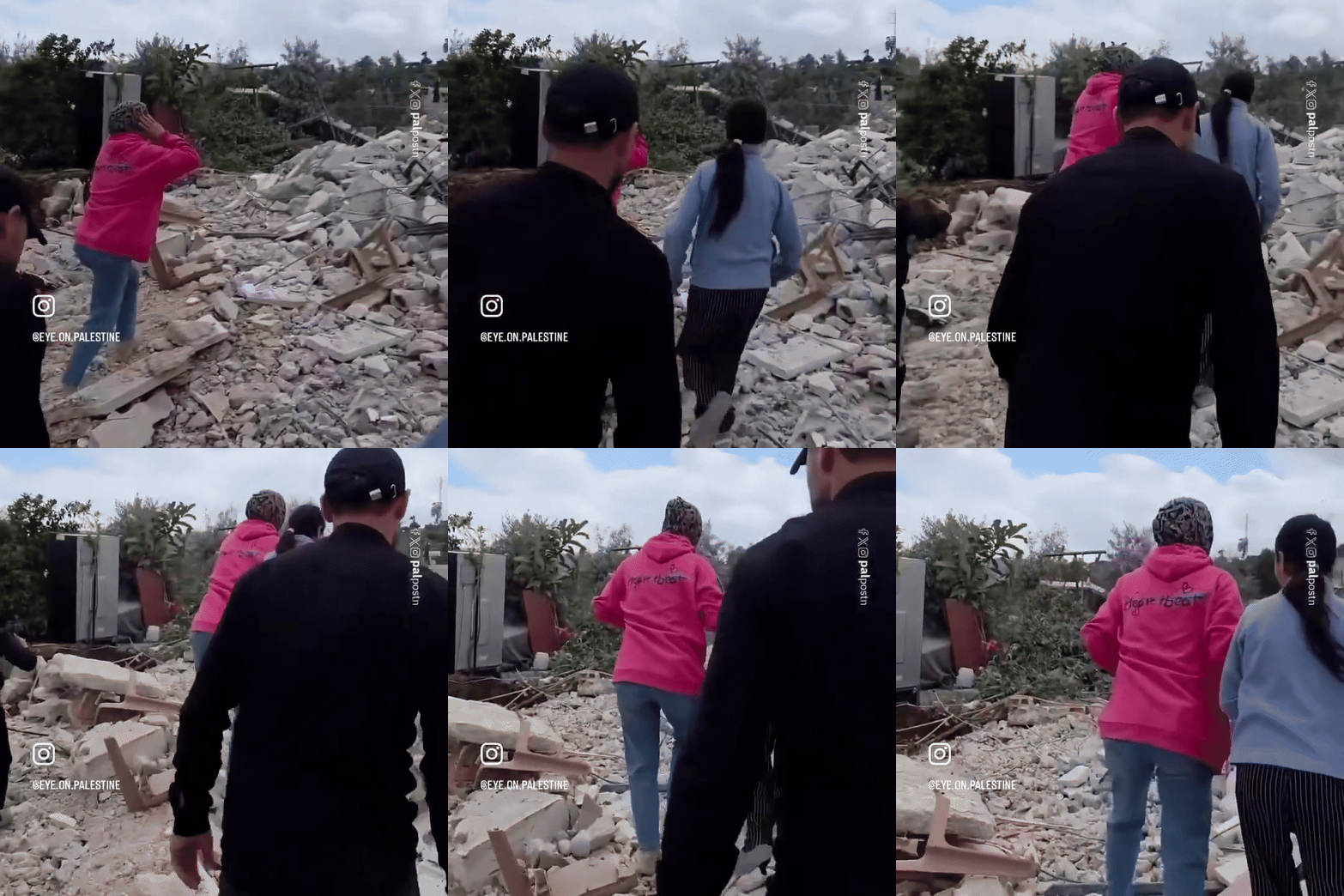
Tarqumiya, west of Hebron, 20 April 2026. Palestinian families gather what remains of their belongings after the Israeli Civil Administration demolished a two-story residential building containing three apartments, along with a water cistern and a concrete retaining wall.
In the first four months of 2026, Israeli authorities demolished 447 Palestinian structures across the West Bank and East Jerusalem, displacing 776 people — including 351 children. Eighty-seven percent of this year’s demolitions were carried out for “lack of permit,” which in practice is a systemic instrument of annexation and displacement, rather than a planning matter, given that Israel approves only a tiny fraction of Palestinian building applications in Area C and East Jerusalem.
Jerusalem has borne the heaviest weight with 50 demolitions that destroyed 144 structures and displaced 351 people. The year’s most concentrated operation came in Kafr ‘Aqab, where, in late January, Israeli forces opened a section of the apartheid wall to carry out the operation, demolishing more than 70 structures over three days under an operation styled “Capital Shield”. Hebron followed with 30 demolitions and 116 structures, including a nine-structure operation in Qalqas in February that displaced 29 people.

The single most acute episode of forced displacement this year came not from demolition equipment but from eviction orders. Between 22 and 25 March, Israeli police evicted 16 Palestinian families in Batn al-Hawa, a neighborhood at the heart of Silwan, just south of the Old City. The evictions are the latest chapter in a long settler campaign by the organization Ateret Cohanim, which has been central to the Batn al-Hawa eviction campaign. Since 7 October 2023, about 28 households — 160 people — have been pushed out of that neighborhood alone.
In Area C, Bedouin herding communities have remained particularly exposed and vulnerable to coordinated settler violence as well as demolition campaigns. On 15 April, the Civil Administration demolished 17 residential and agricultural structures in Az Za’ayyem Bedouin community, displacing 23 people, including 15 children. It is one of 46 Bedouin communities in the central West Bank, the UN has flagged as facing forcible transfer under an Israeli “relocation” plan. In the Jordan Valley, a single operation on 8 February in Hammamat al-Maleh (Al Meiteh) tore down 21 structures and displaced 16 people. Of the 447 structures demolished year-to-date, 31 were funded by international donors, a reminder that the Zionist entity targets not simply homes, but humanitarian aid.
Set against the longer arc, the post-2023 escalation is impossible to miss. The 1,774 structures destroyed in 2024, alongside the 4,293 people displaced that year in the West Bank and East Jerusalem alone, represented the worst annual figures since OCHA began publishing this data in 2009. The 2025 figures maintained the pace, with 1,671 structures destroyed and 2,134 people displaced. By contrast, between 2009 and 2022, the West Bank averaged about 655 structures torn down per year. A single year now matches what used to take nearly three.
Where 2026 lands by year’s end will depend on factors only partly under the Israeli Civil Administration’s control. Through 28 April, demolitions are running behind 2025’s same-period pace — 447 structures destroyed against 662, and 776 displaced against 888 — though still well above every pre-2023 baseline on record. The simplest explanation is bandwidth: with Israel having waged war against Iran and continuing operations in Lebanon and Gaza, the Israeli forces that once accompanied mass West Bank sweeps are just committed elsewhere.