

Cash, Caravans, and Confiscation Orders
Israel routes a billion shekels around its own planning rules while Washington moves to fuse the two militaries.

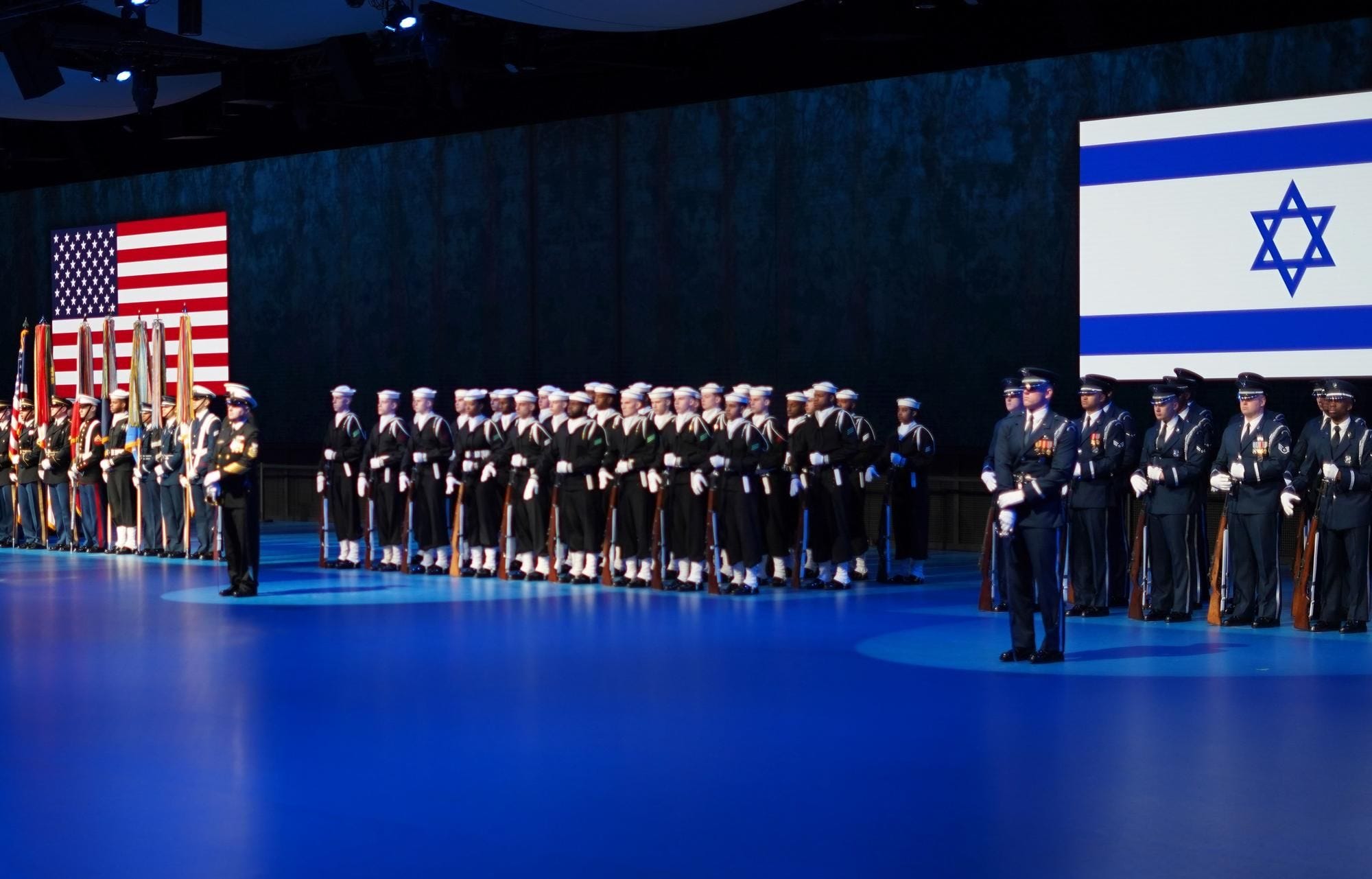
American troops render full military honors to the departing head of the Israeli armed forces, Lt. Gen. Herzi Halevi, during an arrival ceremony at Conmy Hall on Fort Myer, VA, Feb. 18, 2025.
A billion shekels moving towards squatter movement
The Israeli government was supposed to spend its June 11 session approving roughly NIS 1 billion ($338 million) to build out new West Bank settlements. At the last moment it pulled the item and referred it to the Security Cabinet, which is expected to take it up the following Sunday. The delay is mostly procedural; rather than a retreat on advancing the colonial project, the money, and the settlements it would fund, remain on the table.
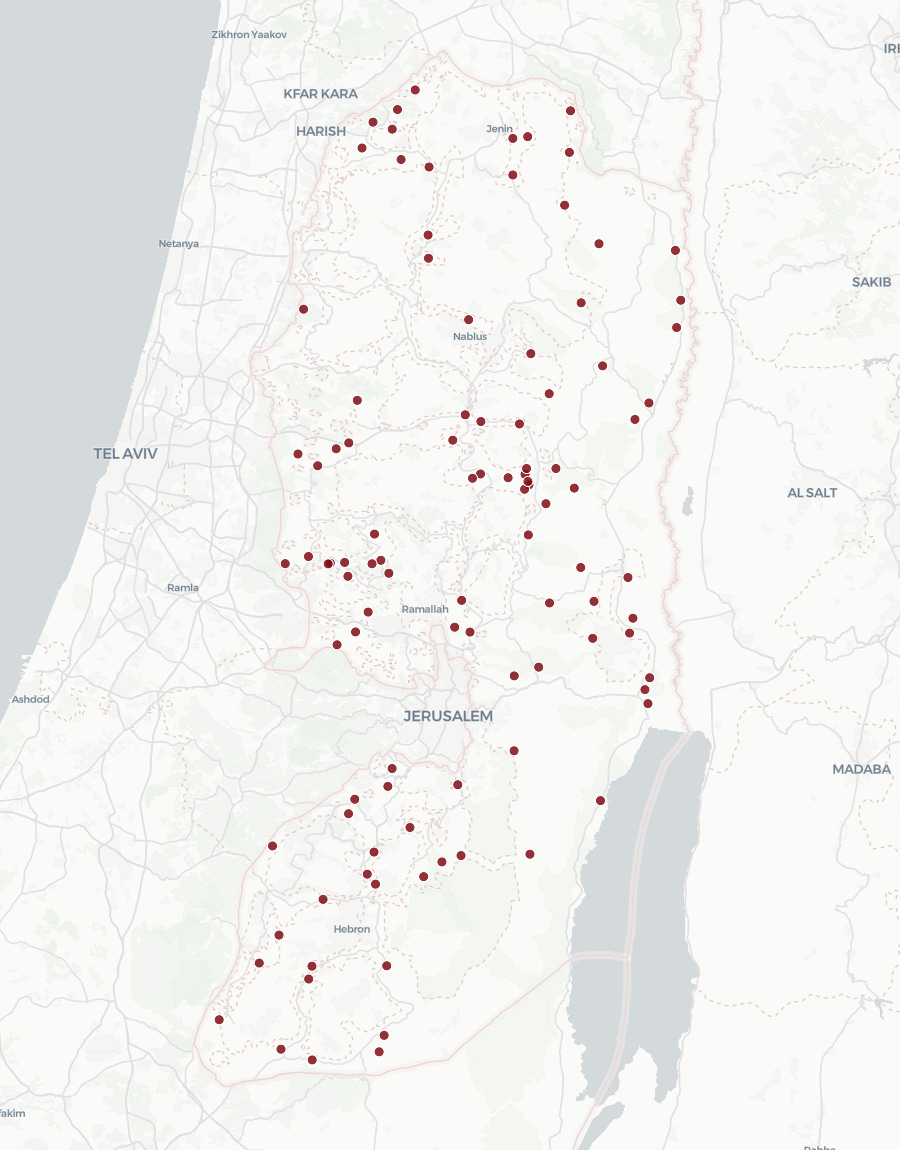
The funding targets some 61 of the 103 settlements the cabinet has approved since December 2022. At each new “temporary site,” the Settlement Division would deliver fifteen residential caravans and two for public use; the Housing Ministry would lay the access roads, sewage, and water lines. The point of the exercise is speed. Most of these settlements have no approved planning scheme, and some have no “state land” available to plan on at all. So the government is preparing to route around its own planning rules, most likely by invoking military orders meant for projects of “national importance”. Build first, regularize later, and by the time any plan is reviewed the homes are already standing. Anyone following the history of the Zionist project will identify this, “facts on the ground”, is one of its defining characteristics.
A week earlier, ministers quietly approved, by telephone vote, another NIS 152 million to draw up plans for 69 of the same settlements, on top of NIS 1.075 billion already committed to the roads that will connect them. Since March, the running total the government has steered toward settlements has climbed from NIS 19.3 billion to roughly NIS 20.7 billion. The billion now before the Security Cabinet is one more installment in a budget being rewritten, line by line, to make the settlements permanent.
Cash in settlers’ pockets
While the infrastructure money waited, a direct subsidy went through. In early June, the Knesset passed the settlement tax benefits law, 32 to 23. Settlers of the 58 settlements now get a 7 percent income-tax break worth up to NIS 10,000 per person each year (money deposited, in effect, straight into settlers’ bank accounts) at a cost of about NIS 130 million annually through the end of 2027.
Like everything else, the law was sold as a “security measure”. To qualify, a community has to sit more than two kilometers from the Apartheid Wall and bus its children to school in armored vehicles. The Finance Committee’s own legal counsel warned that the test was “tailored for a specific purpose in a manner that may exclude other communities whose security needs are no lesser” . They essentially said the criteria were drawn to fit the settlements and little else. The settlements that qualify grew by an average of 22 percent over the past five years; they need no further inducement to grow. The subsidy is essentially rerouting a monetary reward to a political base of the West Bank settler movement.
How US Congress is advancing Zionism
In the first week of June, the House cast three votes that together mark where Congress stands on Israel and its wars. The one that matters most got the least attention.
On June 3, the House passed H. Con. Res. 86, 215 to 208, directing the president to remove US forces from hostilities with Iran. Four Republicans — Massie, Fitzpatrick, Barrett, and Davidson — crossed over to pass it, the first time either chamber has cleared a war powers measure since the aggression against Iran began.
A day later, the House rejected H. Con. Res. 84, Rashida Tlaib’s resolution to remove US forces from Lebanon, 92 to 324. Democratic leadership opposed it — Jeffries, Clark, and Aguilar said no US servicemembers were engaged in hostilities there — and steered members toward Tlaib’s narrower follow-up, H. Con. Res. 108, which carves out continued security cooperation with the Lebanese Armed Forces.
The more consequential vote drew the least notice. The House Armed Services Committee advanced the FY2027 defense bill, HR 8800, 44 to 12, after spending roughly twenty minutes dismissing, on a voice vote, Ro Khanna’s amendment to strip Section 224. That section would establish a US-Israel Defense Technology Cooperation Initiative, directing the Pentagon to designate an executive agent to integrate Israeli-origin weapons and technology into US military systems across missile defense, AI, cyber, and autonomous platforms.
Notably, on June 3, the day before the markup, Marlin Stutzman introduced H. Res. 1339, endorsing what Netanyahu, in a June 1 letter to Stutzman, called “my plan to shift the framework for US-Israel defense cooperation from aid to partnership.” Khanna argued that Section 224 tracks that language directly; the section’s authors denied any role for Netanyahu.
The effect of Section 224 is structural. It converts the relationship from annual military aid (which Congress votes on each year, and which is visible as a line item) into an embedded framework that is harder for any future Congress to unwind and less exposed to public review. There is still a chance this structural integration with the Zionist project could be defeated in Congress. But with the broader left anti-War and pro-Palestine movement reluctant to hold elected officials accountable, whatever circumvention of this provision may materialize will perhaps come from the corporations that would be projected to lose in this arrangement.
Separately, on June 5, 85 members of Congress led by Schakowsky and Pocan, urged Secretary of State Rubio to use every diplomatic tool against settlement construction in E1, the corridor whose planned roads would cut the West Bank in two.
New military orders
Military order H/03/83
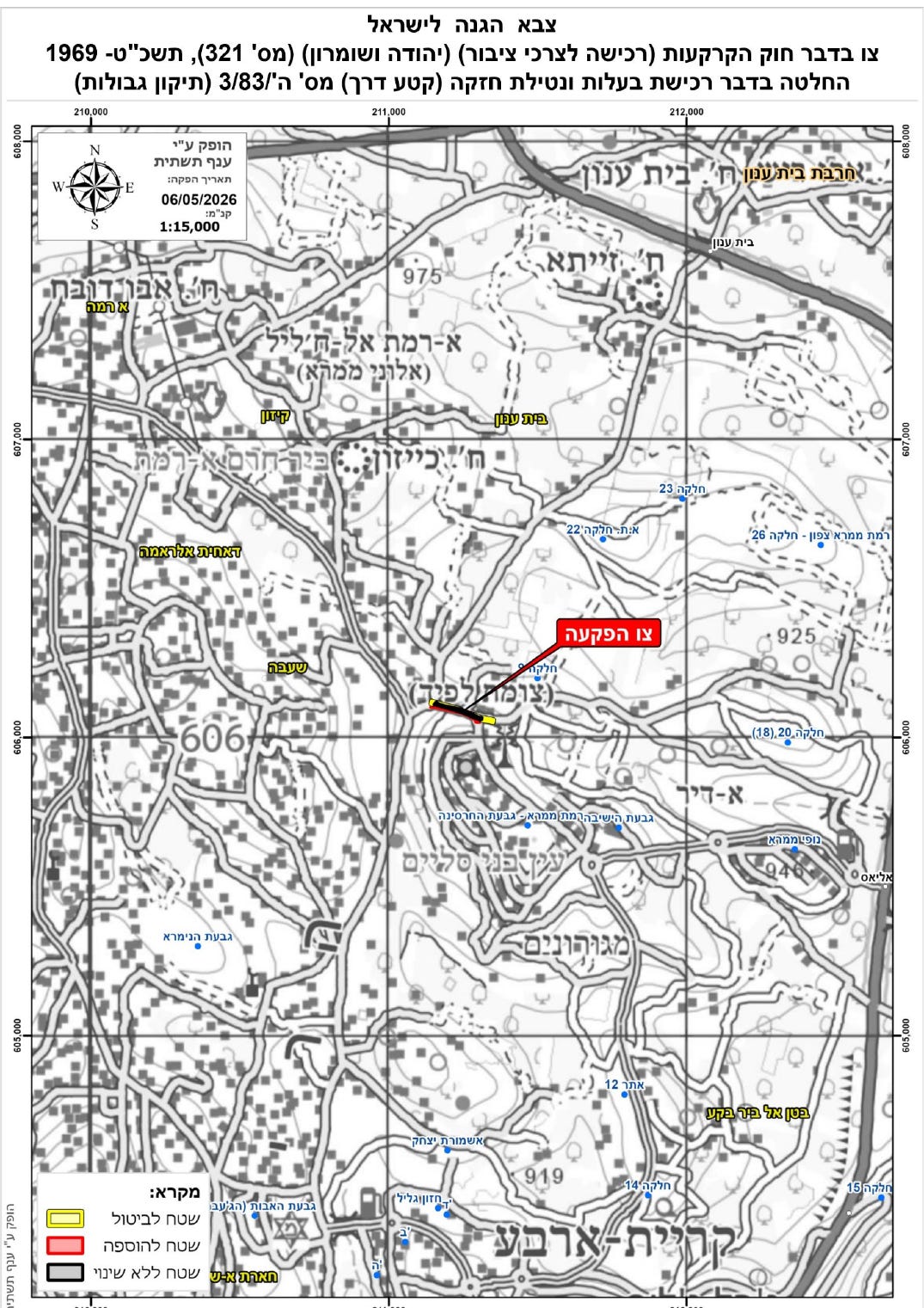
On June 7, the Israeli Civil Administration amended the boundaries of a road-segment expropriation first signed in 1983, with H/03/83 — originally issued under Order 321, the 1969 military order that lets the army take land for “public needs.” Signed on May 25, 2026 by Hillel Roth, deputy head of the Civil Administration for civilian affairs, this order takes a further 0.828 dunams and gives back 0.755 along a stretch of road near Kiryat Arba, on land belonging to the Hebron-area hamlets of Khallet al-Buweira, Khallet ad-Dab’a, and Khallet as-Sansal. It’s worth noting that this order is roughly 43 years old, but the Israeli state continues to use it in various ways to advance the dispossession of Palestinians from their lands. So each military order issued should never be read as a “one off”; instead, it should be read as the first domino falling in a larger chain of events.
Confiscation orders in the north
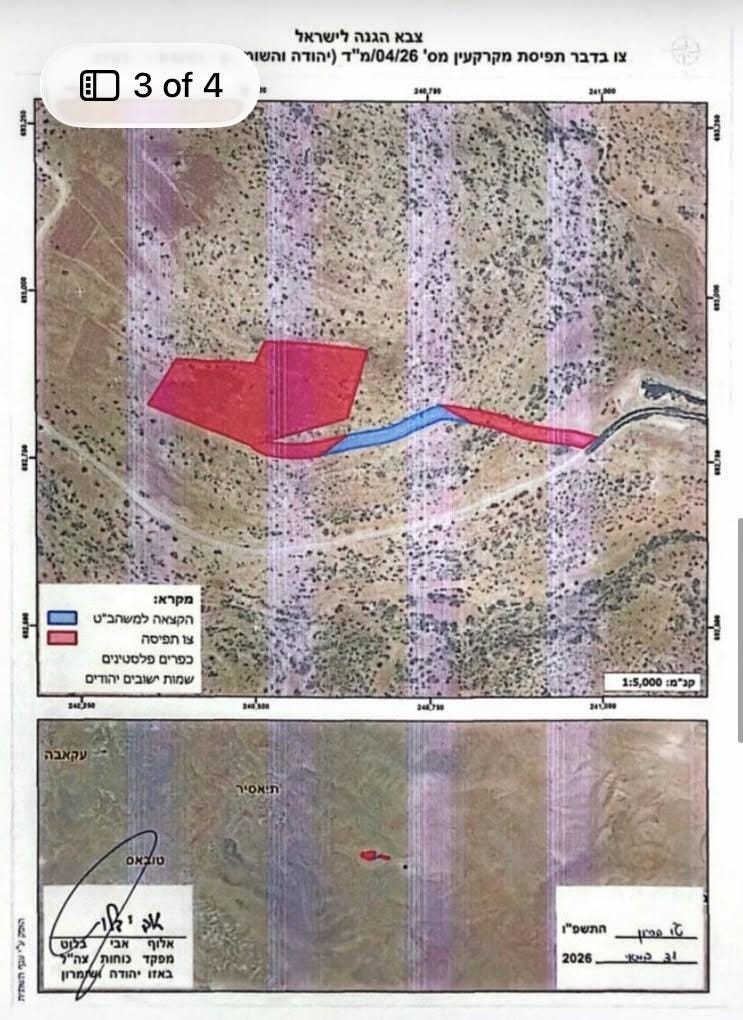
Confiscation orders were issued East of Tubas, in Tayasir. A seizure order signed by the commander of Israeli forces in the West Bank takes 41.748 dunams for declared military use, part of Firing Zone 901.
Israel continues advancement on Tulkarem
South of Tulkarem, seizure order 77/25 confiscates 30 dunams from the villages of Shufa and Kafr al-Labbad.
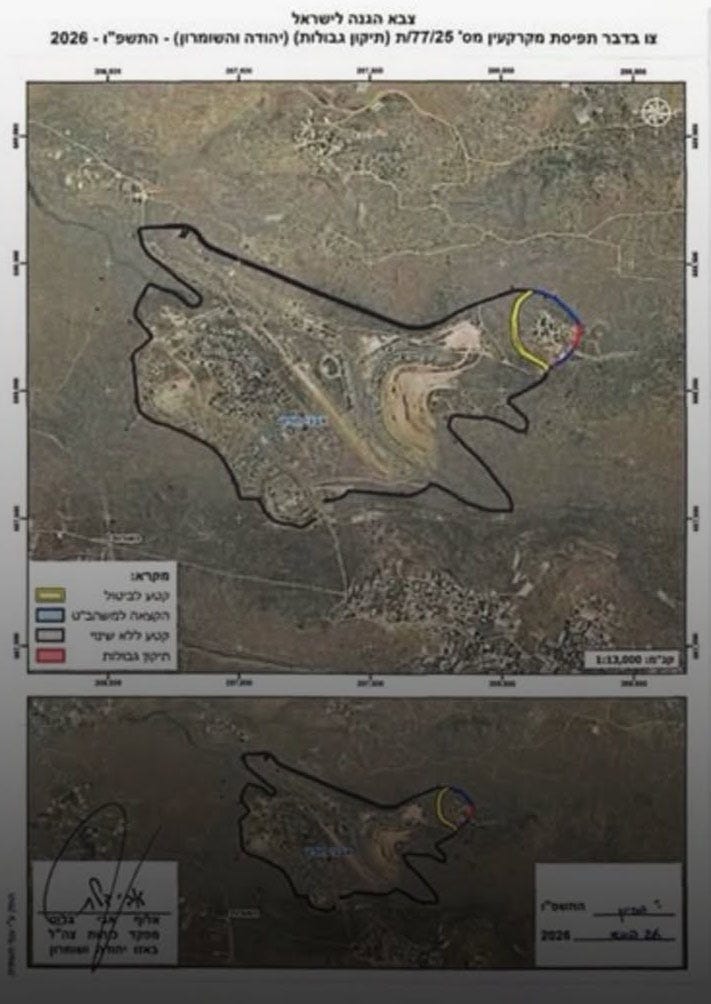
South Hebron
East of Yatta, in the Hebron village of al-Dirat, soldiers delivered final stop-work and demolition orders against thirteen homes and structures on June 10.
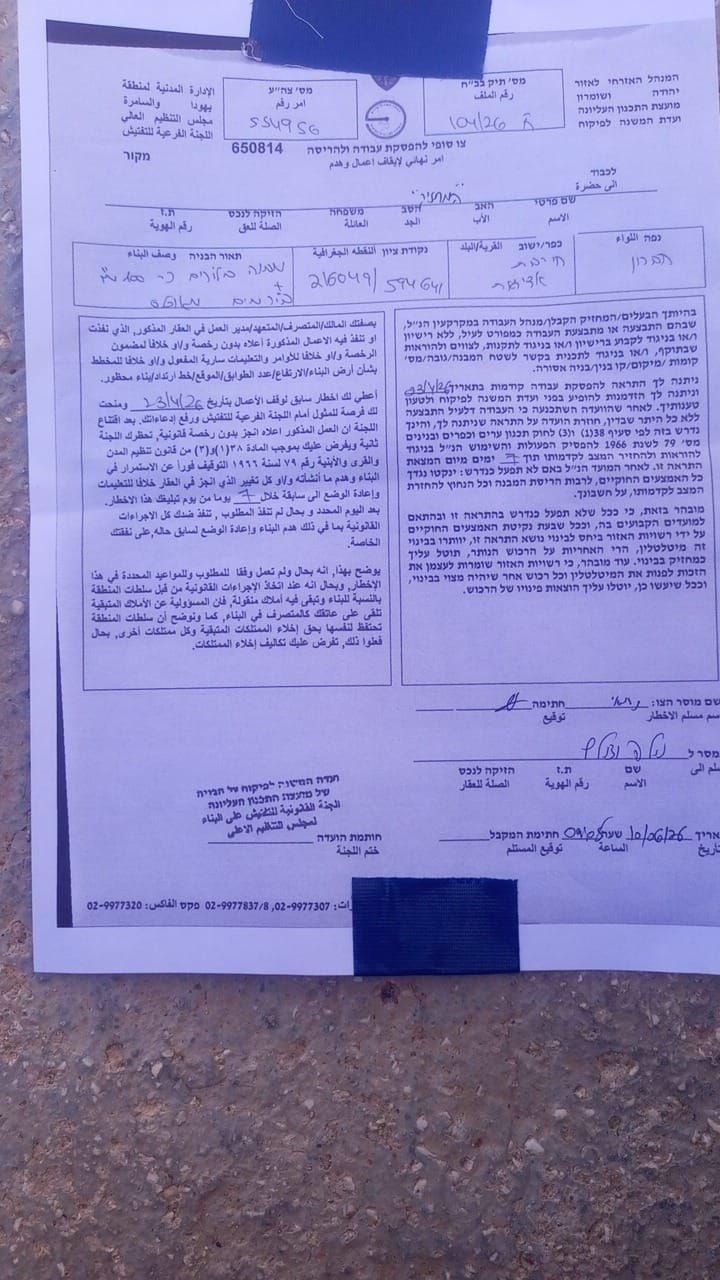
Additional orders
The Israeli states issued a seizure of roughly 2,803 dunams at Ja’ab in Jenin, beside the Tarsila settlement; an expropriation for a “security road” linking the Daniel settlement to al-Khader through Nahhalin land near Bethlehem; and a run of demolition and stop-work notices on the commercial shops near the Bizaria junction, served across Tulkarem, Jenin, and Nablus to clear the path of a settler road meant to reconnect the settlements of Homesh and Sanur. Set beside the individual takings, the scale of the campaign underneath comes into focus: a single March booklet of military orders, issued under Orders 321, 783, and 892, opened 20,002 dunams across fifteen settlement sites to confiscation, and a June 7 order handed to Tubas residents added 1,083.8 dunams to an existing army camp, in force through December 2028.
Demolitions this week
Israeli forces carried out nine demolition operations across the West Bank and East Jerusalem during the week, destroying 24 structures, displacing 30 people and affecting more than a hundred others — almost all of it, as ever, justified by the absence of a building permit that Palestinians in Area C and East Jerusalem are almost never granted.
The heaviest single blow fell on Barta’a ash Sharqiya, in Jenin. On June 8 the Civil Administration leveled ten structures there, among them a multi-storey home that had housed a family of eight; eight people were displaced and forty-five affected.
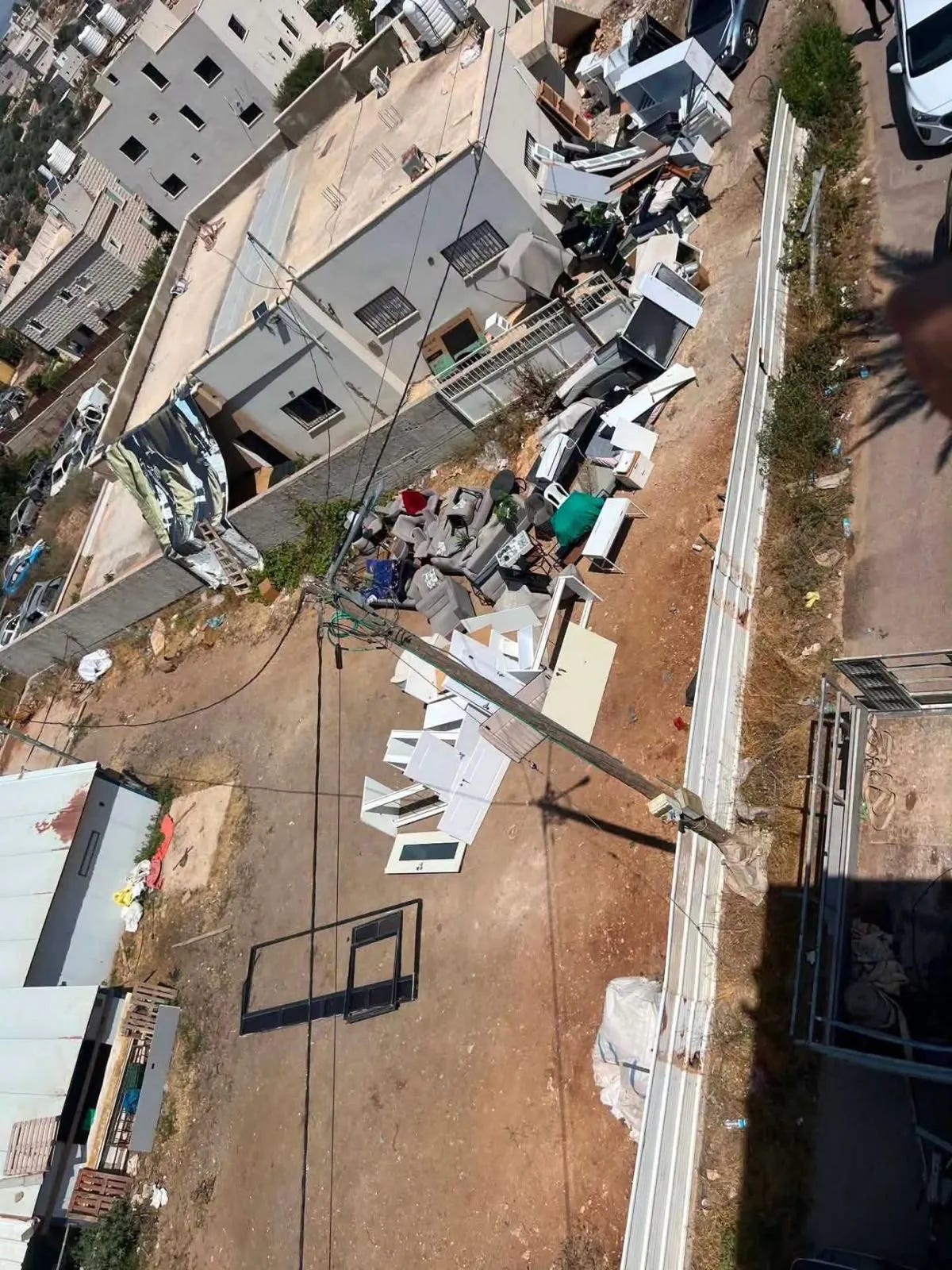
The same day, near Road 60 south of Hebron, forces brought down a two-storey house in Qalqas along with its water cistern and a livelihood structure, displacing a family of four.
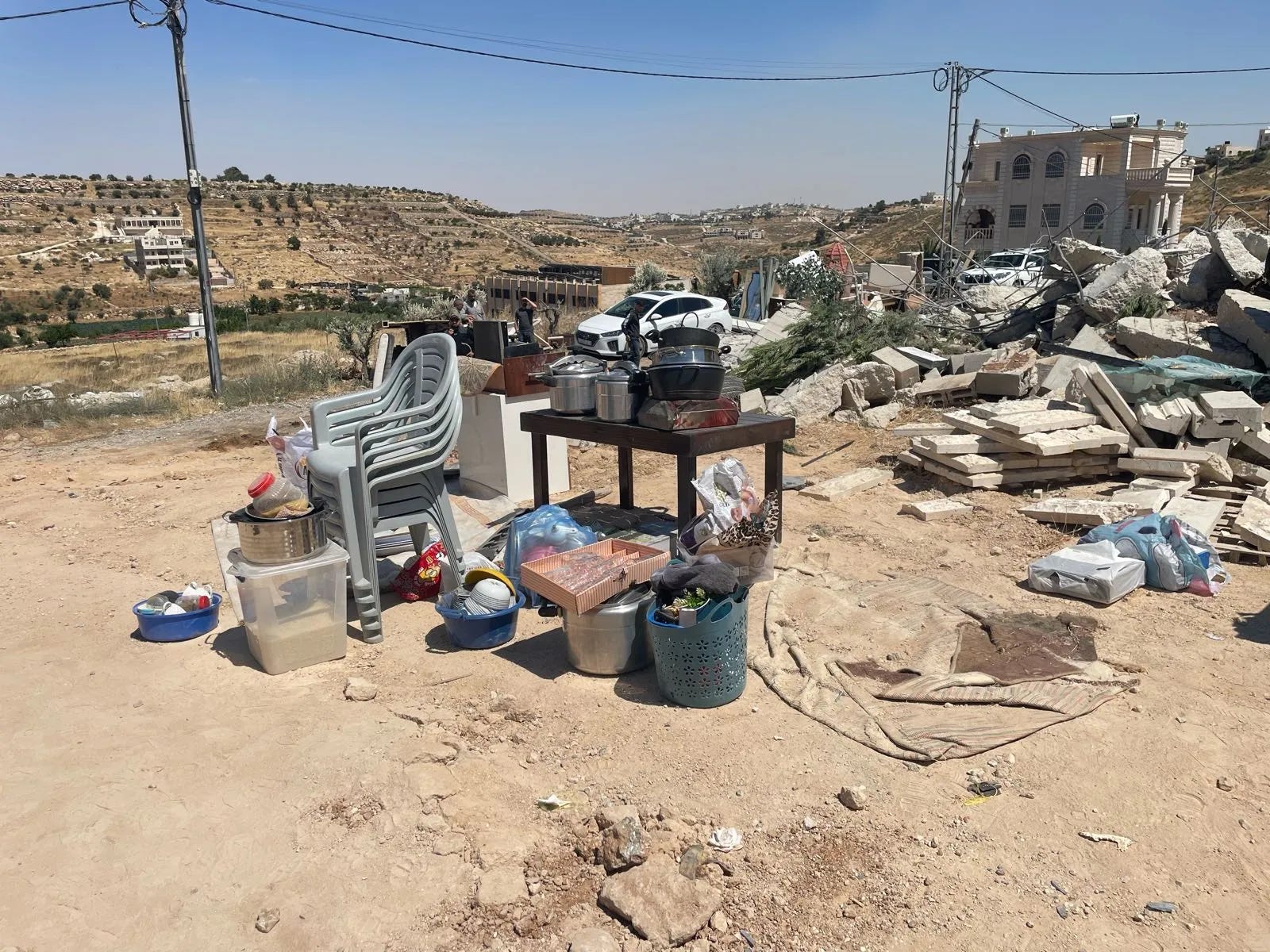
In Husan, west of Bethlehem, the bulldozers took four commercial structures at the village’s western entrance the next day — a car wash, a snack shop, a tarpaulin workshop — costing five families their livelihoods and affecting 28 people, 17 of them children.
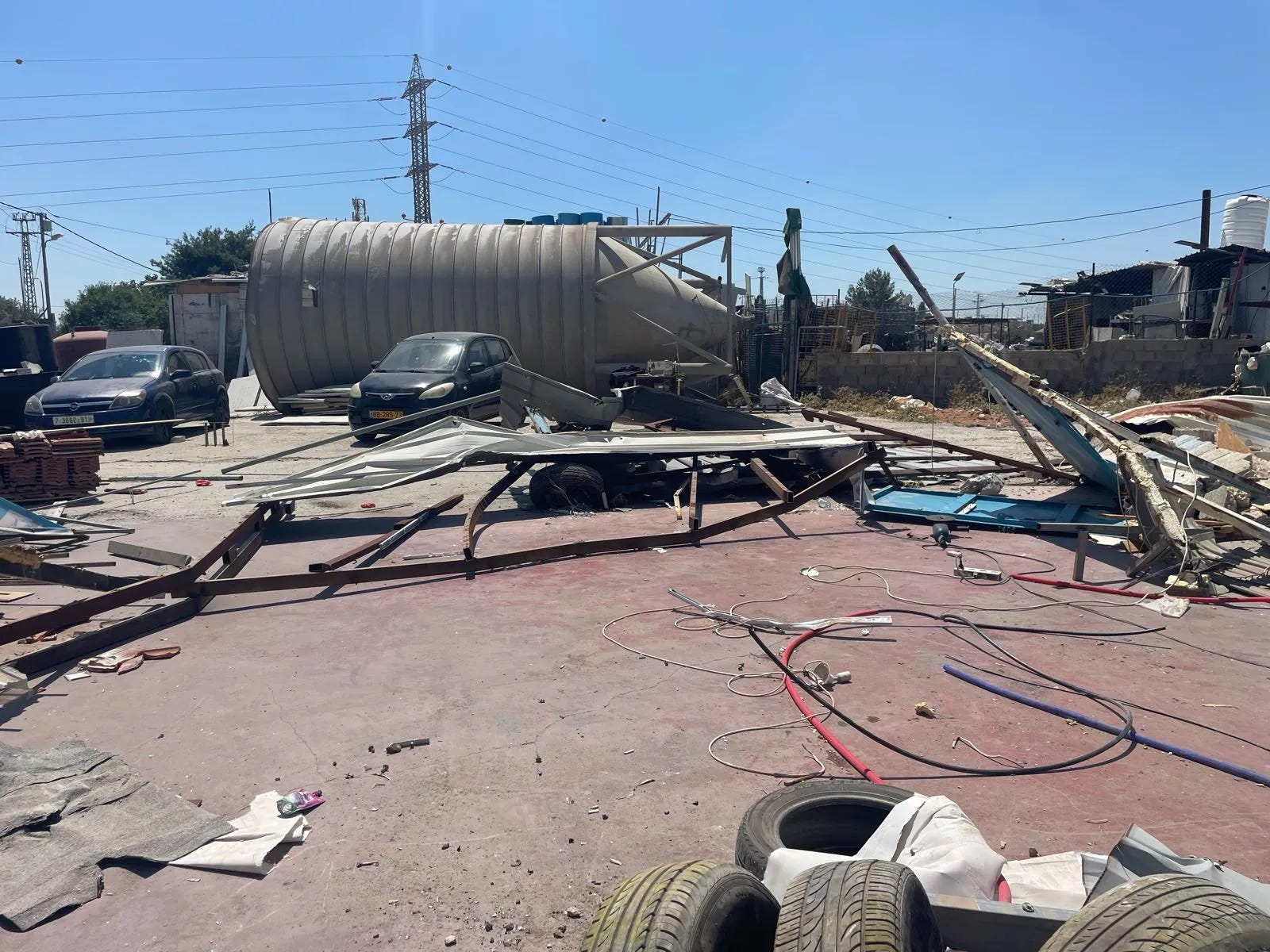
Palestinians were forced to tear down their own homes in East Jerusalem to avoid the heavier municipal fines that follow an official demolition. In Silwan’s Bir Ayoub, a family was forced to destroy their own rooftop apartment that served as a home to a child and a pregnant woman, and at least two other self-demolitions were carried out in At Tur and Sur Bahir.
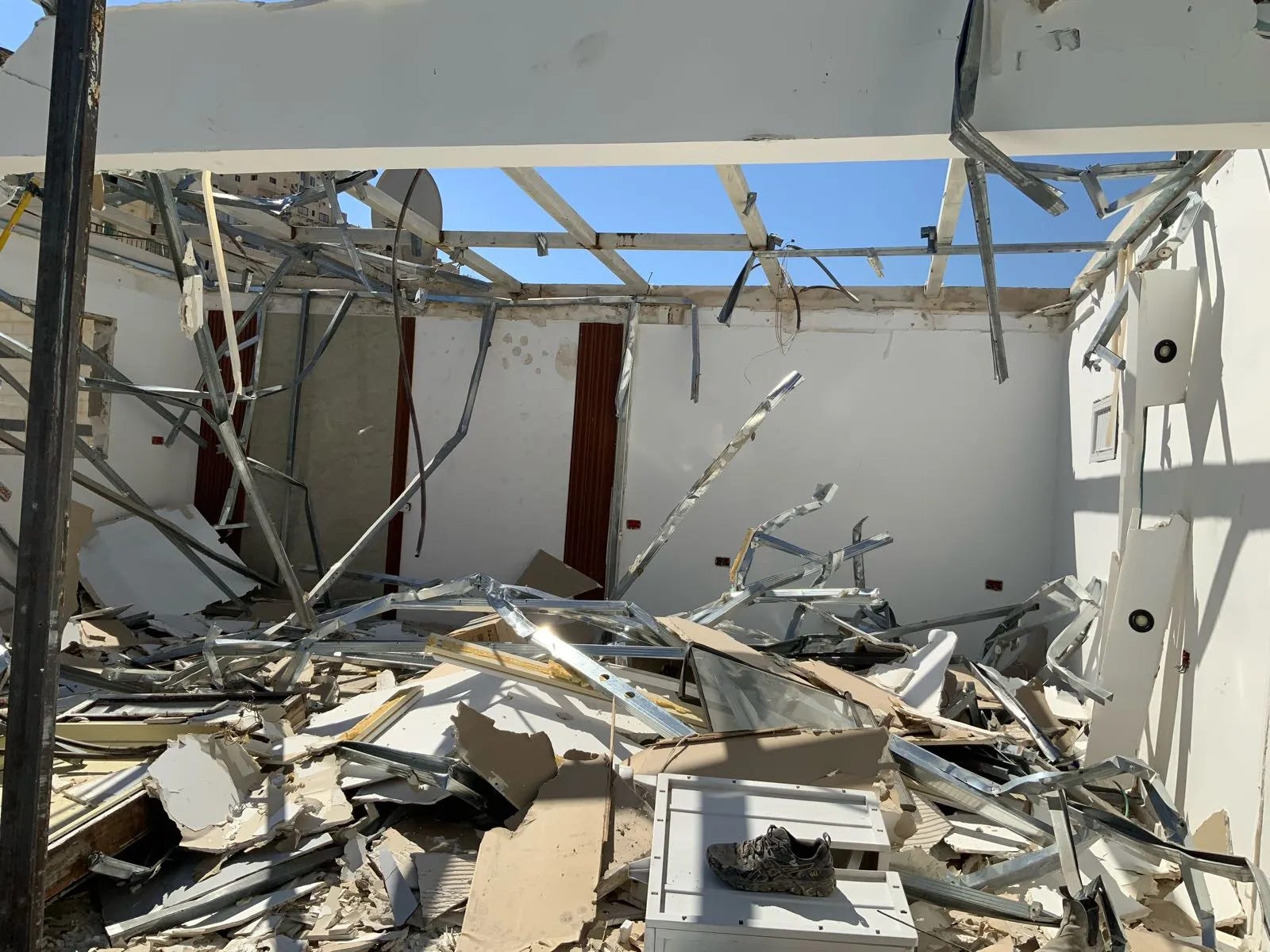
The week’s largest displacement came on June 10, when a single demolition in the South Bir Nabala Bedouin community north of Jerusalem put three households comprising ten people, among them three children and a man with a disability, out of their homes at once.
Killed this week

Haitham Ezz El-Din Omar Hmeida, 18, Ramallah and al-Bireh governorate — June 4, 2026. The Israelis killed him during an Israeli military incursion into the village of Beitin, east of Ramallah, in which forces fired gas canisters, stun grenades, and live ammunition. The army has withheld his body.

Sam Fahd Abu Heikal, seven months old, Hebron governorate — June 5, 2026. Israeli forces opened fire on the car carrying him and his parents in the Tel Rumeida area of Hebron; all three were shot, and the infant died of his wounds.
Data Points 2026 Year-to-Date
Home demolitions: 220 incidents, 680 structures destroyed, 1,029 people displaced (461 children), through June 10.
Arrests: 4,324 arrests recorded across 158 daily reports.
Settler attacks: 1,476 attacks year-to-date.
Martyrs: 63 killed year-to-date, through June 11.
Supporting the work
The Good Shepherd Collective is able to do this work because individuals are willing to make regular contributions. The easiest way to do that here is to sign up for a paid subscription to our Substack. This funding will help to add the revenue to give space for more Palestinian writers to write and be compensated for their work. If you want to contribute in other ways and other amounts to the Good Shepherd Collective’s work, you can do so here.