

How to Launder a Siege
Aid looting ran at 92% while Israeli-armed gangs held the roads. It hit zero the month that Hamas took control of the supply chain. But nobody wants to talk about that.

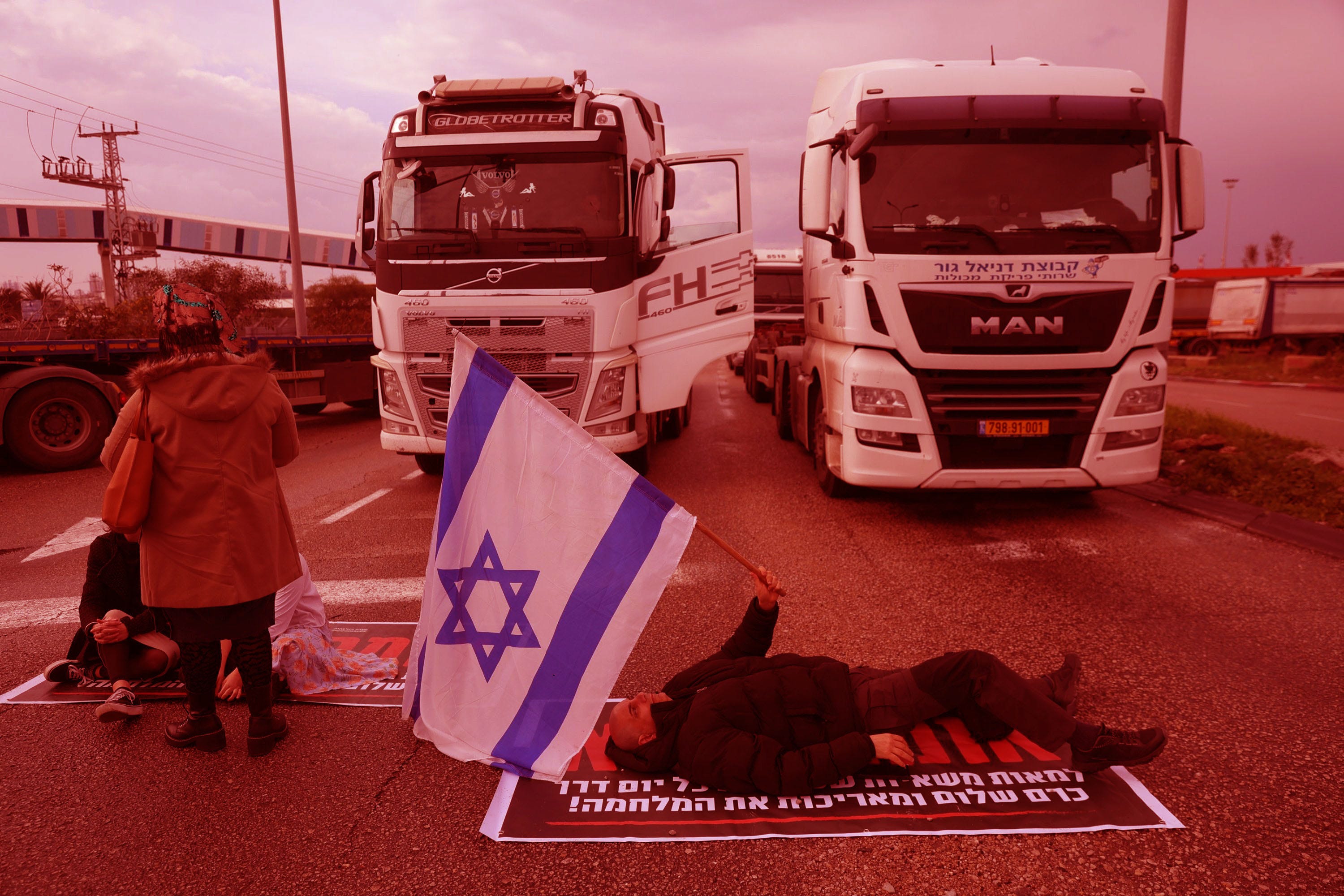
Aid trucks are barely entering Gaza. Community fundraising for Palestinian families in the Strip has slowed down. Prices continue to remain elevated by design. It’s important we return back to dynamics that are still animating this genocide and identify the tactics of divide and conquer, as they are some of the oldest instruments in the colonial toolkit. We should recognize that those carrying out this genocide rely heavily on Western racial tropes to do their work: images of warring clans, lawless tribes, native society that dissolves into predation the moment imperial order is withdrawn. Western coverage of Gaza throughout the genocide has rehearsed these images with near-liturgical fidelity to the zionist narrative. Aid stories in the news began not at the Israeli-controlled crossings or with the zionist siege policy but with “Arab chaos,” with “armed gangs,” and with a Palestinian street depicted as ungovernable, exploitative by nature, and turned on itself. For months, readers were told Hamas was stealing the food. The narrative was not incidental: it justified the throttling of deliveries, excused the collapse of the pipeline, and obscured the fact that the actual interceptors operated under an Israeli umbrella of influence and, by Israel’s own admission, with Israeli weapons. The mass propaganda about Hamas provided the political cover for US “aid agencies” to gun down Palestinians at food lines.
The numbers of course cut through this kind of story cleanly. Aid flow is measurable: trucks are counted at the crossing, counted again at the destination, and the gap is the loot. Overlay that ledger against the political timeline — the arming of Yasser Abu Shabab’s Popular Forces, the October 2025 ceasefire, the Hamas-led crackdown, Abu Shabab’s killing in December — and the “chaos” resolves into something far more legible: a proxy operation with a start date, an operating tempo, and an end date. When Palestinian forces dismantled the Israeli-armed militias, aid started arriving. The order Western coverage treats as absent in Gaza was restored by the very actors that coverage casts as its enemy. But people chose propaganda over objective data.
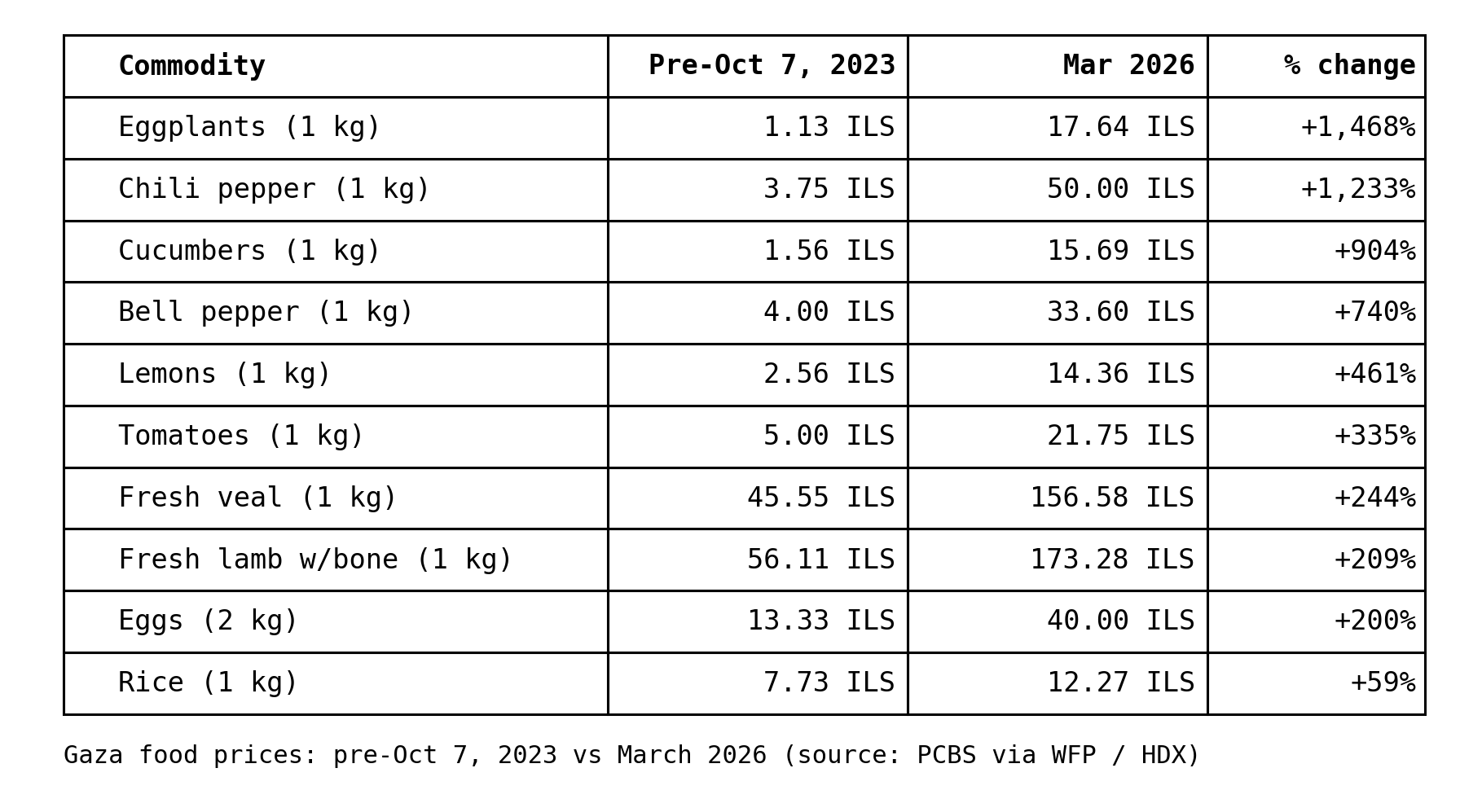
Nonetheless, it’s important to turn to objective figures to reiterate the racial dynamics and highlight Palestinians’ ability to govern themselves, even during a genocide. Two data streams tell the story of Gaza’s wartime economy. The first is the Palestinian Central Bureau of Statistics commodity price series, and the second is the UN’s aid-delivery tracker, which logs trucks collected at crossings, delivered to their destinations, and intercepted en route. Read together, they show a market under siege and an aid pipeline that was, for most of 2025, functionally a looting operation acting as a proxy of the broader zionist movement. These groups were financed, equipped, and provided logistical support by the Israeli government.
These armed proxies heavily manipulated market forces, which, of course, was by design. Against the pre-Oct 7, 2023 baseline prices, the five steepest price increases for basic food items in March 2026 were eggplants (+1,468%), chili pepper (+1,233%), gasoline (+1,093%), cucumbers (+904%), and the 12 kg cooking-gas cylinder (+853%). Fresh vegetables that used to be grown inside Gaza have risen between four and fifteen times: bell pepper +740%, lemons +461%, tomatoes +335%, potatoes +379%. Animal protein roughly tripled in price — veal +244%, lamb +209%, eggs +200%. The commodities that rose least are precisely the ones that dominate humanitarian aid baskets: rice +59%, bulgur +58%, sugar +40%. The split is really diagnostic. Goods that depended on Gaza’s own farms, fuel imports, and commercial supply chains — all of which Israel destroyed or blockaded with their own military, armed gangs, or the squatter gangs blocking the roads — ran away from baseline prices by factors of four, nine, and fifteen. Goods still arriving by aid truck have stabilized to pre-October 7, 2023, rates. Price, in other words, is tracking the siege itself: the steeper the climb, the more completely that commodity’s supply has been severed.
While the OCHA dataset only begins on May 21, 2025, so a clean truck count back to Oct 7, 2023 isn’t available from this source, what it does cover is damning enough. From May 2025 through April 18, 2026, 28,844 trucks were counted at crossings; 21,568 reached their destination; 7,226 — about one in four — were looted by these zionist-backed gangs. Month by month, the loot rate in summer 2025 was 66% in May, 92% in June, 88% in July, 85% in August. In August alone, 3,010 of 3,554 trucks entering Gaza never reached their destinations.
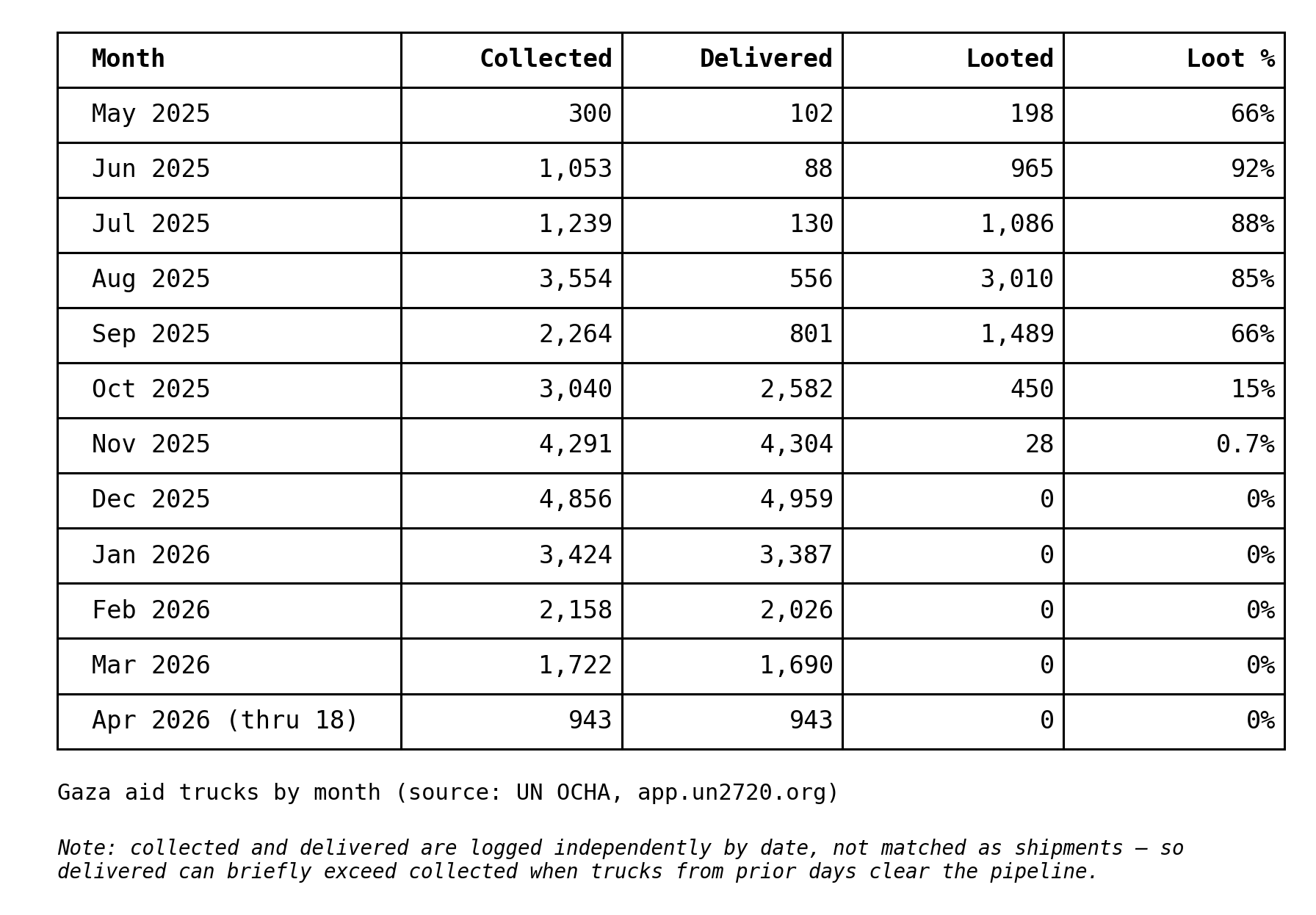
Then it stops. From October 2025, the loot rate falls to 15%, in November to 0.7%, and in December to zero. Year-to-date in 2026, of 8,247 trucks collected, 8,046 have been delivered — a 97.6% success rate, and zero logged as looted. The inflection is too sharp to be a coincidence: Palestinians and the collective government and resistant forces — including Hamas, of course — were able to bring a looting to an end.
In 2024 and 2025, the primary aid-convoy predator was the Popular Forces militia, led by Yasser Abu Shabab, a Tarabin Bedouin from Rafah, operating under the IDF’s sphere of influence. Even a Washington Post investigation cited an internal UN memo saying the gangs “may be benefiting from a passive if not active benevolence” of Israel’s military. On June 7, 2025, France 24 reported that Israel had openly admitted arming the group; a Sky News Data and Forensics probe later recorded an IDF soldier describing the military supplying “grenades… money… vehicles… food.” Conversely, a US probe determined Hamas wasn’t involved in the looting.
On July 2, 2025, the Gazan courts gave Abu Shabab ten days to surrender on charges of treason, collaborating with hostile entities, forming an armed gang, and insurrection. He didn’t. The ceasefire took effect on October 10, 2025, and from that point, Hamas moved systematically against the militias. Hamas reasserted control over clan-aligned groups; Mondoweiss described it as an internal crackdown that a security source called “the largest yet,” with interrogations reportedly confirming that seized weapons had been supplied by Israel. Even neo-liberal outlets turned on the zionist propaganda. On December 4, 2025, France 24 reported that Abu Shabab had been killed near Rafah; NBC News framed it as a “blow to Israeli policy,” and an Al Jazeera investigation published weeks later named additional Popular Forces members still serving as Israeli agents inside Gaza. Abu Shabab’s own clan, the Abu Suneima family, publicly disowned him.
The timing lines up almost perfectly with the Hamas crackdown. Loot rate: 66–92% from May through September 2025, while Abu Shabab’s network was active and armed. 15% in October, the month of the ceasefire and the first Hamas sweeps. 0.7% in November. Zero from December, which was the month Abu Shabab was killed. When the militia network intercepting aid was dismantled by Palestinian resistance forces, aid started reaching people. December 2025 marked the dataset’s peak, with 4,959 trucks delivered. Since then, monthly throughput has fallen steadily — to roughly 1,700 in March — now driven by Israeli restrictions on aid requests rather than gang activity.
The bottleneck has shifted from different zionist points of control again, from the road to the crossing, and with it the pretext for preventing the arrival of aid. As long as the looting continued — carried out by armed gangs the Zionists were funding — the siege could be laundered through a story about Palestinian chaos: warring clans, lawless streets, a society supposedly incapable of feeding itself without Western supervision. Meanwhile, the price series and the truck ledger refute that story. The numbers show a market whose every distortion traces back to Western imperialist destruction and the zionist blockade, and an aid pipeline that started working the moment Palestinians dismantled the Israeli-armed gangs preying on it. It’s so important to reiterate: governance in Gaza was never the problem.
The Call is reader-funded work in service of Palestinian liberation, not a business. Consider supporting by getting a subscription.