

Jewish Currents Gave Omar Shakir the Hero's Exit He Didn’t Deserve
Inside HRW's venture capital board, Israeli tech investments, and the liberal media ecosystem that obscures imperialism at work.
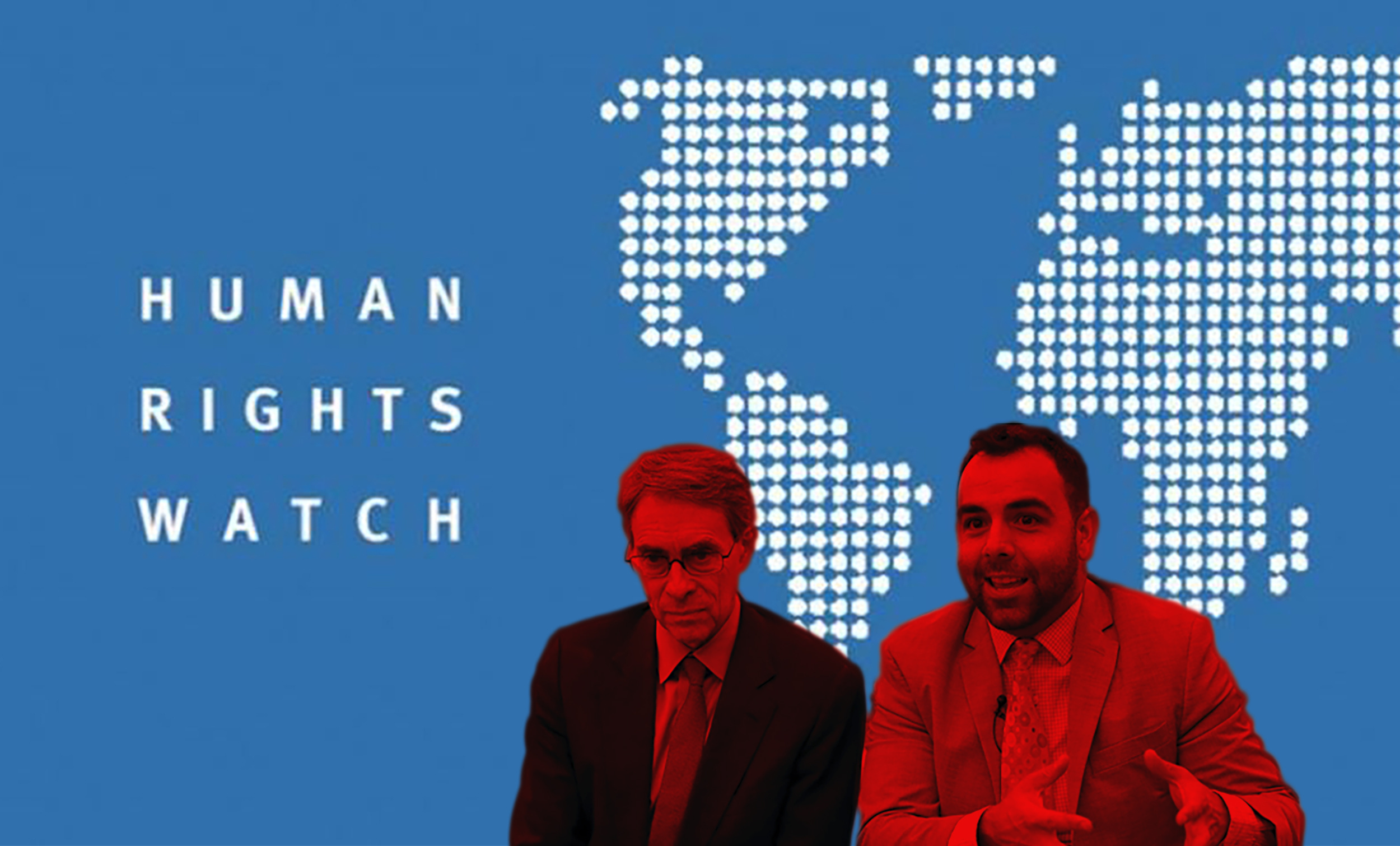
This piece was written by Cody O’Rourke and Ameed Faleh
Omar Shakir’s resignation from Human Rights Watch made headlines. Jewish Currents, where Shakir serves on the advisory board, published the most detailed account — a narrative of principled dissent against cowardly leadership. But the story being told about his departure is doing more work than it appears. It locates the crisis at HRW in the decisions of specific executives — Philippe Bolopion, Bruno Stagno Ugarte, Tom Porteous — rather than in the institutional architecture that produced those decisions. It rehabilitates HRW, by implication: if the problem is that good people left, then the solution is to get good people back in, rather than asking whether the institution can be reformed at all. And it avoids the financial ecosystem entirely — the board composition, the donor networks, the overlapping funding streams that connect HRW, Jewish Currents, and the broader liberal solidarity landscape.
Palestinian civil society was already here. In August 2024, over twenty Palestinian organizations called on people of conscience worldwide to reconsider their relations with HRW after its October 7th report — a report published while Shakir still led the Israel-Palestine team. In the words of the BDS National Committee’s assessment, HRW “chose to abstract the actions of the oppressed from the context of oppression in the service of Israel’s colonial domination.” The suppression of the right of return report confirmed the pattern. It didn’t create it.
This piece attempts something different. Rather than retelling the story of who blocked what report and when, we examine the organizational leadership, financial connections, and institutional incentives that make these outcomes predictable. The question isn’t whether HRW failed Omar Shakir. It’s what HRW’s structure tells solidarity movements about how to interface with human rights organizations embedded in the political economy of neoliberalism, and whether the liberal human rights industry, as currently constituted, is capable of serving Palestinian liberation at all.
Human Rights Watch did not begin as a universal human rights monitor. It began in 1978 as Helsinki Watch, founded by Robert Bernstein, a zionist, and Aryeh Neier, with the explicit purpose of monitoring compliance by the Soviet bloc with the 1975 Helsinki Accords. It was an anti-communist project, tracking “abuses” in the USSR, Czechoslovakia, Poland, and Romania while working alongside dissident groups like the Moscow Helsinki Group and Charter 77. It would make sense that the direction of HRW would be steered by former NATO commanders, CIA analysts, State Department officials who defended rendition, and corporate lobbyists for mining and banking giants — the architects and enablers of the very abuses a human rights organization should be confronting.
Americas Watch was created in 1981, ostensibly to demonstrate that the organization’s gaze extended beyond the Soviet bloc. But the timing is instructive. The US was then waging covert wars against leftist movements across Central America — backing death squads in El Salvador; funding the Contras in Nicaragua; supporting a genocidal counterinsurgency in Guatemala — all in defense of its long-standing treatment of Latin America as a sphere of unchallenged dominance. In Guatemala alone, the army and its paramilitary units systematically attacked over 600 villages under General Ríos Montt, whom Reagan praised as “a man of great personal integrity” even as declassified cables confirmed US knowledge of the massacres. It expanded the organization’s geographic scope without disturbing its ideological orientation. Africa Watch and Asia Watch followed, and by 1988, the components had merged into what is now Human Rights Watch - an institution that had grown outward from Cold War anti-communism and zionist institutional leadership, acquiring regional coverage like a portfolio acquiring assets, without ever confronting the foundational politics that shaped it.
Venture Capitalists, Luxury Brand Consultants & Tech Bros
The organization’s board of directors comprises members from the financial, legal, and media sectors: founding partners of venture capital firms, managing directors of art galleries, luxury brand consultants, co-founders of private equity firms, international lawyers, and retired U.S. ambassadors.
For example, HRW’s board member David Lakhdhir spent over 30 years as a partner at Paul, Weiss, Rifkind, Wharton & Garrison, a firm that has represented Israeli corporations, including the wholly state-owned Israel Aerospace Industries. One of those firms, Davis Polk, rescinded the job offers of students who supported anti-genocide protests. Lakhdhir’s firm made significant donations to relief efforts in Israel after October 7th. This is the professional home of the man who co-chairs the board deciding whether HRW publishes reports critical of Israel.
Board member Bijan Sabet co-founded Spark Capital, a venture capital firm managing over $12 billion. Spark’s portfolio includes Cybereason, an Israeli cybersecurity firm co-founded by Lior Div, a veteran of the Israeli Unit 8200, Israel’s signals intelligence unit. Sabet’s Spark also invested in Deel, Capitolis, and eToro, invested in Israeli infrastructure, rather, which creates an obvious conflict of interest — given the global calls to boycott companies benefiting from zionism.
HRW’s board member, Louisa Lee-Reizes, is literally a consultant who helps private equity firms acquire luxury brands — advising capital on how to buy and profit from luxury goods — while sitting on the board of an organization that’s supposed to hold governments and politicians accountable. The luxury industry is also notorious for supply chain human rights abuses of child labor in mining, exploitative garment work, etc.
HRW’s John Studzinski is Vice Chairman of PIMCO, which has purchased nearly $1 billion in Israeli government bonds since October 2023. It is remarkable that an organization whose leadership personally profits from Israeli debt would presume to issue reports on the very violence those investments help finance, or that those who author these reports don’t understand the structural contradiction of the board.
In 2014, over one hundred scholars wrote an open letter calling on HRW to close its “revolving door” with the U.S. government, citing cases like Tom Malinowski’s move from HRW’s Washington advocacy director to Assistant Secretary of State, a former CIA analyst sitting on an HRW advisory committee, and board members with backgrounds in the Nixon White House. NYU historian Greg Grandin called HRW “Washington’s adjunct” in an analysis that documented how the organization’s positions on Latin America tracked predictably with U.S-Western Imperialist interests.
What the Money Says
Given the ideological makeup of the board, it is unsurprising that institutions financing HRW are the same ones that animate the neocolonial features of Western philanthropy. In 2010, the Open Society Foundations pledged $100 million to HRW over ten years. At the time, HRW’s annual budget was around $48 million. A single donor supplying roughly 20 percent of the organization’s revenue over a decade creates structural dependence, whether or not anyone makes explicit demands. The broader donor base tells a similar story. HRW’s funding comes from major US institutions: Ford Foundation, MacArthur Foundation, and the Rockefeller Brothers Fund, among others.
There is also the Saudi fundraising scandal. In 2009, Sarah Leah Whitson, then HRW’s Middle East and North Africa director, led a fundraising trip to Saudi Arabia. After the scandal broke, they officially stated that “Human Rights Watch takes no government money of any kind”. The Intercept later conducted its own investigation, documenting Saudi investments in HRW.
In 2012, HRW Executive Director Kenneth Roth solicited and accepted a $470,000 donation from Saudi billionaire Mohamed Bin Issa Al Jaber. HRW’s own researchers had documented serious labor abuses at Jadawel International, a construction company Al Jaber owned: workers had their passports confiscated, residency permits withheld, and wages unpaid for months. Second, the donation came with a condition that the funds couldn’t be used for LGBT rights work in the Middle East and North Africa.
These structural contradictions and inherent conflict of interests between so-called human rights and their institutional financing begin to illuminate why HRW spent decades avoiding the word “apartheid” in connection with Israel. When it finally published its 2021 report using that term, the decision came years after smaller organizations such as Al-Haq and even liberal zionist groups, B’Tselem, had already made the case, and after the political cost of saying so had dropped considerably. HRW did not lead on that question. Rather, it followed, once the ground felt safe enough.
What Jewish Currents Leaves Out
Alex Kane’s Jewish Currents interview with Omar Shakir was intended as an exposé of Human Rights Watch leadership. But in many ways, the piece does more to entrench the reality of HRW’s affiliation with zionist and liberal zionist formations than to challenge it. The article discloses that: “Shakir is a member of Jewish Currents’ advisory board” while detailing the reason for both Omar Shakir and Milena Ansari’s resignations from HRW, citing HRW taking an unpublished report regarding the denial of the right of return for Palestinian refugees “back to the drawing board,” effectively trying to meddle in the report’s contents. The article leaves the reader with the impression that Shakir took an unprecedented, principled stand on behalf of the Palestinian people.
Let us be clear: What Shakir and Ansari did is the minimum ethical requirement. What the article doesn’t explain is how the relationship between Shakir and HRW at large shapes the framing of the entire piece, which reads as Shakir’s account of events, with his interpretation as the organizing spine of the narrative. The Jewish Current piece never asks whether Shakir’s decade at HRW itself requires scrutiny. The piece is structured to present his resignation as a principled stand, not as a belated exit from an institution which, as Palestinians have been explaining for years, is structurally compromised. This is not an innocent mistake, nor the result of simple happenstance: Jewish Currents has an institutional interest to protect Shakir’s reputation, as he is a member of their advisory board. If Kane had written the piece to critically examine his years at HRW as a form of liberal complicity, it would reflect badly on his Jewish Currents advisory board. As such, the martyr framing accepted by the Jewish Currents editorial staff becomes convenient: it boosts Jewish Currents while protecting Shakir from accountability.
The piece identifies specific decision-makers as the problem — Bolopion, Stagno, Porteous, Borello — while treating HRW’s institutional architecture as basically sound until these individuals intervened:
“[Stagno] further said he worried that the findings ‘will be misread by many, our detractors first and foremost, as a call to demographically extinguish the Jewishness of the Israeli state.’”
The article presents the problem in liberal terms, as the problem of an individual through Stagno’s personal anxiety and cowardly decision-making, rather than being structural. This result is not a matter of personal anxiety, but rather the predictable output of an institution whose board, donors, and advocacy relationships are embedded in a political ecosystem that treats Jewish demographic supremacy as a legitimate interest to be “managed” rather than a feature of settler-colonialism, apartheid and zionism. Who sits on HRW’s board? Who funds them? What are the overlapping donor networks between HRW, Jewish Currents, and the broader liberal zionist ecosystem? Kane doesn’t ask and doesn’t divulge.
Shakir has worked at HRW for nearly a decade. Perhaps Shakir’s most “memorable” moment to many Palestinians is when HRW published the Al-Ahli Hospital report that, as the BDS National Committee documented in a statement, concluded “without any evidence that a Palestinian-fired rocket was responsible for the killings.” In addition, the report was rightly criticized by a large coalition of Palestinian organizations in an open letter published in Mondoweiss, which rightfully pointe out “HRW is choosing to spread unfounded theories. Given the lack of evidence, this can only be seen as supporting Israeli propaganda and justification for the ongoing genocide.” Palestinian scholars argued that HRW and Shakir were “putting Palestinian lives at risk”. Furthermore, HRW failed for over nine months to produce a coherent report naming Israel’s assault on Gaza as genocide, as many other scholars and organizations did. The Community Action Center - Al Quds University, Palestinian trade unions and over 20 Palestinian organizations called on Palestinians to “reconsider their relations with HRW, including by refraining from cooperation with it.”
Going back to the article, Shakir notes that:
“The job has involved attacks and pressure campaigns. But what kept me in the organization for so long was its absolute commitment to the facts and the law.”
This is revealing. Shakir stayed because he believed the institution was effective. He is saying the system was fine until it broke — on his report, on his watch. But Palestinians were telling him, and the world, that HRW’s “commitment to facts and the law” was already compromised. The Al-Ahli report. The October 7th report. The refusal to name genocide.
Kane’s framing is perhaps most visible in how he handles Palestinian voices. He includes a quote from Ubai Aboudi — “Palestinian civil society organizations and human rights organizations did not participate [in the boycott of HRW] because we believed that Human Rights Watch had integrity” — but treats it as a coda rather than an opening. He doesn’t ask the obvious follow-up: why were Palestinians already debating a boycott of HRW in 2024? What was the substance of the BNC’s critique? He just leaves Aboudi’s trust hanging in the air, unexamined — which may be the point.
After all, the August 2024 Palestinian civil society statement didn’t just object to one report by HRW, it fundamentally omits the settler-colonial structure of the violence: “It seems HRW not only ignores Israel’s settler-colonial reality and the oppressor-oppressed relationship of power and resistance; it also values every civilian Israeli life 200 times more than any civilian Palestinian life.”
The February 2026 BNC statement goes even further: “Excluding Palestinians from the applicability of universal rights constitutes anti-Palestinian racism. And it is not the first time for HRW.” Kane cites none of this. The Palestinian structural critique — that HRW’s problems stem from colonial epistemology, institutional racism, and the political economy of liberal human rights organizations — is absent from the piece. Instead, we get a story about a good man who tried his best inside a system that let him down.
Taken together, HRW’s origins, its board composition, and its funding sources reinforce a clear conclusion: Shakir was not a man of principle failed by a system larger than himself. He was a willing participant in HRW’s efforts to obfuscate the reality of genocide in Palestine. As such, the “heroism” granted to Shakir is, at best, confusing to those who know the relationship of HRW to its funding sources and to its history of tackling Palestine.
Some may ask about the point of this article at a time when zionists are applauding HRW and Shakir’s separation. This is a valid question, and it primarily stems from the notion that we are “hurting our allies” — cutting off our noses to spite our faces. But a cursory look at HRW’s actions before Shakir’s resignation reveals an organization that served as an observer to Palestinian suffering and a collaborator for the claims fanning zionist genocide in Gaza. This article is not interested in rehabilitating HRW or arbitrating Shakir’s intentions. It is interested in a simple question: can organizations structurally tied to zionism — through their boards, their donors, and their institutional DNA — serve Palestinian liberation and anti-colonial praxis? The evidence says no. Palestinian suffering does not need better-positioned advocates within the liberal human rights industry. It requires dismantling that industry’s complicity.
Simply exceptional! Thank you for your research & well-thought out thesis. Your analysis and argument clearly shows us that a structural system that is funded, powered and funded by Zionists will never serve Palestinian liberation. One cannot work for such an organization and claim to be helping lesson the plight of Palestinians. Their mere presence there whitewashes the organization’s complicity and furthers the occupation & oppression.🙏❤️