


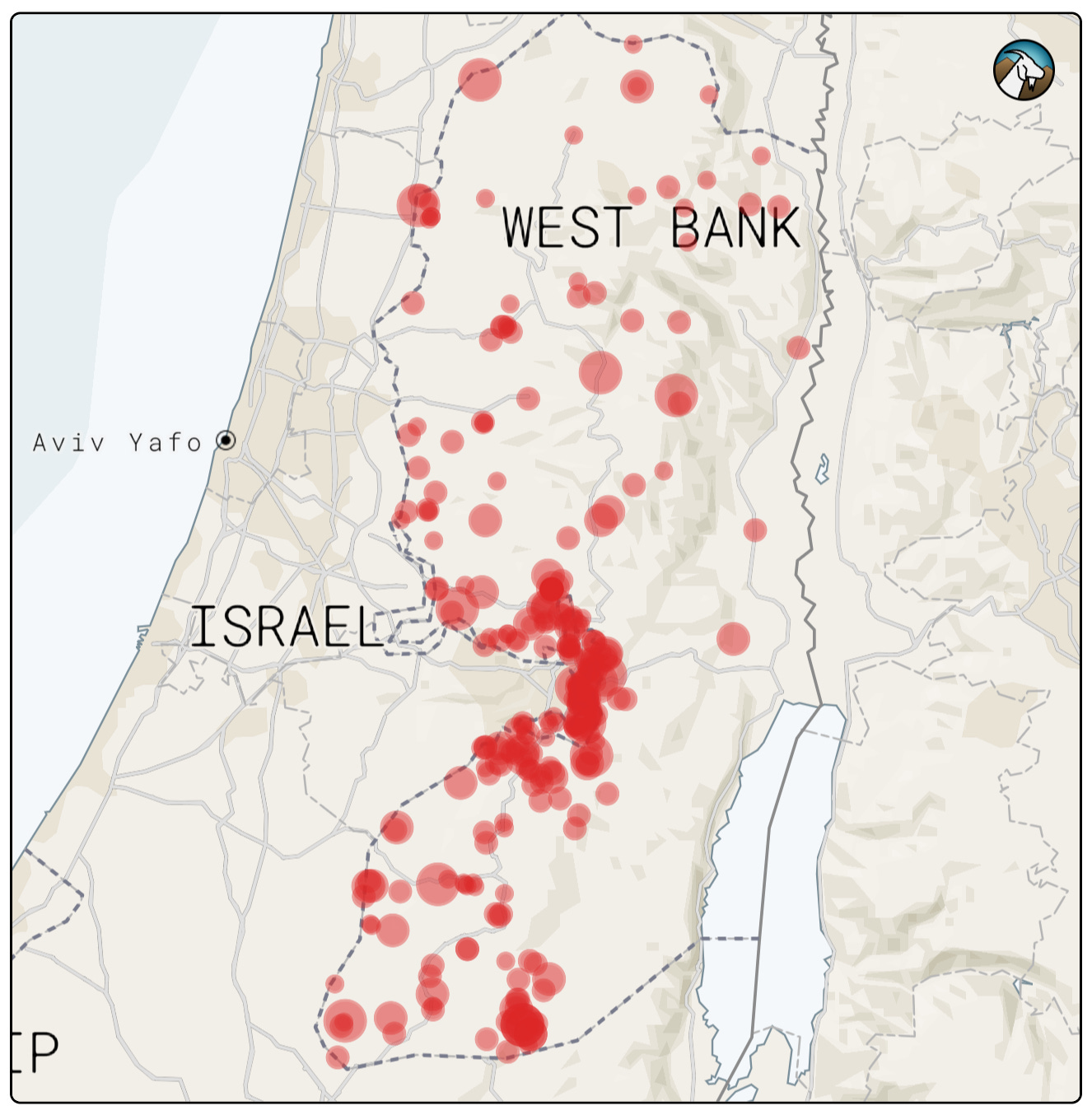
The year 2025 marks another devastating chapter in Israel’s systematic demolition campaign against Palestinian communities in the occupied West Bank and East Jerusalem. With 547 demolition incidents displacing 2,137 people and destroying 1,665 structures in these areas alone, this year stands as one of the most destructive on record — continuing an alarming upward trajectory that has intensified dramatically since 2023.
This report covers only documented demolitions in the West Bank and East Jerusalem. It does not include the massive destruction and displacement in Gaza, the demolitions targeting Palestinian Bedouin communities inside Israel, like the Naqab, or the large-scale military operations that have devastated refugee camps in Jenin, Nur Shams, and Tulkarem throughout 2025. The accurate scale of Palestinian displacement this year is far greater than these figures alone can convey. For example, according to UNOSAT satellite imagery analysis as of October 2025, 123,464 structures in the Gaza Strip have been destroyed, and an additional 74,809 structures have sustained severe, moderate, or possible damage. This brings the total to 198,273 affected structures — approximately 81% of all buildings in the area. However, comprehensive data reports on this are incomplete, as they rely entirely on satellite imagery. While the data is still not fully public for 2025 for Palestinians in 1948 occupied Palestine, demolitions of Palestinian homes and structures in the Naqab were reported to have reached 4,911 in 2024 — more than double the number of structures demolished in the West Bank and East Jerusalem this year.
(Israeli National Security Minister Itamar Ben Gvir personally delivered demolition orders to Bedouin communities in the Naqab, underscoring the state’s commitment to displacing indigenous Palestinians from their ancestral lands.)
By the Numbers: 2025 in Context
The 2,137 people displaced from their homes in the West Bank and East Jerusalem alone in 2025 represent the second-highest annual displacement total in the seventeen years of available data, exceeded only by the 4,293 people displaced in 2024. This two-year period has seen a combined 6,430 Palestinians forcibly displaced from these areas — more than any comparable period in the dataset’s history.
But when you take into consideration Israel’s “Operation Iron Wall” in January 2025 (excluded from these data sets), the violence of displacement becomes unparalleled. Israel’s operations forcibly displaced some 40,000 people from refugee camps in Jenin, Tulkarm, and Nur Shams. This represents the most significant and protracted displacement since 1967. 32,400 Palestinians are languishing in precarious situations.
To understand the severity of 2025, consider the historical trajectory:
From 2009 to 2019, annual displacement figures fluctuated between approximately 500 and 1,200, averaging approximately 900. In 2020, 1,009 people were displaced, followed by 1,214 in 2021 and 1,046 in 2022. Then came 2023, when displacement surged to 2,302 — more than double the previous year. The escalation continued into 2024 with an unprecedented 4,293 people displaced, and 2025 has sustained this elevated pattern, with well over 40,000 having been displaced in the West Bank and East Jerusalem alone.
The frequency of demolition operations has also intensified. In 2025, demolitions occurred on 216 distinct days — nearly 60 percent of all days throughout the year. The average of 1.5 incidents per day represents a threefold increase from the 0.5 incidents per day recorded in the earlier years of the dataset.
Masafer Yatta Under Siege
The community of Khallet Athaba‘ in Masafer Yatta exemplifies the relentless nature of zionist settler-colonialism. This small herding community, located within the area Israel has designated as “Firing Zone 918,” experienced three separate mass demolition operations in 2025 alone.
On February 10, Israeli forces demolished eleven residential structures, including six donor-funded buildings, along with latrines and water cisterns. Seven families comprising 46 people, including 24 children, lost their homes. The operation destroyed water tanks and uprooted twenty trees.
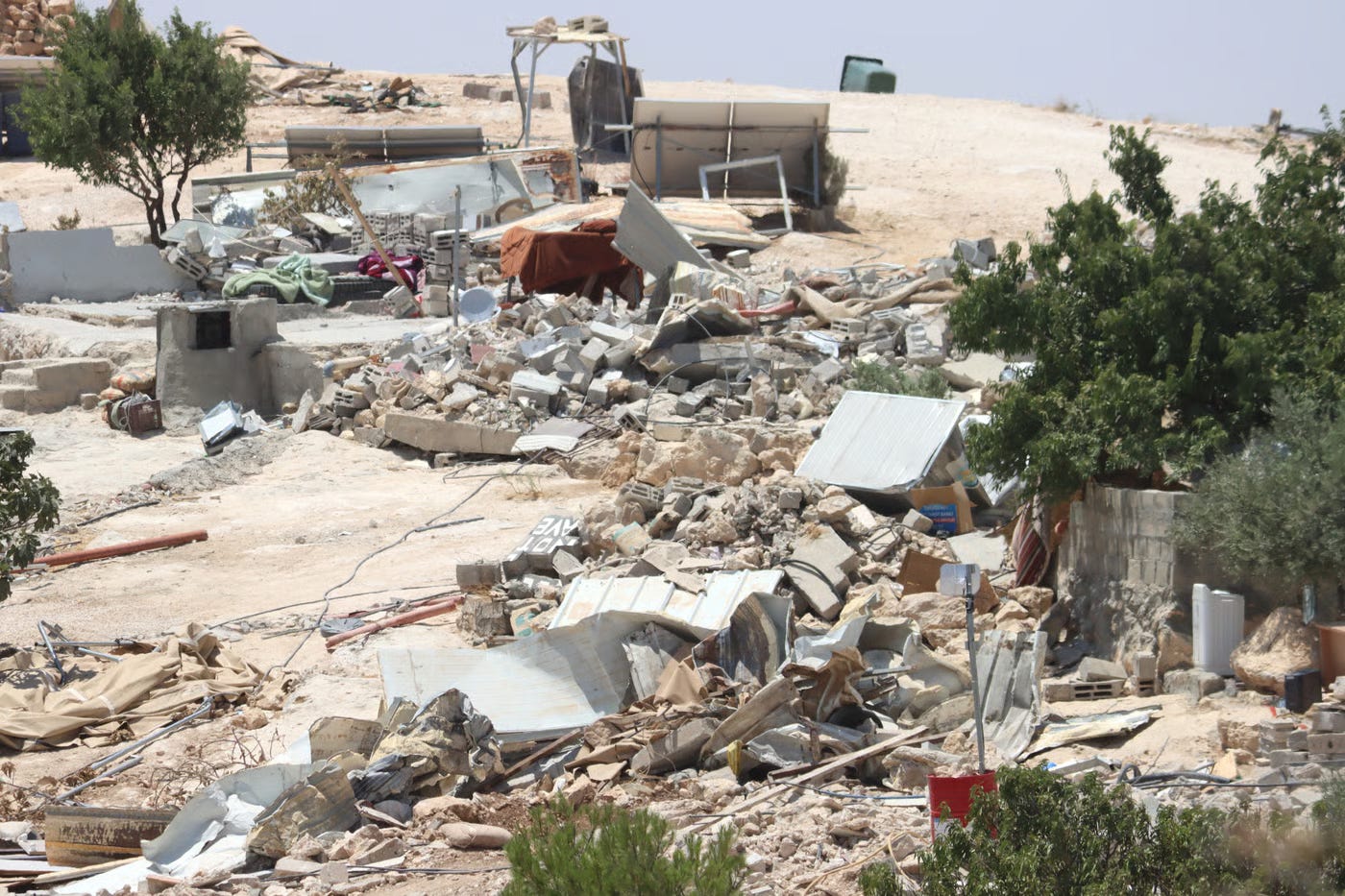
Just sixteen days later, on February 26, zionist forces returned to demolish the emergency shelter that humanitarian organizations had provided in response to the first demolition. Eight inhabited residential tents, all donor-funded, were destroyed, again displacing 46 people. During this operation, Israelis detained and physically assaulted a 36-year-old Palestinian man. No prior written notification was given for these demolitions.
The third and most extensive demolition came on May 5, when Israeli forces demolished eight inhabited residential structures, six inhabited caves, five animal shelters, seven latrines, six water cisterns, and the community center. The operation destroyed the water network, the internet infrastructure, and the communal solar system, leaving residents without basic services. Ten families totalling 49 people, including 26 children, were displaced, with more than 85 percent of community structures demolished. Twenty of the destroyed structures had been provided by international humanitarian organizations.
The residents of Khallet Athaba’ had exhausted all legal remedies to prevent demolition and displacement through St. Yves legal organization, but Israeli courts rejected every appeal. This pattern of demolition/humanitarian response/re-demolition illustrates how Israel’s permit regime functions not as a planning mechanism but as a tool of displacement and bureaucratic erasure.
East Jerusalem: Silwan Under Pressure
East Jerusalem’s Silwan neighborhood, home to approximately 50,000 Palestinians, continued to be the target of zionist non-profit organizations like Ateret Cohanim and the City of David in 2025. Two of the year’s five largest displacement incidents occurred in this historic community adjacent to the Old City.
On January 5, a Palestinian family was forced to self-demolish their 300-square-meter residential building after years of rejected permit applications and court fines exceeding 120,000 NIS. The demolition displaced six households comprising 39 people, including 18 children and two people with disabilities. The family had occupied part of the structure since before 1967 and, in the 1990s, expanded it to accommodate their growing family. Daily threats from Jerusalem Municipality officials ultimately compelled them to demolish their own home to avoid paying both the substantial fines and the cost of an Israeli-conducted demolition.
The year’s largest single displacement occurred in Silwan on December 22, when Israeli forces demolished a four-story residential building in the Wadi Qadoum area, displacing 50 people from ten households — including 21 children and two female-headed households.
( Israeli forces demolished a four-story residential building in Wadi Qadoum on December 22, leaving 50 Palestinians homeless—including 21 children and two female-headed households. )
The building had stood since 2013, and residents had spent more than a decade pursuing legal remedies, paying more than 900,000 NIS in court-imposed fines through monthly installments. But the structure of the zionist legal system is designed for resource capture from the indigenous communities.
The December operation began at 4:00 AM when heavily armed Israeli forces raided the building, physically assaulting residents and giving families only minutes to evacuate. Eyewitnesses reported that a bus carrying Israeli settlers arrived alongside the military; settlers participated in emptying apartments, damaged furniture, intimidated residents, and threw stones at them. The demolition proceeded despite a court hearing scheduled for that same day, denying families a final opportunity for legal intervention.
These planned military operations of displacement and resource capture reveal a consistent pattern of zionism: Palestinian families invest years and substantial financial resources pursuing permits through Israeli legal channels, only to face inevitable rejection and demolition. The permit system — under which Israel approves fewer than two percent of Palestinian building applications in Area C — functions as a bureaucratic mechanism for ethnic displacement rather than legitimate urban planning.
The financial burden compounds the displacement itself. Families pay lawyers’ fees, court costs, and accumulating fines, often for years or decades, before ultimately losing their homes. Those who cannot afford to self-demolish face additional charges for the cost of Israeli demolition crews.
The clinical language of incident reports cannot capture the full human cost of these demolitions. In Khallet Athaba’, families watched as bulldozers destroyed not only their homes but their caves — shelters their ancestors had used for generations. In Silwan, children lost not only their bedrooms but also their drawings on the walls, their toys, and their sense of safety.
The December demolition in Wadi Qaddoum left families without official documents, cash savings, clothing, and furniture. The operation lasted over twelve hours, during which Israeli forces sealed off the entire area, preventing Palestinian movement. Families who had spent a decade paying fines — believing they were working within the system — found themselves homeless in a single day.
The psychological toll extends beyond those personally displaced. Neighboring families live with the knowledge that their homes may be next. Children grow up understanding that no amount of legal compliance can guarantee their family’s safety. The demolition regime instills pervasive precarity across entire communities.
The data reveals an unmistakable escalation. Average daily demolition incidents have risen from 0.27 in 2010 to 1.5 in 2025 — a more than fivefold increase in fifteen years. Total annual displacement has more than tripled from the pre-2023 average. But again, this omits the physical erasure of Gaza and campaigns of displacement across the Naqab.
This acceleration coincides with stated Israeli government policies to expand settlements and assert control over Area C, which comprises approximately 60 percent of the West Bank. The demolition campaign targets not only individual families but entire communities, systematically destroying the infrastructure — water systems, solar panels, roads, community centers — that enable Palestinian life in these areas… which, of course, is the point.
The 2025 demolition data documents a policy of sustained, systematic displacement. Behind each statistic is a family—children who watched their home reduced to rubble, parents who spent their savings on legal fees only to lose everything, elderly residents displaced from land their families have inhabited for generations.
What you can do
The demolitions of Palestinian homes and infrastructure across historical Palestine are often spearheaded by the settler group Regavim or other organizations like them. In their year-end newsletter, Regavim claims credit for numerous actions targeting Palestinian land and structures, including pressuring the Civil Administration to demolish a 9-kilometer Palestinian road in the West Bank following a June 2024 government decision. The work extends across historical Palestine, as they’ve lobbied for new legislation protecting Israeli settler farms and ranches in the Naqab and Galilee after “years of activism, dozens of hearings and scores of petitions”. Their legal warfare is financed through the US charitable system. They’ve used that money to file High Court petitions against what they call “chop shops” in Palestinian areas, and used charitable funds to document and map some 4,900 kilometers of Palestinian roads they label as “illegal infrastructure” for a Palestinian state.
Activists in the United States and Canada can take meaningful action by challenging the charitable status of organizations that funnel tax-deductible donations to Regavim. In the US, the Central Fund of Israel (Tax ID 13-2992985) serves as the fiscal conduit for these contributions, while in Canada, Mizrachi Canada facilitates the same. By filing complaints with the IRS and the Canada Revenue Agency, documenting how these funds support a systematic program of displacement and erasure against Palestinians, advocates can work to revoke the tax-exempt privileges that subsidize dispossession.