

Nobody is talking about this devastating fact
Israel is demolishing Palestinians home and infrastructure at a rate of every 3.5 hours across the West Bank and East Jerusalem. 2026 is on pace to set new records. Nobody is talking about it.

Israeli forces demolished another 2-story home. This is the home to the Issa brothers in al-Khader, ( Bethlehem). No prior demolition notice. Sometimes if the Civil Administration goes to issue a demolition notice, they just drive by and throw it out the window.
In 2009, there were 103 recorded demolitions of homes and infrastructure, which amounts to roughly one every three or four days. By 2024 and 2025, that figure had climbed to around 550 per year, or more than one and a half operations every single day. 2026 is projected to be seven times the amount recorded in 2009. Understandably, the absolute horrors Israel has carried out in Gaza have taken precedent within the news and discourse. Nonetheless, the fact remains that the increasing pace of demolitions have become normalized. Demolitions are not episodic events tied to specific flashpoints — they are now constantly running in the background to advance the process of zionism on the ground in Palestine.
The last 30 days of data from the West Bank and Jerusalem underscores the acute level of destructive violence in the current moment. Over this period, there were 63 demolition operations — a daily average of 2.1, higher than any full-year average on record. More than 330 people were forcibly displaced, with children accounting for nearly half of this population: 167 out of 336. On average, a rate of five children per day are losing their homes, and with it their sense of security and stability — which, of course, is the point.
Projections for 2026 are alarming: At the current pace, this year Israel is on track to execute 691 military operations and administrative demolitions. If this current trajectory holds, this will displace more than 3,300 people and destroy over 2,200 structures. If so, 2026 would surpass 2024, which set the record for displacement in East Jerusalem and the West Bank. 2024 was notable for a spike in people displaced per incident (averaging over 7.7 per operation), which reflected larger-scale raids during a period of heightened Israeli military activity across the West Bank that was overshadowed by the zionist extermination efforts in Gaza and the bombardment of Lebanon and a lesser extent, Syria. The ongoing genocide in Gaza, and the prospects of the US attacks on Iran, continues to bury the mass demolitions in the news.
What’s hardest to convey in a data summary is the cumulative weight of this violence. These aren’t isolated incidents scattered across the last decade. They represent a systematic, ongoing process of displacement, one that has now been running at high intensity for years, with no indication of slowing down. The data, by itself, doesn’t explain why (which is why we need frameworks of analysis and theory). But it does make clear that what is happening on the ground is happening more frequently, affecting more people, and showing no signs of slowing or reversing.
The demolition data does not exist in isolation, but instead, operates as a function of settler-colonialism, imperialism, and capitalism. It runs alongside a parallel set of processes, ones that are less immediately visible but equally consequential. While Palestinian structures are being destroyed at an accelerating rate, settlement construction in the West Bank is being approved at a pace that its architects describe openly as a demographic project. In the first 55 days of 2026 alone, the Israeli Higher Planning Council approved 2,425 new settler housing units. The largest single tranche, 1,388 units, is earmarked for a new neighborhood of the settlement Kdumim (west of Nablus), positioned to draw it physically closer to the settlements of Havat Gilad and grow in ways to support the development of Yitzar and Ariel. The planning process that would once have required a defense minister sign-off at multiple stages was streamlined in 2023, when that requirement was eliminated. The result: 27,941 settlement units were advanced in 2025 alone, an all-time record.
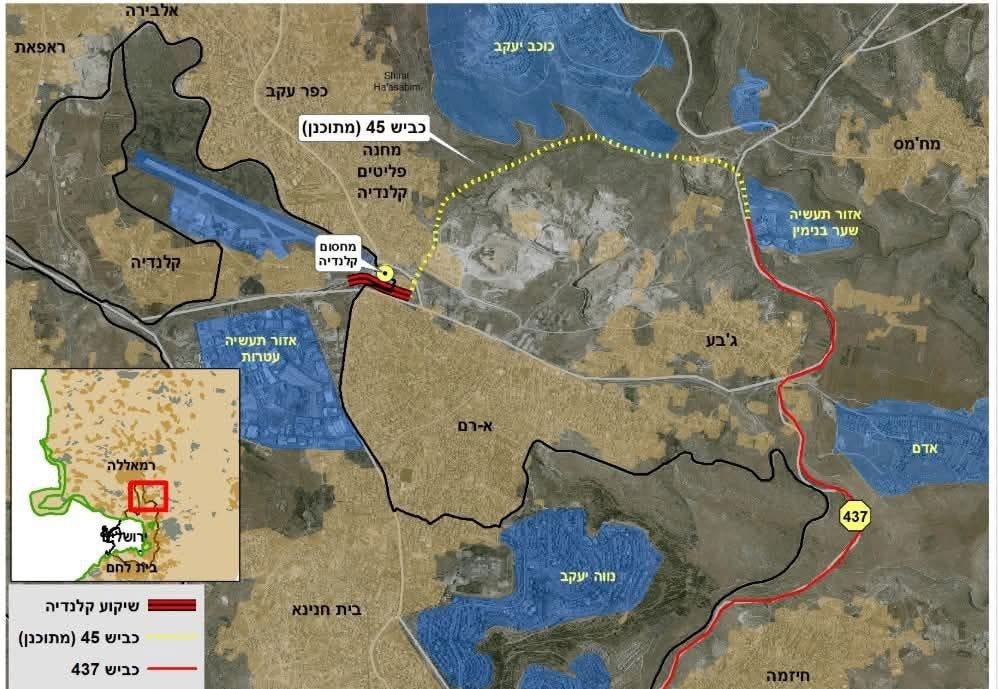
Infrastructure investment follows the same logic. This week, Israeli Finance Minister Smotrich and Transportation Minister Regev broke ground on Road 45, a NIS 400 million bypass road north of Ramallah that will allow settlers to commute into Israel through the Qalandiya underpass — bypassing the checkpoint inspections that Palestinian residents must undergo. Combined with NIS 120 million already spent on the Qalandiya underpass and NIS 160 million being spent on Road 437, the total infrastructure investment in this corridor approaches NIS 680 million.
Read together, these two processes (mass demolition and mass construction) reveal the underlying mechanisms playing out across historical Palestine. In this way, we can see how zionism — a form of settler colonialism — operates not simply through violence but through the active reorganization of space and capital. Palestinian homes are demolished to produce vacancy; settler housing is approved to fill it. Infrastructure subsidies lower the cost of settlements in the West Bank compared to the western settlements in Tel Aviv and Jerusalem. This creates an economic force which transfers the population to make facts on the ground permanent in the eastern settlements of Ariel, Efrat and Hebron.
The bureaucratic infrastructure — planning councils, bypass road budgets, weekly approval sessions — functions as capital accumulation by dispossession: business in each of these nodes accrue billions and millions of dollars in security, surveillance, propaganda development, construction and destruction contracts. These processes are sustained by a specific political economy that links Israeli state policy to Western capital and imperial interest. The United States and European governments provide the diplomatic power, the military aid, and the investment frameworks (public and private) that make zionism financially viable at scale for the capitalist class; in return, Israel functions as a forward base for Western power in the region. This is in part why zionist territorial ambitions are tolerated so long as they align with broader strategic goals and operate at the prospects of profit.
The demolition numbers at the top of this document are not a separate phenomenon from the housing approvals and road construction budgets or from US imperialist ambitions — which Israel plays a critical role. The process of demolitions, the mechanism of settlement expansion, help visualize the zionist structures as a key part of Israel as a vassal state: not simply a client, but an active instrument of empire, performing dispossession on behalf of a geopolitical order that benefits from regional fragmentation and the erasure of Palestinian life — except for the cases in which life can be monetized. The demolitions documented in this report are not aberrations or excesses: they are the granular, daily expression of the relationship between zionist settler-colonialism and capitalism.