

On the Monotony of the Checkpoint

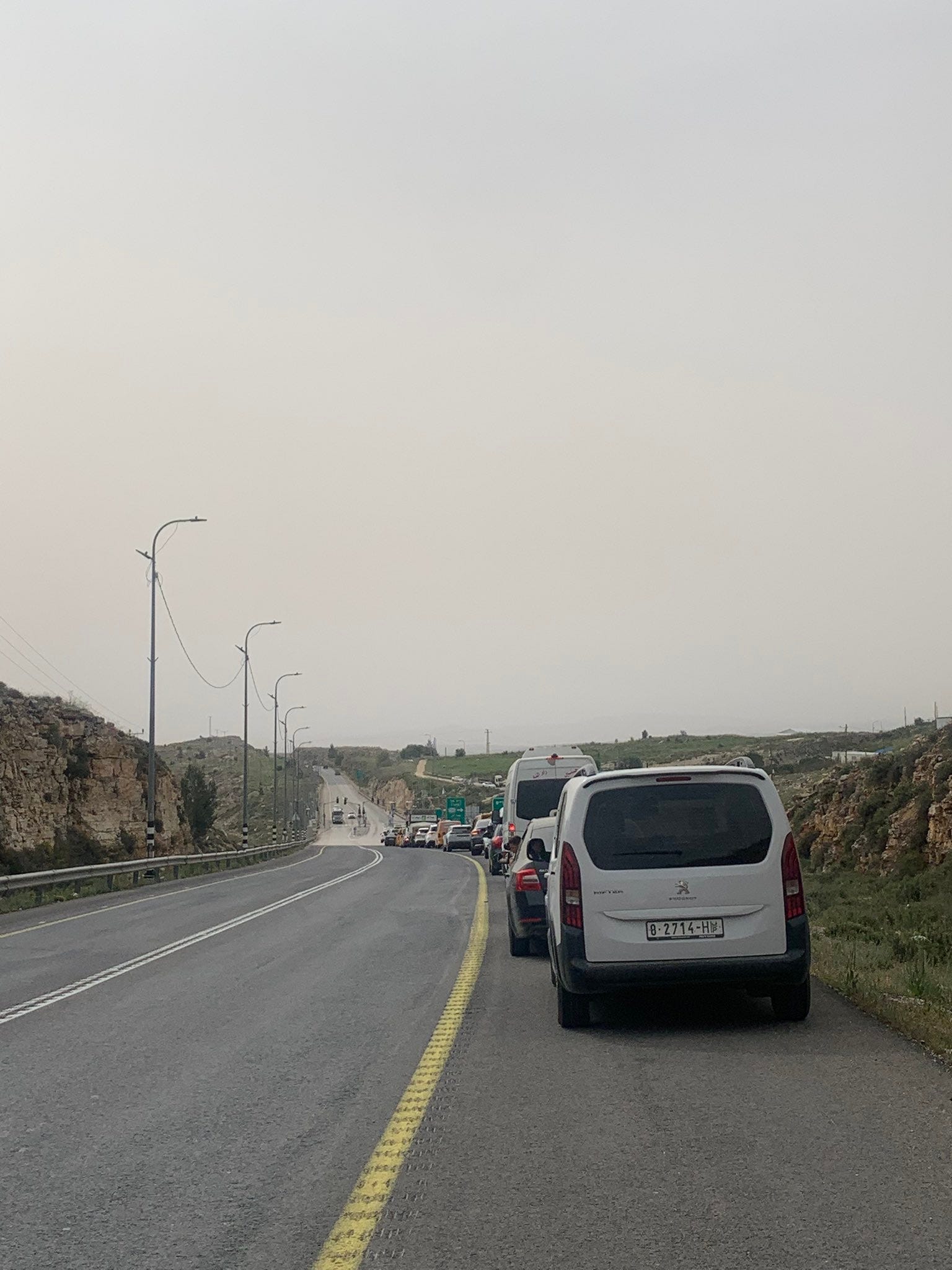
My way of life has required me to be constantly on the move, almost daily, for the past four and a half years. During these four and a half years, multiple events have happened either in the West Bank or directly affecting the West Bank: the armed uprisings in the Northern West Bank, where I live; the genocide in Gaza; the War on Lebanon; the 12 Day War on Iran. The common denominator between all of these events are gates and checkpoints; they “multiply like rabbits,” as one friend remarked.
But checkpoints and gates are not rabbits, they are mechanisms of control; they spatially atomize the Palestinian landscape, leading to a social atomization of the residents of the village or city. Checkpoints and gates operate on predictability and unpredictability: they can close down anytime but they have “rough” schedules of operation, where soldiers change shifts or in the cases of some checkpoints, close down the checkpoint entirely. Some soldier shifts are harsher than others. This has led to Palestinians capitalizing on the sleepiness of the soldiers of the night shift just before the arrival of the morning shift. Soldiers do not inspect cars, or demand identification, nor arbitrarily strip search and arrest people when they’re sleepy and want to “clock out.” In this context, the narrow time frame between the sleepy soldier and the freshly-wakened soldier serves as a way to circumscribe Palestinian time within Israeli time. It is also, in a sense, a method of resisting the checkpoint. Another way is using unpaved roads connecting adjacent farmland to bypass the checkpoints.
In April, settlers transitioned to daylight savings while Palestinians and the rest of the Arab region did not. This entailed a change at the checkpoint schedules: they open them according to daylight savings time, costing us an hour while closing them at non-daylight savings time, robbing us of another hour. Time becomes a weapon whereby it can be used to further steal Palestinian time and, as such, productivity during the day. It also destroys Palestinian social fabric that extends into multiple cities. Social atomization, as mentioned above, applies to a large part of the Palestinian population who prefer to stay in their hometown than to travel to another city and endure the hassle of the checkpoint. They might have something urgent to do, but would hold off on it, or they might skip a hang out with friends in another town because it is not worth the hassle. Others, however, choose to endure the hassle of the checkpoint in order to carry out their daily lives. I am an example of the latter, as commuting forms a backbone of my daily life.
Sometimes, soldiers would “relax” the checkpoints because the lines would be so long that they would interfere with settler traffic or even block the entrance of a settlement. There are two types of roads in the West Bank: settler-only roads, and mixed roads, with the latter often occurring on roads where the road to a settlement coincides with the road to a Palestinian city. In the context of Zionism, the quality of life of the settler is of the utmost importance. As such, checkpoints may relax during the times at which settlers commute to and from work, so as to not subject them to Palestinian time and Palestinian traffic.
After more than four years, checkpoints become less of scary instruments of control and more of a daily monotonous exercise: you check a Telegram channel for the hourly update on the checkpoints you’ll pass, you get into the minivan, and depending on the time between reading the Telegram channel checkpoint update and your arrival, the update may become outdated. In this case, it changes and you have to wait, you’ll be stuck between the silence of the passengers and the recurring fights that may happen between drivers on cutting the checkpoint line. Public transport minivans especially love to cut the line, and the passengers rarely complain because they get to their destination faster. Once your turn comes at the checkpoint, you’re trapped between two possibilities: an ID check or passing normally without disturbance. If the former happens, the soldiers may want to conduct a biometrics test on everyone via photographing their faces. Sometimes, they check their phones which may lead to arrest or harassment or the passengers “getting off the hook.” Other times, they pick a random passenger to hassle about random things: where they are going and why, their biometrics, or their different-looking ID picture which was likely taken when they were adolescents. When minivans coming from the Northern West Bank are questioned about where they came from, the instinct of the driver is to always say a city’s name that is not in the Northern West Bank. Mere affiliation with a city becomes an object of scrutiny for the soldier, abusing both the driver and the passengers with arbitrary checks and sometimes arrest.
I titled this personal note the way I did because, to me, these measures have become routine just like brushing your teeth or combing your hair. They do not feel “out of place” as they did before. Zionism, in essence, constricts Palestinian geographies and time over a long period so that Palestinians like me do not feel that such control mechanisms are invasive and malicious. Routine becomes another way that Zionism establishes facts on the ground in the long-term. In the case of which Zionism wants to appear as “accommodating to Palestinians,” they will lessen the amount of checkpoints and call that a concession. That’s what happened in the aftermath of the Second Intifada, as the Palestinian Authority pledged to fight resistance in the West Bank while Israel pledged to withdraw soldiers from Palestinian cities and lessen the amount of checkpoints paving the way for a “political solution” that never came. Quality of life for the Palestinian, as such, becomes the end goal rather than liberation.
As such, in our analysis, we must differentiate between genuine improvements on the ground and quality of life measures that Israel takes to whitewash its image in both the West Bank and the Gaza Strip. We must never allow Zionism to set the goal post of our aspirations, but rather force it to concede to our demands through attrition. Any other option to be taken would not constitute an advance for Palestine.