


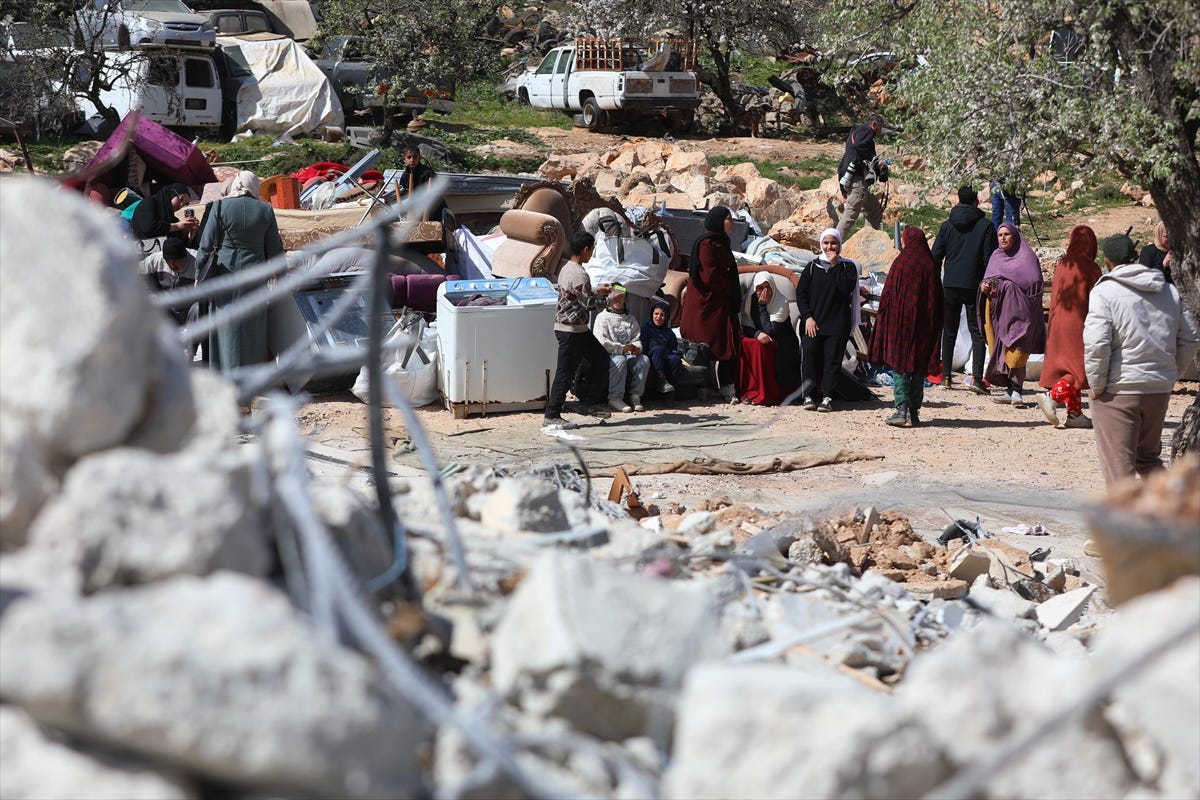
In the first two weeks of February 2026, the Israeli government approved a set of administrative decisions that amount to the legal scaffolding of annexation. Within the same 30-day window, settler violence in the West Bank doubled. These are not parallel developments. The policy decisions create the material conditions for the violence, and the violence clears the ground for the policy to take effect. This is how zionism perpetuates itself in material terms. Nonetheless, the sequence is worth laying out plainly.
On February 8, the Israeli security cabinet repealed Jordanian-era restrictions on land purchases in the West Bank, eliminated transaction permit requirements, and opened previously classified land registries to the public. A week later, on February 15, the full government allocated NIS 244.1 million to establish a land title settlement process in Area C, under which Palestinian landowners must prove ownership through documentation most do not and cannot possess. Land that goes unclaimed transfers automatically to the Israeli state. Area C is 3.3 million dunams. Roughly 1.9 million remain unregistered. The five-year target is 290,000 dunams. Combined with land already classified as state land, this will dispossess Palestinians from up to 83% of Area C.
Meanwhile, on the ground, settler attacks climbed from 65 incidents in the last week of January to 137 incidents in the first nine days of February. Not a single day in the 30-day reporting period passed without at least one attack. The geographic pattern is specific. Ramallah and Nablus each recorded 28 incidents. Hebron had 26. Tubas and Jericho, which cover much of the Jordan Valley, had 23 and 20 respectively. These are not random distributions. They correspond to the areas where Palestinian agricultural land is most exposed and where Bedouin and farming communities are most vulnerable to displacement.
The tactics follow a logic of accumulation. Settlers graze livestock on Palestinian cropland, destroying harvests. Squatters uproot trees: on January 27, roughly 500 olive, fig, and almond trees were cut down in the Wadi Al-Rakhim area outside Yatta. They burn equipment, like the three bulldozers, two trucks, and five vehicles torched near Awraf village on January 21. Settlers closed roads with earthen berms and stone-throwing, as at Mukmas. The last 30 days have been brutal. 15 Bedouin families in Wadi Al-Auja evacuated because the attacks would not stop. A stolen tractor in Al-Auja at the end of January. Pepper spray inside a family’s home in Yatta this past month. Foreign solidarity activists beaten at a Bedouin gathering near Al-Auja. This sort of violence is only possible when the Israeli state, the broader settler movement, and the armed forces operate in tandem — as they have.
Each of these incidents makes it harder to stay. That is the point. The new land registration process will formalize what the violence has already begun; transferring Palestinian land to the state by making it uninhabitable first.
Israeli abductions and arrests of Palestinians operate on the same axis. The Palestinian Negotiations Affairs Department documented 929 abductions over the 30-day period, averaging 32 per day. The rate rose roughly 40% from the first week to the last, peaking at 54 on February 12. Mass detention raids in the Old City of Hebron, sometimes pulling more than a dozen people at once, were routine. A 15-year-old was arrested in Kfar Numa. Thirteen residents detained in a single night in Bethlehem. Many arrests came through summons to Israeli intelligence offices, a process that functions less as law enforcement than as a system of social control — removing individuals from their communities on a rolling basis, generating compliance through unpredictability and ripping apart the fabric of communities as they use violence and intimidation to try to create collaborators.
Road closures, though smaller in absolute number (28), tripled over the period and served the same function. Iron gates sealed at village entrances. Main roads blocked between communities. Movement restricted in Ramallah, Bethlehem, Salfit. The effect is to fragment Palestinian territorial contiguity, making coordinated resistance to land seizure harder and daily economic life more precarious. The fragmentation of Palestinian lands happens at the macro level — like through colonial logic of international law (the Oslo Accords, the UN partition plans), and the micro level — road closures and the establishment of squatter communities that lay beyond the scope or enforcement of law.
The cabinet decisions from February extend Israeli administrative authority into Areas A and B as well, territory that, according to Oslo, falls under Palestinian civil control. Israeli agencies will now operate there under mandates covering archaeology, heritage, water, and environmental hazards — categories broad enough to justify demolitions anywhere. This is the dream of the settler organization Regavim and the broader zionist movement. Within this same legal arrangement, in Hebron the Palestinian municipality is losing its planning authority around the Ibrahimi Mosque. A new Israeli body will govern the Rachel’s Tomb area in Bethlehem as well, putting the already embattled Aida camp in an even more precarious position.
What is happening is a settler-colonial process operating through two channels simultaneously. The legal channel converts Palestinian land into state property through registration mechanisms designed to dispossess — essentially just building off the existing Ottoman and British systems that were in place before zionist administration. The extralegal channel — settler violence, backed by Israeli military infrastructure and arrest operations — by design drives Palestinians off the land before the paperwork arrives. Neither channel functions without the other. The policy needs the violence to empty the land. The violence needs the policy to make the seizure permanent. This is the cyclical nature of zionism.
The NIS 244.1 million budget line is what makes this different from prior escalations. It is not a declaration or a statement of intent. It is an operational expenditure, staffed by a new administration housed in the Israeli Ministry of Justice, designed to process land claims at industrial scale. This will no doubt be facilitated by the many “charities” like the Jewish National Fund and Regavim. The violence documented in Palestinians is what that process looks like before it reaches the Israeli registrar’s office.