

Protective Presence and the Machinery of Control
An insight into some of the lesser known dynamics underpinning liberal and zionist protective presence organizations in Palestine.
By Cody O’Rourke and Lara Kilani
O’Rourke and Kilani write to provide a general review of liberal and zionist protective presence programs, drawing on their combined eighteen years of experience in close proximity to these organizations. The authors reframe the dynamics underlying liberal and zionist protective presence work in Palestine, illuminating elements of organizational infrastructure that are not divulged online, openly shared with participants and, generally, are obscured from Palestinian “co-resistors”. Rather than pointing to specific events or spotlighting certain liberal and zionist organizations, the authors hope that this analysis will give readers the tools to look critically at such organizations in Palestine and far beyond it.
The Model of Protective Presence
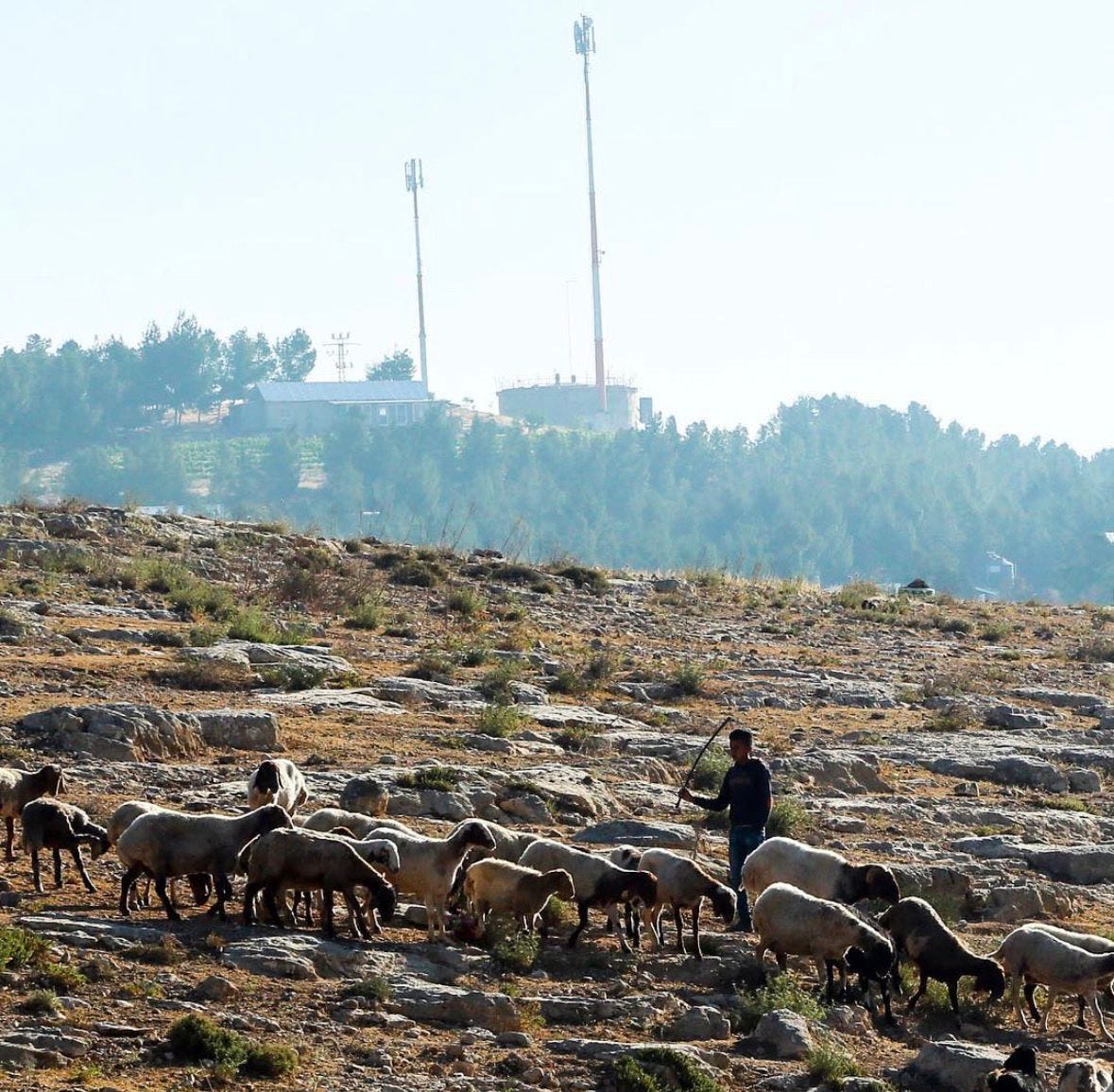
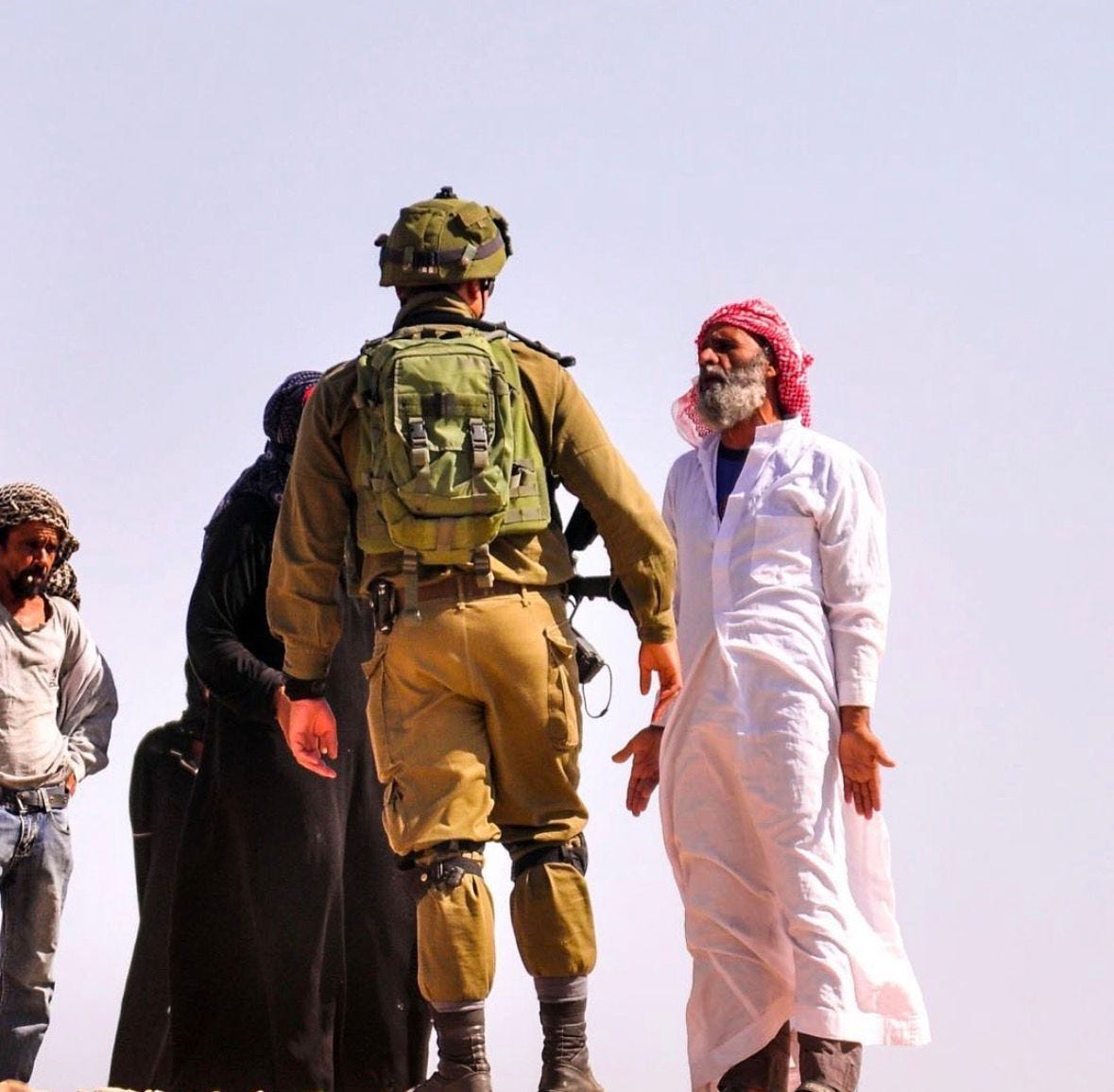
Each week, international and Israeli volunteers descend on the South Hebron Hills and Jordan Valley equipped with GoPros and cameras, documenting demolitions that Palestinians have already documented, witnessing violence that Palestinians have endured and witnessed for generations, and constructing organizational infrastructure that Palestinians will never control. For observers outside Palestine unfamiliar with the landscape of protective presence, viral footage of international and Israeli activists enduring verbal assault and physical violence may appear to represent the apex of solidarity. For those of us working within these spaces, however, the calculus is more complex: Palestinian liberation requires more than the substitution of one beaten body for another. Watching settlers beat activists alongside Palestinians before returning to film the rubble is not a program for liberation — it is a bizarre ritual of witness that mistakes presence for power.
Protective presence programs organized predominantly within liberal and zionist frameworks promise solidarity but deliver something structurally ambiguous. This includes both the programs of liberal and zionist organizations, some of which are founded and maintained by Jewish internationals who move to take up settler citizenship in Palestine, and those maintained by a community of international volunteers on the ground and abroad. These tend to be built on a model in which Palestinian suffering is meticulously recorded and commodified, yet rarely linked to winnable advocacy campaigns designed to dismantle the structures of zionism. When solidarity is conditioned on Palestinians accepting the legitimacy of the settler (as it is by all organizations which name “occupation” rather than zionism as the primary issue), when donor lists and email databases remain locked in the organizations’ infrastructure outside the access of the people which it is supposed to serve, and when the international visibility of a Palestinian village requires what amounts to a stamp of approval from Israeli partners, the mechanism of protection becomes indistinguishable from the machinery of control. In this article, we examine how organizations such as the Center for Jewish Nonviolence and Achvat Amim, among other organizations founded and maintained by internationals or Israeli settlers, advance settler-colonial logics through multiple mechanisms: the misrepresentation of protective presence; systems of resource capture that builds donor infrastructure inaccessible to Palestinians; the lack of meaningful advocacy interventions; and the facilitation of Jewish immigration and settler citizenship acquisition by their own members. We also propose concrete reorientations toward solidarity frameworks that center anti-zionist praxis — not to dismiss the impulse toward solidarity, but to redirect it toward frameworks that transfer infrastructure and decision-making to Palestinian hands, the development of winnable advocacy campaigns, and measure success by the material advancement of Palestinian liberation rather than the visibility of international witnesses.
Protective presence, in theory, serves several interconnected functions. The “protective” element operates on the premise that international presence deters violence, and that settlers and soldiers are less likely to attack when foreign witnesses are watching and recording. Documentation captures evidence of violations for use in legal proceedings, policy advocacy, and public awareness campaigns. This documentation, ideally, is meant to feed advocacy efforts targeting the material and political structures that sustain the violence, such as challenging tax-exempt donations to settlement organizations, pressuring arms manufacturers, and pushing for legislative change. Beyond these instrumental functions, protective presence claims to build solidarity networks connecting Palestinian communities to international supporters, donors, and media, while providing material assistance to families facing demolition or displacement. The measure of success, properly conceived, would be the material advancement of Palestinian liberation, not the visibility of international witnesses. What follows is an examination of how protective presence organizations fail, distort, or abandon each of these functions.
The Covid-19 pandemic and the post-October 7th, 2023 zionist genocidal war on Gaza have significantly reduced international travel to Palestine, disrupting protective presence operations as settler violence and impunity have soared. Liberal zionist organizations, however, have maintained access to volunteers throughout this period. Their participants are overwhelmingly Jewish, allowing international volunteers to enter by virtue of their identity and to extend their stays through privileged access to visas, residency, and even citizenship. These programs also draw on Jewish Israeli residents and citizens who face no entry barriers. While travel restrictions have since eased, liberal zionist groups leveraged years of mostly uninterrupted access and consistent funding to elevate their influence within Palestinian communities. Though the structural critiques we outline below — resource capture, political conditionality, refusal to engage in strategic and prolonged advocacy, the centering of non-Palestinian actors — are not exclusive to liberal zionist formations, these organizations warrant particular scrutiny because their proximity to the state and access to Jewish identity confer advantages that amplify these dynamics. Nonetheless, the patterns outlined below (excluding the facilitation of Jewish settlement) are generally consistent across many protective presence organizations and programs beyond explicitly liberal zionist formations.
Faulty Premises
The deterrence premise had greater validity in earlier decades, when international presence carried sufficient political cost to restrain some settler and military violence. That calculus has shifted. Internationals have been killed — Rachel Corrie in 2003, Tom Hurndall in 2004, Ayşenur Ezgi Eygi in 2024 — beaten, detained, and deported with minimal consequence, demonstrating that the assumed protective hierarchy of privileged bodies no longer operates as reliably as it once did, if it ever did. More fundamentally, the deterrence framework that centers international and Israeli activists erases Palestinian-led protection efforts that have proven effective without international and Israeli mediation: in villages around Nablus and Ramallah, Palestinian protection committees have organized to physically confront and drive settlers from their lands. The deterrence component also conflates two distinct outcomes: stopping violence and deferring it.
Settlers frequently surveil protective presence patterns and time their attacks for periods when internationals are absent; the violence is not prevented but postponed, often to moments when documentation is less likely and witnesses are fewer. What appears as protection may function primarily as postponement, offering communities a reprieve rather than security while crediting international presence with an efficacy it does not possess.
In recent times, activists have acknowledged the limited impact of being present, and in return have pointed to the documentation, education, and advocacy as the utility functions of protective presence. However, the premise that these protective presence efforts fill a documentation gap fundamentally misrepresents Palestinian civil society, and frankly, Palestinian history. Al-Haq holds consultative status with the United Nations Economic and Social Council and has submitted extensive communications to the International Criminal Court over the years. The Palestinian Centre for Human Rights in Gaza has filed over 1,200 formal complaints regarding the violence of zionism. OCHA maintains continuous monitoring operations across Palestine, systematically cataloguing home demolitions. All of these efforts draw on the rigorous documentation of zionist violence, carried out every day by regular Palestinians.
The documentation produced by many protective presence organizations suffers from fundamental limitations that render it essentially unusable for any purpose beyond immediate social media circulation. Footage and incident reports are dispersed across individual activists’ Instagram stories and Twitter threads, and never consolidated into structured, searchable databases with standardized metadata, geolocation, timestamps, and categorical tagging. This means the material cannot be programmatically queried, cross-referenced, or aggregated for longitudinal analysis; it exists outside of the archival infrastructure that would allow researchers, legal advocates, or international bodies to retrieve and cite it systematically.
The contrast with Palestinian documentation organizations is stark. Groups like Defense for Children International and Addameer maintain methodologically rigorous databases designed for evidentiary use in legal proceedings and policy advocacy. Much of the liberal and zionist protective presence documentation, by contrast, is configured for the ephemeral temporality of social media; the content is designed to generate immediate engagement before algorithmic suppression buries it within hours. This inadequacy explains why many of these organizations are virtually never cited as sources for demolition statistics, displacement figures, or trends in settler violence, as there is no sustained effort to collect this information or turn it into a meaningful, accessible tool for the communities that host protective presence groups. If the perpetual documentation and publication of zionist violence alone were sufficient to halt its perpetuation, then the images now circulating globally — immolated infants, children dismembered beyond recognition, prisoners subjected to mass sexual violence in detention — would have already produced the political pressure necessary to end the genocide in Gaza.
Perpetuation, Not Disruption
Given these facts, the utility of these liberal and zionist organizations’ documentation and presence emerges only when they are able to leverage the rhetorical currency of neoliberal identity politics, using their participants’ or organizations’ Jewish identity and/or Euroamerican whiteness to legitimate criticism of zionism or the Israeli state as a political credential or discursive move to mitigate accusations of antisemitism. This, in return, perpetuates colonial epistemologies, centering non-Palestinian witnesses as more credible narrators of Palestinian suffering and positioning the colonized as incapable or inadequate at representing their own experience. Consider a November 2023 Jewish Currents article, “Amid a Settler Onslaught, Protective Presence Activism Falters,” which centered the opinions of Israelis, including self-proclaimed zionist Arik Asherman, and citing no Palestinians at all.
Protective presence groups, at times, claim to be engaged in advocacy. But a closer investigation reveals how these campaigns divert political energy and capture material resources from Palestinian communities. First, a critical distinction must be drawn between education and advocacy, which is a conflation that obscures the strategic vacuity of most liberal and zionist protective presence work. Stating that Israel commits human rights abuses is not an advocacy campaign; it is, at best, an educational component that might be nested within an advocacy campaign. Advocacy, properly understood, aims to change the laws, policies, and material structures that, in the case of Palestine, facilitate indigenous erasure and capitalist accumulation. As such, it is designed to target specific legislative provisions, funding streams, institutional relationships, and regulatory frameworks with the goal of altering them. Education raises awareness while advocacy redistributes power.
When organizations brand themselves around documentation and witness without articulating concrete policy targets, they create the impression of political mobilization while engaging in none of its substance. Supporters donate believing that their contributions advance structural change, when in reality the organizational model is designed to perpetuate itself through cycles of crisis documentation and emergency fundraising rather than to render itself obsolete by achieving definable victories. Even the overarching goals of many of these organizations are vaguely outlined at best, relying on slogans like “co-resistance and solidarity against Israeli occupation” — phrasing which would likely inspire trust and cooperation from some Palestinians and internationals — without naming a stance on zionism.
The opportunities for genuine advocacy are and have been abundant and specific. Boycott, Divestment, and Sanctions campaigns offer concrete targets: pressuring universities to divest from companies profiting from occupation, lobbying pension funds to exclude Israeli arms manufacturers, and challenging contracts between municipalities and complicit corporations. Equally available are campaigns to challenge the charitable tax-exempt status of zionist organizations that directly fund settlement expansion and land expropriation — a legal vulnerability that has had some success in Canada and in the United States but remains almost entirely unexploited by liberal and zionist formations in Palestine. In general, liberal and zionist protective presence groups have largely abstained from material interventions through advocacy. Some offer rhetorical gestures toward BDS in the abstract. However, the measure of advocacy is not whether an organization includes supportive language in its mission statement or in its members’ social media posts, but whether it actively mobilizes resources to disrupt the financial and legal architecture that enables zionist conquest. To document violence while leaving untouched the tax-deductible donations that fund the violence, for example, is not a failure of strategy but a revelation of internal priorities and (a lack of) political vision.
Material Support, Dependency, and Political Conditions
Furthermore, the campaigns that do take place through these liberal and zionist protective presence programs are generally fundraising for emergency assistance. Any influx of financial resources into a marginalized, at-risk community inevitably generates power imbalances, and in the context of settler-colonialism, these imbalances carry existential weight. When liberal and zionist organizations fundraise for Palestinian communities facing demolition or displacement, the money often determines whether families remain on their land or join the statistics of forced transfer. This work is critical, and those who facilitate it deserve acknowledgment for providing material lifelines in moments of acute crisis. Yet the very criticality of this support obfuscates the structural dependencies it institutes and animates. Palestinian communities cannot risk openly criticizing the political frameworks, organizational practices, or ideological limitations of their liberal and zionist benefactors, because to do so would mean jeopardizing the financial flows upon which their physical survival depends.
The systematic exclusion of Palestinians from international payment infrastructure compounds this dependency. Without access to PayPal, GoFundMe, or conventional banking systems that would allow them to fundraise directly, Palestinian communities become structurally reliant on intermediaries who can navigate these platforms on their behalf. But the dynamic extends beyond dependency alone. Each emergency fundraising campaign becomes an opportunity for resource capture: a one-time fundraising campaign raising five thousand dollars for a family facing demolition simultaneously harvests donor contact information such as email addresses, giving histories, demonstrated willingness to contribute to Palestinian causes, which are then leveraged indefinitely. The emergency passes, but the donor list remains, becoming organizational infrastructure that funds operations, builds institutional profiles, and sustains liberal and zionist organizing long after the immediate crisis has been addressed. Palestinian suffering thus functions as a lead-generation mechanism, converting humanitarian urgency into durable institutional assets that vulnerable Palestinian communities themselves will never control. More perniciously, this resource extraction directly capitalizes on the liberal and zionist project of marketing coexistence on settler terms, which is the very framework Palestinians seek to dismantle through decolonization.
In this relationship, material assistance from liberal and zionist organizations arrives freighted with political conditions that Palestinians understand well. To maintain access to international solidarity networks, Palestinian communities, organizations, and activists must navigate unspoken boundaries including but not limited to the condemnation of armed resistance, prohibition on the articulations of decolonization, and the legitimization of the settler’s presence as incontrovertible. Sustained support is contingent on the behavior of those being assisted, with solidarity effectively held for political ransom. This conditionality has manifested in joint programming between protective presence groups (and the communities in which they maintain a presence) and political organizations like J Street, whose delegations have participated in Center for Jewish Nonviolence actions. The power imbalance has also produced disturbing practices of ventriloquism, such as liberal and zionist activists ghostwriting op-eds published under the names of Palestinians, or Palestinians granting access to their organizational and personal social media accounts for internationals to manage. In these arrangements, the Palestinian voice (now a Palestinian name speaking in a foreign voice) becomes a vessel for messaging engineered in liberal and zionist talking circles through content calibrated to advance organizational agendas fundamentally incompatible with building a program of anti-colonial resistance.
These dynamics produce and maintain a perverse gatekeeping function. Palestinians who gain international visibility through collaboration with these groups are disproportionately those willing to express their acceptance of the settler and to frame resistance within terms legible to liberal sensibilities. Liberal and zionist groups essentially issue a stamp of approval that assures international audiences that, unlike others, these Palestinians are not terrorists but that they are, in fact, marketable and fully vetted, both socially and politically. Many Palestinian names that Western audiences may recognize trace their prominence to relationships with Israelis who provided access to networks, organized speaking tours, and performed the legitimizing function of vouching for their moderation. The infrastructure of liberal and zionist solidarity thus becomes one of the primary channels through which Palestinians can be heard internationally, but only if they accept the terms of their own dispossession as debatable rather than criminal.
The Outcome is the Goal
As these organizations build their capacity, their structures are leveraged in real ways to advance settler migration, intensifying the inherent contradiction of their work when members of these organizations themselves participate in the demographic project of settlement. All That’s Left, the Center for Jewish Nonviolence, Achvat Amim were founded by Jewish activists from abroad who relocated to Palestine, obtaining Israeli citizenship or residency through pathways available exclusively to Jews. International activists who declared that they opposed the amorphous “occupation” on weekends spent their weekdays going through the process to obtain Israeli citizenship through the same exclusionary laws that dispossess the communities they claim to protect. This is, by definition, participation in settler-colonial population transfer. One cannot oppose the violence of zionism while benefiting from the legal architecture of Jewish supremacy that enables one’s presence in the first place.
The structural critique here is not that individual participants in protective presence programs are malicious, nor that the material assistance to communities under attack is unneeded or unwelcome. Rather, programs that refuse to name zionism as settler-colonialism, that center non-Palestinian actors as authoritative witnesses, that build organizational infrastructure Palestinians do not and cannot access or control, and that condition solidarity on political constraints that delegitimize Palestinian resistance cannot but reproduce the colonial logics they nominally oppose. The path forward requires not a better-resourced protective presence but the dismantling of the structures that necessitate protection in the first place. Those projects cannot be led by those who benefit from those very structures. Today, protective presence projects in the United States, seeking to prevent Customs and Border Patrol agents from abducting family members and wrenching communities apart, can learn from these lessons in order to sharpen their tactics and avoid the pitfalls of liberalism. It is not about sustaining protective presence work, but destroying the need for it.
A Brief Q&A
When discussing the shortcomings of the contemporary form of protective presence online, a Jewish ally reached out to pose a few questions that had arisen. We’d like to pose and answer them here:
Question 1: Is there a form of protective presence that advances liberation without perpetuating zionism?
The honest answer is that protective presence constituted within liberal and zionist formations probably cannot be reformed into a decolonial practice because its fundamental premise — that the presence of privileged people deters violence — relies on the very hierarchy it claims to oppose. Couple this with the reality that most protective presence groups are funded by zionist donors, and the inherent conflict of interests renders it a moot point. There is also the reality, increasingly visible through acts of settler and state violence, that the hierarchy of “privilege” is not enough to deter violence.
A more generative reframe might be: What if the goal isn’t “presence” but “infrastructure transfer”? Anti-zionists with access to payment systems, donor networks, language skills, and visa privileges could work to build systems that Palestinians control rather than systems that depend on continued intermediation by internationals and Israelis. The measure of success becomes obsolescence — building capacity until your presence is no longer necessary — rather than sustained engagement that perpetuates dependency.
Question 2: What are we critiquing when we critique “coexistence”?
Coexistence frameworks assume the settler’s presence is a settled question and ask only how to manage relations between two populations with “equivalent claims”. This is the liberal and zionist trap which treats the outcome of conquest as the starting point for negotiation. This assumes that it is not zionism itself that is fundamentally violent, oppressive, and eliminatory, but its practices under the current government.
The critique against claims for “coexistence” isn’t against the concept of Jews and Palestinians living together. Rather, it’s a rejection of the frameworks that demand that Palestinians the legitimacy of their dispossession as the precondition for being heard. Coexistence as currently articulated means Palestinians accepting the reality of life under colonization and forfeiting claims to sovereignty, supplanted by zionist theft.
Question 3: What uncomfortable truths must Jewish anti-zionists face?
There are several uncomfortable truths: Jewish anti-zionists cannot function as a distinct community, but rather must be part of a larger whole in order to be of any use, and that whole is made up of all anti-zionists. Furthermore, renouncing zionism ideologically while holding Israeli citizenship or residency is a contradiction that must be resolved materially, not just rhetorically. The networks, platforms, and visibility Jewish anti-zionists access come from the same infrastructure of Jewish privilege that zionism constructed. Palestinian liberation should produce a future that Jewish anti-zionists cannot fully envision or control, and solidarity means supporting that future anyway. The role of Jews (like all non-Palestinian anti-zionists) in Palestinian liberation is not to lead, envision, or direct, but uniquely, Jewish anti-zionists can dismantle the structures within Jewish communities that enable zionism to persist.
Question 4: Work within existing orgs, form new ones, or support Palestinian organizations?
This question often wrongly assumes that Jewish anti-zionists need organizational homes of their own for their political work on Palestine (i.e., as Jewish anti-zionists, rather than merely anti-zionists). But if the critique is that Jewish-led organizations inevitably center Jewish experience and capture resources that should flow to Palestinians, as they do in Palestine and the United States, then the answer is to support Palestinian organizations directly, materially, and without seeking recognition or institutional credit. Jewish anti-zionists who wish to work within their Jewish communities by unraveling zionist narratives, challenging communal institutions and charities, disrupting financial support for zionism, confronting family and synagogues have plenty of work cut out for them which doesn’t require a Palestine-focused organization. It first and foremost requires Jewish people to do the uncomfortable internal work that Jewish people only can do, while Palestinians lead the liberation movement that only Palestinians can lead.
Thank you for posting this.
Thank you for this.
the following sentence left me wondering:
"Furthermore, renouncing zionism ideologically while holding Israeli citizenship or residency is a contradiction that must be resolved materially, not just rhetorically."
Can you please further clarify? I get the critique of "solidarity activists" obtaining citizenship and moving to settle in Palestine during their "solidarity" work, but what about those who were born in Palestine, and they, let's say, second or third or fourth generation settlers, have no second citizenship, are anti-zionists, and truly want to engage in actual, Palestinian-led campaigns, without making a name for themselves? those are a tiny minority don't get me wrong, the israeli society is absolutely genocidal and fascist to its core, but those individuals do exist. how can they reconcile the contradictions "materially"? what would that mean? should they find any way to simply leave or is there a way for them to engage in meaningful action? (apart from what already written in the article I assume)