

Same Donors, Different Movements
The financial infrastructure behind the zionist movement also funds the organizations meant to dismantle it. We built a database of 14,653 nonprofits that shows exactly how.

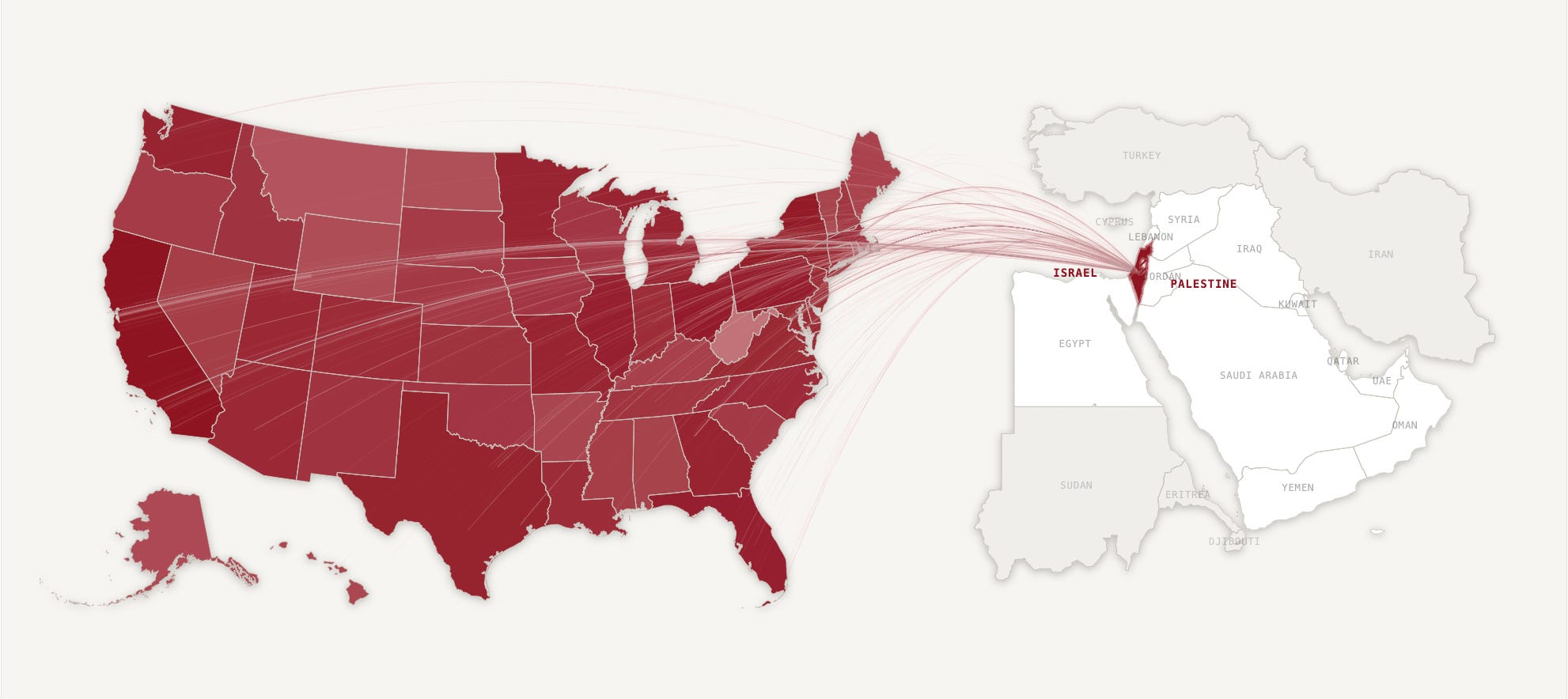
Between 2013 and 2023, US-based nonprofits moved $17.65 billion to Israeli and foreign entities through the tax-exempt charitable system. In 2023 alone, $2.57 billion left the country — more than two-thirds of the annual US military aid package, with none of the restrictions. We know this because we counted it: 29,751 individual grant transactions, exposed in the IRS filings that every US nonprofit is required to submit. While the data reveals an entanglement of interests that create structural liabilities in US movement spaces, it also highlights strategic opportunities to disrupt the material resources that advance the zionist movement in Palestine.
Good Shepherd Collective maintains an open-source database of 14,653 US-based 501(c)(3) organizations identified as participants in the zionist financial ecosystem. The database is the evidentiary backbone of Defund Racism, a coalition campaign challenging the tax-exempt status of organizations that fund settlement expansion and military operations across Palestine. It is built entirely from verified IRS 990 filings available through the IRS Exempt Organizations Business Master File and electronically filed returns. Organizations are classified by function — direct funders, intermediaries, advocacy groups, and domestic infrastructure — and by confidence level, using grant recipient analysis, Schedule F foreign activity disclosures, and cross-references against known zionist-linked entities.
Our research unearthed two aggregate figures that matter: $2.57 billion and $9.3 billion. The first is the amount of money that actually left the United States and landed in “Israel” in 2023. We isolated this number by counting only terminal grants — grant transactions in which the recipient is an Israeli or foreign entity, rather than another US-based intermediary. Between 2013 and 2023, those terminal grants totaled $17.65 billion across 29,751 individual transactions. That figure grew from $626 million in 2013 to $2.57 billion in 2023, a 311 percent increase over the decade.
The second figure ($9.3 billion) is the total annual revenue of the ecosystem itself — the full domestic apparatus of fundraising, programming, advocacy, and lawfare operations that sustained the pipeline in 2023. Summing revenue across all 14,653 organizations for the same period produces $93.65 billion, but that number double-counts money as it moves between organizations within the ecosystem (a donation to a Jewish Federation that becomes a grant to the Central Fund of Israel appears as revenue for both). Subtracting the $13.6 billion in intra-ecosystem grants we can trace by EIN produces a de-duplicated estimate of roughly $80 billion in net revenue entering the system from outside donors and other sources between 2013 and 2023. In 2023 alone, the ecosystem generated approximately $9.3 billion in de-duplicated revenue, up from $5.3 billion a decade earlier, a 75 percent increase. In comparison, over the same period, Lockheed Martin’s revenue grew 49 percent, from $45.4 billion to $67.6 billion.
As anyone would guess, the period after October 7, 2023 accelerated these flows significantly as the broader zionist movement mobilized to animate and conceal a genocide simultaneously. Friends of the IDF reported $282 million in revenue for its fiscal year overlapping the attack, nearly triple its $89 million baseline the year prior. The Jewish National Fund’s revenue doubled to $224 million. The Jewish Federations of North America launched a $908 million Israel Emergency Campaign, the largest in their history, pushing total Federation fundraising past $3 billion in 2024. (Note: These surges are partially captured in the 2023 filing data but will be more fully reflected in 2024 filings as they become available from the IRS.)
It’s worth going back to the military-aid comparison, but maybe not for the reason you’d expect. Much of the US organizing around Palestine solidarity focuses on reducing the $3.8 billion annual military aid package. Under the 2016 Memorandum of Understanding, that money comes with a requirement: by 2028, 100 percent of it must be spent on US-manufactured defense systems. It cycles back into US factories and US paychecks, which means US politicians understand that cutting it means cutting jobs in their districts. That campaign is going nowhere. But the large NGOs keep rolling it out, “email your representatives” to “block the bombs”, because it’s an email harvesting mechanism. Organizers need to look at the data and political landscape and ask themselves: Is it even the right target?
The fact is, charitable dollars are a different problem, and they work in two directions that are arguably more beneficial to the zionist project than military aid. Nobody in Congress reviews how the Jewish National Fund spent its $224 million in revenue last year, or what Friends of the IDF did with its $282 million, nearly triple its pre-October 7 budget. Abroad, the money goes to “Israel” and stays there — building new outposts in the West Bank and sustaining the older settlements of Tel Aviv and Petah Tikva, developing infrastructure on occupied land, arming militia formations that hunt Palestinians. It’s completely unrestricted. There is no offset provision. No buyback clause. It’s turning into schools, hospitals, museums — the country’s infrastructure.
But the pipeline also does something at home: the domestic fundraising apparatus that moves this money not only creates infrastructures of oppression, surveillance, and lawfare through the likes of the Canary Mission and the ADL, but it also manifests real structural dependencies that compromise the very organizations best positioned to challenge it.
The scale of this zionist apparatus is hard to overstate. Our database identifies 14,653 US nonprofits in the funding ecosystem. The obvious players are there: Birthright Israel Foundation ($1.16 billion lifetime revenue), PEF Israel Endowment Funds ($289 million in 2023), and the Jewish Federations of North America, which alone have directed over $2 billion in Israel-linked grants over the years. The Jewish Federations of North America launched a $683 million Israel Emergency Campaign, bringing 80,000 new donors into the system and pushing total Federation fundraising to $3 billion in 2024 — roughly $1 billion more than a typical year. And it is through this analysis of financing and institutional relationships that reveals why challenging this nonprofit system never seems to be really on the table: the granting networks create structural dependency that mandates silence.
For example, Jewish Federations are community funding hubs. They collect donations from individuals and distribute them to local institutions: day schools, community centers, elder care programs, small museums, and food banks. These organizations serve real community needs and depend on Federation allocations to keep their doors open. The Federations also send hundreds of millions to Israel annually, funding everything from Birthright trips to direct grants to Israeli organizations operating and coordinating armed gangs from Nablus to South Hebron.
This is the structural problem. A local day care, food pantry, or museum that receives Federation funding has no direct involvement in settlement expansion. But its leadership knows where its funding comes from. When a campaign asks community organizations to take a public stand against charitable dollars flowing to organizations that demolish Palestinian homes or lobby against Palestinian land rights, the calculation is not just moral. It is financial. Organizations that would not otherwise align themselves with zionist political projects find themselves unable to speak up because the same donor networks fund their operations. The dependency IS the point.
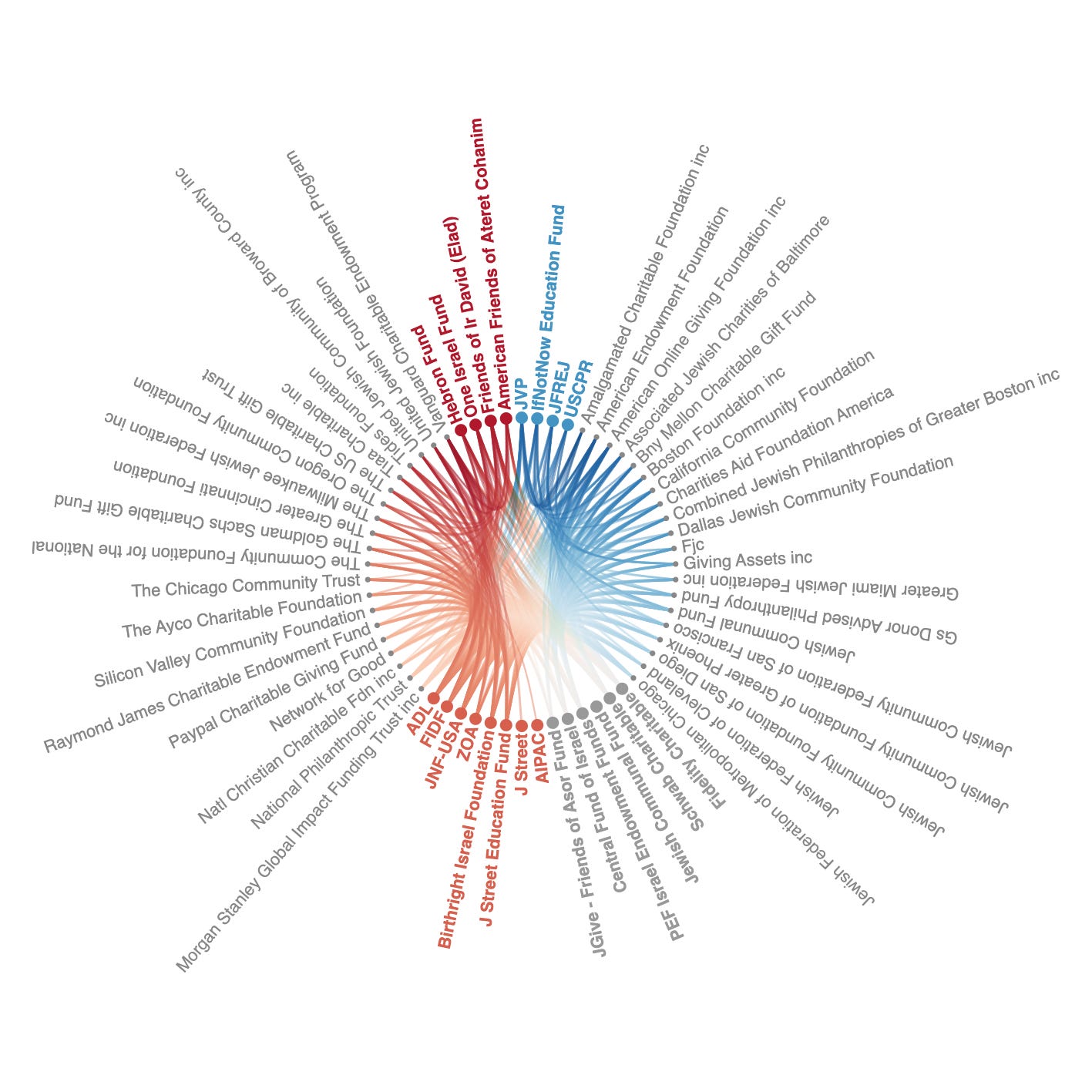
However, it’s one thing for a local food pantry or day school to stay silent — those organizations aren’t responsible for building a liberation movement, and their dependency on Federation funding makes their silence, if not forgivable, at least legible. But the entanglement doesn’t stop at community institutions. The same donor-advised funds that route hundreds of millions to Birthright, the JNF, and Friends of the IDF — Fidelity Charitable, Schwab Charitable, Vanguard, the Jewish Communal Fund — also fund JVP, IfNotNow, USCPR, and JFREJ. The organizations that are supposed to be challenging the pipeline are receiving money through it.
Taking a small sample from our dataset, we find that 257 funders give to two or more of these categories. Of those, 36 fund both Palestine solidarity and zionist/settler organizations simultaneously. Those 36 directed $284,167,856 (96.0%) to zionist and settler organizations and $11,719,521 (4.0%) to solidarity groups. In this subset of data, that is a ratio of $24.2 to every $1.
Nearly every shared funder tilts 90% or more toward the zionist side. Fidelity Charitable, Schwab Charitable, the Jewish Communal Fund, and Vanguard route 93–99% of their cross-category grants to zionist organizations. Palestine solidarity groups are structurally dependent on the same financial infrastructure that overwhelmingly funds the networks they exist to oppose.
The big NGOs aren’t just going to decouple from their financial lifeline. In fact, we met years ago with a coalition of D.C.-based NGO types who explicitly said they would not engage in such a campaign because it could put their own organizations at risk of losing their nonprofit licenses. And it goes without saying, the IRS will not fix this. It is an unelected bureaucracy with no political incentive to act, and it has revoked the tax-exempt status of exactly zero major Israel-linked organizations despite decades of documented compliance issues. Compare that to Canada, where the grassroots pressure forced the Revenue Agency to revoke JNF Canada’s charitable status in August 2024 after finding it funded military base construction and failed to control how donations were used in Israel. That was a CAD $241 million operation, shut down by small formations working collectively.
In the US, there is a strategic opportunity with the State Attorneys General. Unlike the IRS, they are elected. They face voters who can hold them accountable and force them to use their power to regulate state-registered nonprofits under their administration. New York AG Letitia James sued the Trump Foundation into dissolution and brought the NRA to trial under the same Executive Law §63(12) that could apply to organizations misrepresenting their charitable activities to New York donors. An AG investigation does not require congressional approval. It requires political will, and political will responds to organized constituents, public pressure, and donor scrutiny. That is a lever grassroots movements can pull. You cannot vote out the IRS commissioner. You can vote out an Attorney General, and they know it.
The violence across the West Bank, the settler attacks, and the home demolitions do not sustain themselves. It requires funding, and a significant share of that funding runs through the US tax-exempt charitable system. Every dollar that moves through a “friends of” organization to an Israeli entity operating in the West Bank, the Naqab, the Golan Heights, carries a US tax subsidy with it. US taxpayers are underwriting this, whether they know it or not.
Defund Racism is building the empirical infrastructure to change that. Our open-source database tracks the money: who gives, who receives, how much, and where it goes. The pipeline from US donors to West Bank settlements is not hidden. It is filed with the IRS every year, in black and white.
The campaign is rebooting, and when it launches, the scale of what we’re building will require a network to match. Sign up for email updates at goodshepherdcollective.org, subscribe to The Call on Substack, and follow @Shepherds4Good on social media. We need to be connected before the moment arrives … not after.