


Price Overview
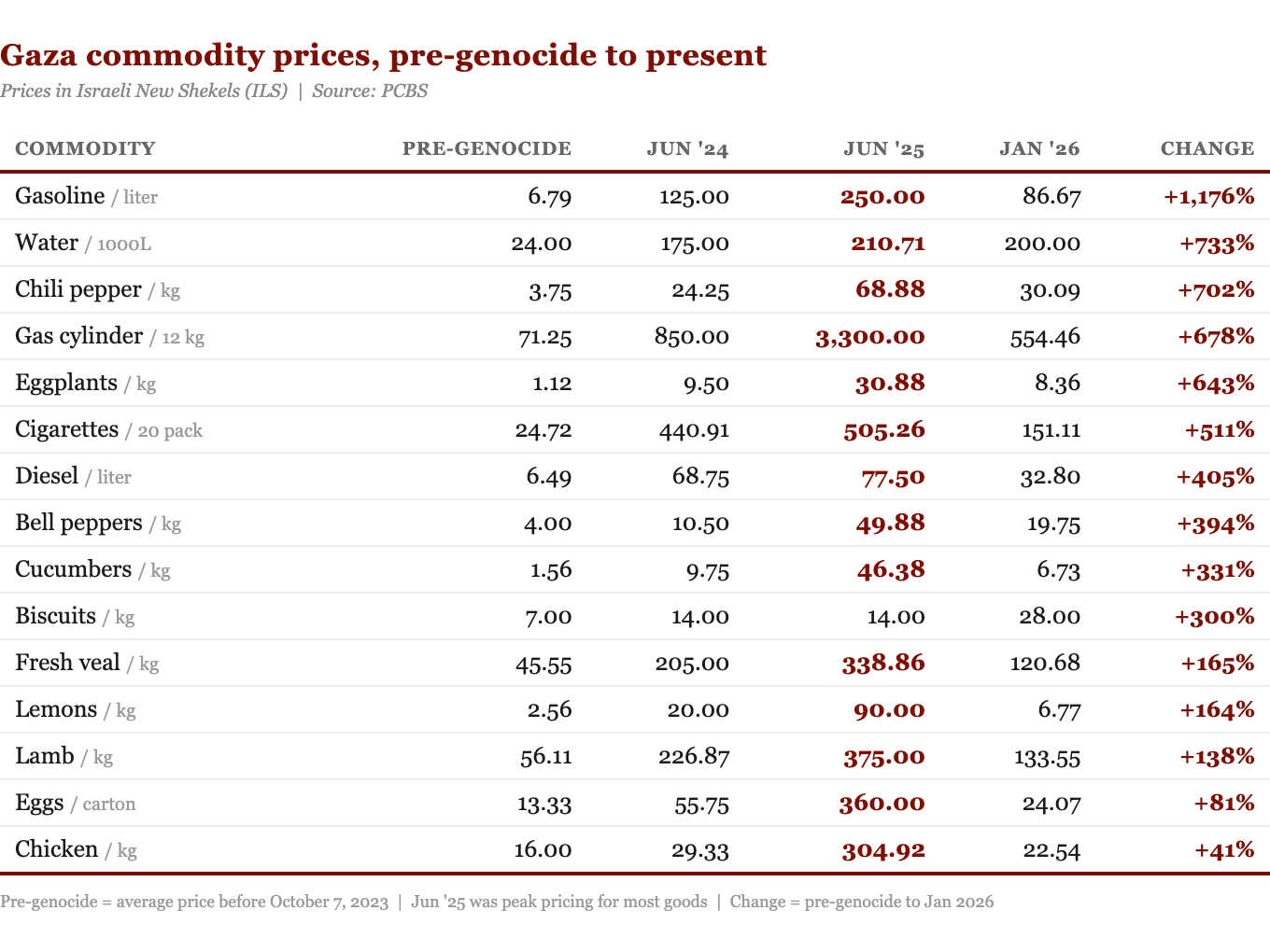
As of January 2026, the most recent data available from the Palestinian Central Bureau of Statistics (PCBS), commodity prices across Gaza have risen by an average of 216% since October 7, 2023, across the 42 goods tracked. The median rise is 116%. Fresh produce and protein took the worst of it. Bell peppers cost 394% more than before the war. Cucumbers are up 331%. Veal has risen 165%, lamb 138%, lemons 164%. Flour, rice, bread, and cooking oil have actually fallen below their pre-war prices, down an average of 21%, but that is a handful of items against dozens that have doubled or worse. A lot of families were already unable to afford these goods at their pre-war prices. At current levels, the market functions for almost no one.
The comparison to prices elsewhere makes the scale clearer. Apples in Gaza cost 2.8 times the EU average. Rice and onions are both double the price of the EU average.. Some cheese products sell at nearly twice the US price. Some items have dropped below international averages since the ceasefire, but the population has no employment and no functioning economy. Even reduced prices are out of reach. People skip meals or they eat less, and the data illustrates that this is by design.
Costs of travel
Gasoline has gone up 1,176% in price since October 2023. It was 6.79 ILS per liter. Now it is 86.67 ILS for the same amount. Diesel is up 405%, from 6.49 to 32.80 ILS. A 12-kilogram gas cylinder, the kind most households use for cooking, went from 71.25 to 554.46 ILS. That is a 678% increase. A bottle of mineral water has doubled. Reading the PCBS statistics paints a grim picture of people entrapped.
Passenger travel from northern Gaza to the center costs 10 ILS per trip now, up from 4 ILS before the war. North to south travel is 18 ILS, up from 8 for shared transport. On paper these look like small numbers, but families who were forced from their homes and have no income cannot afford these fares. They cannot travel back to check on their property. They cannot begin to rebuild. The fuel and transport prices keep them where they were displaced. At 554.46 ILS for a gas cylinder, cooking fuel alone costs more than most families bring in during a week, so communities rely on shared cooking infrastructure and supplies, which families might not have access to if they return to their homes. As a result, they remain where they are and wait for aid because there is no better option. Movement costs money. Staying put may be less costly, in a sense. The manufactured pricing does the work of a checkpoint without requiring a single soldier.
But when prices aren’t enough, controlling the population by use of force is just as readily deployed. Since the ceasefire took effect, Israeli forces have killed 574 Palestinians and injured 1,518 others in Gaza, according to a February 6 report by the Ministry of Health. In the last weekly reporting period alone, 82 Palestinians were killed and 162 wounded. This means that when prices aren’t restricting movement, US-supplied munitions and Israeli soldiers are enacting waves of violence to ensure population control.
Prices since the so-called “ceasefire”
Since the ceasefire in October 2025, 38 of 46 tracked commodities have fallen in price, by an average of 56%. The median decline is 51%. Eggs dropped 96%, from 600 ILS to 24 ILS. The price of chicken fell 77%. Potatoes fell by 77%, and onions fell by 85%. Gasoline went from 250 ILS per liter to 86.67, a 65% decline. Passenger travel from north to center dropped from 100 ILS to 10 ILS.
Eight commodities still rose. Gas cylinders went up another 19%. Biscuits doubled. Cigarettes jumped 63% to 138%. Baby milk powder rose 50%. Despite this, the overall direction is clear: once goods started crossing the border in volume, prices collapsed. That is the strongest evidence of what drove them up in the first place.
The month-to-month numbers tell the same story: between December 2025 and January 2026, rice nearly doubled from 3.27 to 6.27 ILS per kilogram. Bread went up 20%. But eggs continued to fall, and flour dropped another 34%. Prices spike when crossings close or when goods are blocked from entering, and drop when aid is allowed to enter the besieged Strip. The supply of food into Gaza is controlled at the border, by Israeli state forces, and prices inside correspond to what is allowed through. When you control what enters, you control what things cost.
Control of Aid
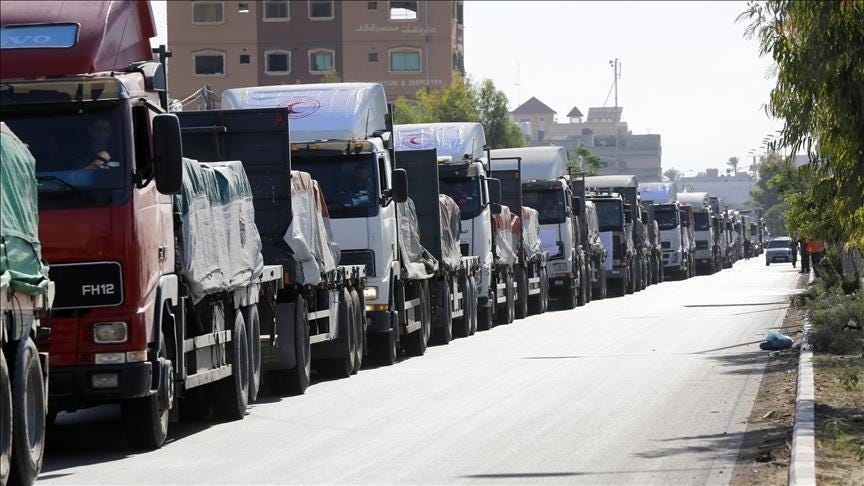
In the last 30 days, 34,706 metric tons of aid arrived at Gaza crossings on 2,354 trucks. That is 1,335 metric tons per day. No interceptions were recorded, which is an improvement over the 0.9% interception rate across the full post-ceasefire period. Israel controls the aid.
Since the ceasefire began on October 10, 2025, total deliveries have reached 207,964 metric tons on 15,593 trucks. Still, the daily rate is falling. The post-ceasefire average was 1,733 metric tons per day; over the last 30 days it has dropped to 1,335. Food deliveries fell 27%, from 1,408 to 1,020 metric tons per day. Sheltering materials rose 15%.
Food makes up 76% of what comes in. Sheltering materials is 10.7%, water and sanitation 4.7%, health supplies 2.5%. No solid fuel was allowed to enter Gaza in the last 30 days. Zero. Gas cylinder prices inside Gaza are up nearly sevenfold, and nothing is arriving through aid channels to offset that. Families either pay black-market rates for cooking fuel or they go without.
Aid is still getting through, but less of it, and in fewer categories. Education materials have dropped 75% compared to the post-ceasefire average. If daily volumes keep falling, the modest price relief on some staples will not hold. The aid pipeline and the commodity market are the same system. What crosses the border sets the price. What does not cross the border sets it higher.
The data leaves little room for interpretation. When crossings open, prices fall. When they close, prices spike. Eggs that cost 600 ILS under blockade dropped to 24 ILS once aid flowed. Gasoline that hit 250 ILS per liter fell to 87 when trucks were allowed through. The market is not broken — it is controlled. Every commodity price in Gaza is a direct function of what Israel permits to cross the border, and the sustained collapse of purchasing power across the Strip is not a byproduct of war, it is a policy outcome. Families cannot move, cannot cook, cannot feed their children at these prices — and that is precisely the point. The ceasefire proved what drives the crisis: not scarcity, but obstruction. As aid volumes now decline again, the question is not whether prices will rise, but whether the international community will continue to watch a population be starved by a couple of zionists working a spreadsheet.