

The Silence is the Point
Mohammed Ibrahim and the children the US and Israel tried to make us forget


Mohammed Ibrahim’s imprisonment and torture by the Israeli state lay bare not just Zionism’s systematic brutalization of Palestinian children, but a darker truth: this violence meets silence because it is not foreign to US culture — it is embedded within it.
Ibrahim, a 15-year-old Palestinian American from Florida, was abducted in February from his family home near Ramallah. He was blindfolded and beaten during the raid, denied all family contact and visitation, lost significant weight, and contracted a skin infection while imprisoned. His release came only after nine months and a pressure campaign involving a meager 27 US lawmakers. That an American citizen child required congressional intervention to escape abuse in Israeli detention. At the same time, US consulate officials failed to make any physical review of his status throughout the entirety of his imprisonment, revealing how deeply normalized such treatment is within the United States and Israel.
The US government doesn’t hold the Israeli state to account over its treatment of Palestinian children, in part, because it animates identical policies at home. Over 100 US citizen children were left stranded by ICE enforcement actions in 2025, including a 15-year-old left alone with his two younger brothers (ages 8 and 9) after their mother was deported to Mexico just three days after being arrested. In April, ICE deported three US citizen children, ages 2, 4, and 7, after holding families incommunicado; one child suffering from metastatic cancer was deported without medication or access to treating physicians. ICE has sent over 600 immigrant children into federal detention shelters in 2025 — a new record — with around 140 still languishing in the system as of November. Whether in Ramallah or New York, the pattern is consistent: family separation, denial of due process, medical neglect, and the weaponization of children as tools of state policy. Against this backdrop, US silence on Israel’s systematic abuse of Palestinian children is not a contradiction but a coherence: the same capitalist logic that justifies child detention in Louisiana justifies it in occupied Palestine.
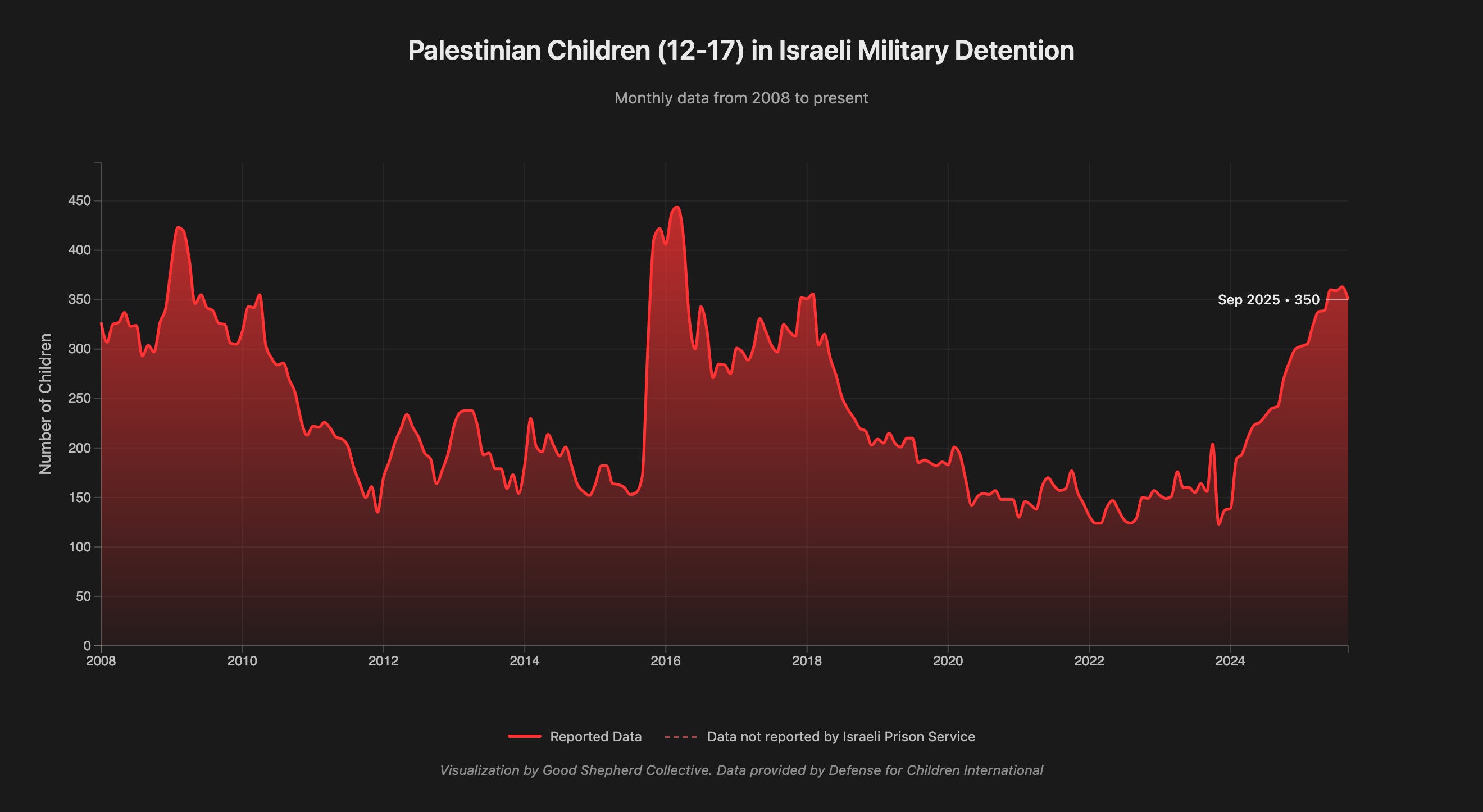
The broader zionist movement has maintained a continuous practice of detaining Palestinian children from the West Bank, Gaza, and East Jerusalem. Monthly data compiled from the Israel Prison Service reveals a troubling pattern: at no point in the past seventeen years has the number of detained Palestinian minors dropped to zero. The data tells a story of systematic incarceration that has now reached historic highs, with 350 children held in Israeli military detention as of September 2025.
An analysis of monthly detention figures reveals significant fluctuations tied to political events and military operations. The data begins in January 2008 with 327 Palestinian children in custody. Numbers peaked at 444 children in March 2016 during a period of heightened tensions, then gradually declined to a low of 123 children in November 2023. What followed, however, represents an unprecedented escalation.
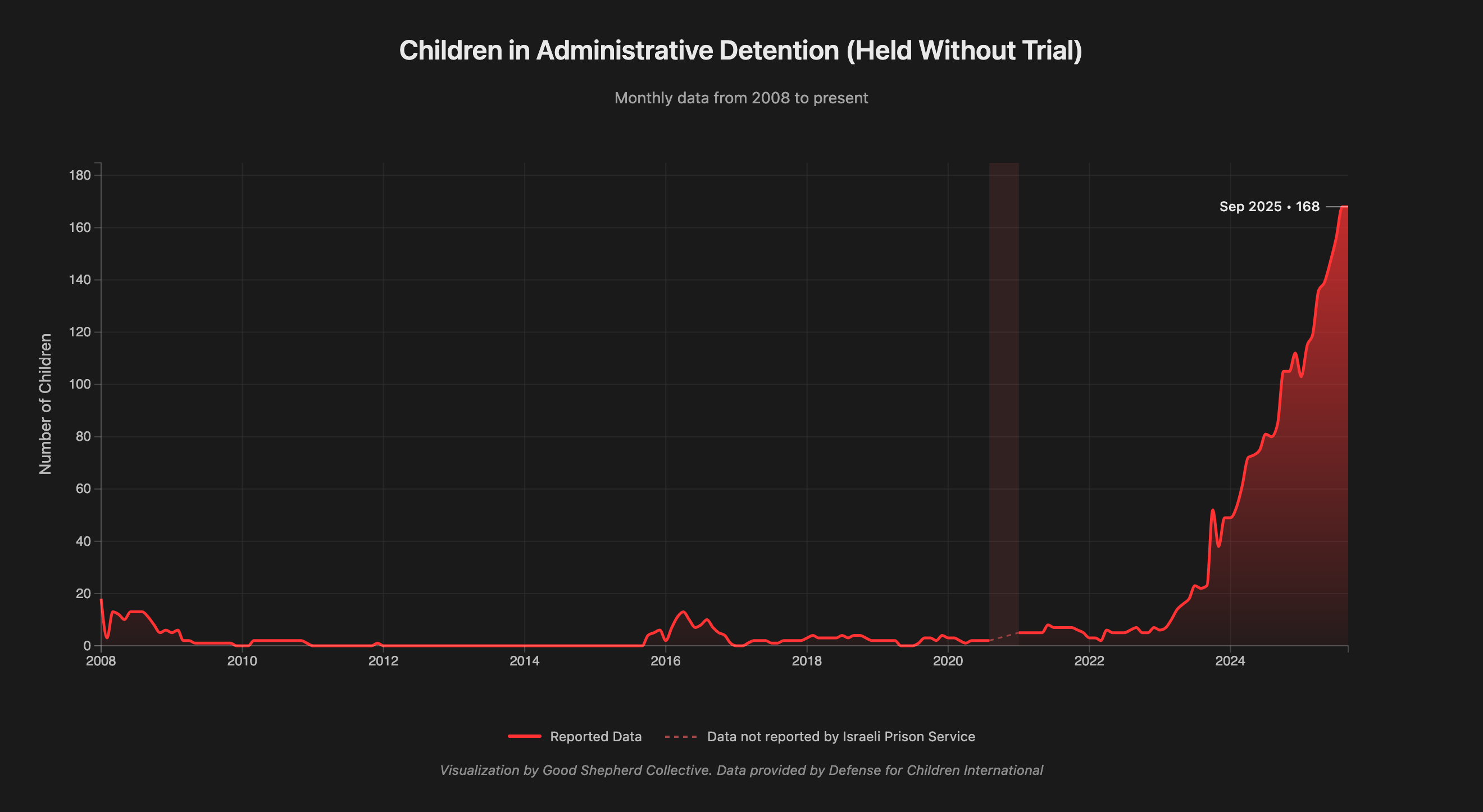
Following October 2023, detention numbers surged dramatically. From 204 children in October 2023, the figure climbed month after month: 287 by November 2024, 300 by December 2024, and continuing upward to 360 children by June 2025. The September 2025 figure of 350 detained children represents one of the highest totals in the dataset’s history. Equally concerning, data on children held under administrative detention (imprisonment without charge or trial) reached an all-time high of 112 children by December 2024, according to Defense for Children International-Palestine (DCIP).
Notably, portions of the dataset contain null values, particularly during late 2020. These gaps occur when the Israel Prison Service withholds data from public disclosure, a practice that human rights organizations and Palestinian community organizers and families have criticized as intentionally obstructing transparency and accountability — a practice of which the Israeli state has a long track record.
Understanding these figures requires recognizing a critical distinction: Palestinian children, as a matter of law, are not treated the same as Israeli children. Instead, Palestinian children in the West Bank, Jerusalem, and Gaza are prosecuted under Israeli military law (Military Order 1651), while Israeli children, including settlers living in the same geographic area, are protected by Israel’s civilian Youth Law. This dual system creates fundamentally different experiences of justice based on nationality.
Under the military system, Palestinian children can be held 8 days before seeing a judge, compared to 24 hours for Israeli minors in civilian courts. DCIP documentation shows that 97 percent of Palestinian children are interrogated without a parent present — a protection guaranteed to Israeli children. Legal counsel can be denied to Palestinian minors for up to 90 days, while Israeli children have the right to consult an attorney before questioning begins. The conviction rate in military courts exceeds 99 percent, and 98 percent of convicted children receive custodial sentences. By contrast, only 6.5 percent of Israeli minors processed through civilian courts receive prison time.
Perhaps most significantly, administrative detention, indefinite imprisonment without charge, trial, or disclosure of evidence, is regularly used against Palestinian children but never against Israeli minors. In March 2025, Israeli forces issued an administrative detention order against a 14-year-old, marking the youngest Palestinian child ever subjected to this practice.
A July 2024 report by Save the Children documented the treatment of over 650 children detained from the West Bank since October 2023. The findings were stark: 86 percent of children reported being beaten during detention, 69 percent were sexually assaulted. Children released from custody displayed physical signs of abuse, including bruises and significant weight loss. Since October 7, 2023, family visits have been completely banned, and the International Committee of the Red Cross has been barred from monitoring detention facilities.
By May 2025, DCIP reported that 37 percent of all detained Palestinian children were being held without any charges filed against them. The most common alleged offense is stone-throwing, which under military law can carry sentences of up to twenty years.
These policies exist within a broader context of Israeli public opinion. A June 2025 survey by Pew Research Center found that only 21 percent of Israeli adults believe Israel and a Palestinian state can coexist peacefully — the lowest figure since polling began in 2013. Among Jewish Israelis specifically, just 16 percent expressed belief in the possibility of peaceful coexistence. A separate May 2025 poll by the aChord Center at Hebrew University asked respondents whether they agreed that there are “no innocents” in Gaza. Among the total Israeli population, 64 percent agreed — nearly two out of three. However, this figure is weighted by Palestinian citizens of Israel, who comprise roughly 17 percent of Israel’s population. Among Jewish Israelis alone, agreement rose to 76 percent.
The detention of Palestinian children through military courts represents not an aberration but a structural feature of zionism. With the number of imprisoned children now reaching historic highs and conditions deteriorating severely, the seventeen-year dataset reflects a policy that has intensified rather than reformed under zionism — despite the billions of dollars poured into Israeli, Palestinian, and international NGOs. The dual legal system, military law for Palestinian children, civilian protections for Israeli children, is built on hundreds of years of Western colonial laws. As such, it is specifically designed to advance and uphold colonial control.