

UNSCR 2803: Peacewashing Settler Colonial Erasure in Palestine
The passing of such resolutions formalizes what Palestinians have known for generations.

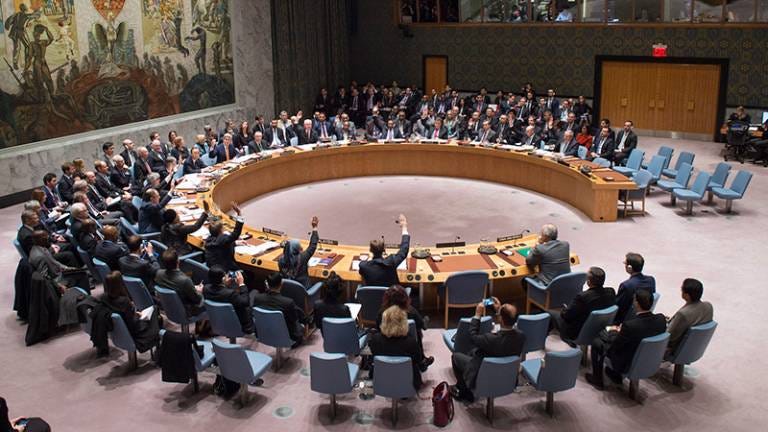
On November 29, the UN marks the International Day of Solidarity with the Palestinian People. Twelve days earlier it endorsed one of the most aggressive and unjust decisions in relation to Palestine and Palestinians. The United Nations Security Council passed a resolution (2803) which accepts the core architecture of the Trump plan for Gaza, including an international stabilization force (ISF). The establishment of this force gained significant media attention. For Palestinians and allies, there is no need to keep stating the obvious that this force has two goals: doing what the zionist entity has failed to do, mainly dismantling the resistance forces in Gaza, and secondly, having a stake in Gaza’s offshore natural gas (Hanieh, 2025). The passing of such resolutions formalizes what Palestinians have known for generations. International institutions are at the behest of a unipolar imperialist project, and no naive vote of confidence from Palestinians or allies will change this fact. These same institutions from the League of Nations Mandate, UN partition plan, occupation paradigm to Oslo have long treated Palestinian resistance as a pathology and Palestinian liberation as a threat.
Post Oslo Deradicalization
The most revealing part of the resolution is in the annex. The first point calls for de-radicalizing Gaza and creating an ‘anti-terror’ zone. This language mirrors the logic that has shaped US policy toward Palestinians since the Oslo period. This rhetoric proliferated in the global war on terror from which Palestine was not exempt. It assumes that Palestinian political consciousness is defective and that Palestinians, young and old, pose a security risk by default unless reshaped. The SC resolution does not address why the zionist entity that is committing a genocide against Palestinians has a role in this ‘peacekeeping’ model nor does it demand accountability from the same entity that has systematically killed, displaced, and starved an entire population. Instead, it claims that Palestinians need to be corrected. They need to be de-radicalized. They need to be policed.
Post- Oslo Dialogue Projects as Counterinsurgency
This rhetoric is a culmination of three decades of Western counterinsurgency strategy in Palestine (as is applicable elsewhere). After Oslo, the US invested heavily in what it called people-to-people dialogue projects (Hawari, 2022). These programs were packaged as grassroots efforts to humanise ‘both sides’. They promised to create trust and rebuild relationships between the coloniser and the colonised. In reality, they functioned as a civilian extension of the entity’s security doctrine. They asked Palestinians to participate in encounters that rendered the political situation abstract and proposed that dialogue and dialogical projects could resolve a context rooted in colonial erasure. They positioned Palestinians as the ones who needed to demonstrate openness to speak to ‘Israelis’ and learn that ‘coexistence’ with zionism is the only accepted outcome.
Groups like the Alliance for Middle East Peace, Seeds of Peace, EcoPeace, Combatants for Peace, among many others, became vehicles through which the US and European governments funnelled millions of dollars. The goal of such projects was never to dismantle the conditions that produce colonial violence against Palestinians in the first place. Rather, the goal was to socialize Palestinians into accepting zionism as an irreversible fact, as an unnegotiable permanence. Palestinian participation became a metric of success. Participation opened access to visas, travel opportunities, internships, and scholarships. Young Palestinians were recruited from refugee camps and universities, being told that dialogue was a form of empowerment, and that refusing to sit with Israelis revealed extremism and barbarity. The recent discourse surrounding Peter Beinart’s visit to Tel Aviv University, and his excuse of ‘it’s important to speak with Israelis,’ presents an example of the banality of dialogue in settler colonial contexts: that speaking to ‘Israelis’ will help change their ‘minds.’ However, what Beinart refuses to consider is that this is never a matter of ‘mindset’ but a settler class that cannot be divorced from their class without decolonization and dezionification. Perhaps the most disturbing element of the discourse was this argument by a Palestinian liberal NGO class that Beinart violated the PACBI rules on normalization, implying that he could simply ‘meet with Israelis’ without violating BDS. This rhetoric does not cut through the underlying issue here; that such rules, after two years of genocide, are simply too accommodating to zionism. Furthermore, they erase the structural reality underlying zionist settler-colonialism, wrongly placing the emphasis on changing individual opinions rather than undoing a system built on the ongoing dispossession and destruction of an entire people. A decolonial vision does not need rules of ‘encounter’ with zionism or settlers but requires a complete dismantlement of those material conditions and class altogether.
The assumption behind all this discourse around dialogue is deeply racist. It casts Palestinians as inherently violent, incapable of moderation, and unwilling to coexist. It creates a hierarchy in which Palestinians who resist zionism are dangerous, but those who choose to cohabitate with it are the ideal civil prototype; Palestinians who cooperate are reasonable and morally superior to those who reject zionism. The US invested in normalizing this rhetoric, accepted by the likes of Beinart, because it justified the broader political project of indoctrination globally and locally: that resistance is irrational while the colonial structure is ‘normal.’ Due to backlash, Beinart belatedly recognized that his Tel Aviv University visit was a mistake and issued an apology the very next day. Despite tarnishing everyone’s timeline, such an incident has opened a necessary conversation on normalization in a moment when the “highest legally binding body” has institutionalized a further degree of normalization at the service of imperial expansion.
Ghassan Kanafani captured the dangers of normalization incisively in his description of the conversation between the sword and the neck (Kanafani and Carleton, ABC 1970). The sword invites the neck to negotiate. The sword insists that the neck must be cooperative and reasonable. The sword dictates the terms and interprets any refusal as aggression. Kanafani’s point is that this arrangement is violent even before the blade cuts – negotiations or dialogue under settler colonialism are a political trap. They force the colonized to perform bureaucratized politeness and formalities in the face of systemic annihilation. UNSCR 2803 institutionalizes this pattern on a deeper international scale as it demands Palestinian compliance with a plan designed around Israeli security and Western capital, and Palestinian rights and self-determination are completely erased even on paper.
The Settler Class as Morally Diseased
The cruelty of the ‘de-radicalization’ framing became impossible to ignore as the genocide unfolded in Gaza. Two years of destruction finally exposed who actually needed de-radicalization, as Israeli society openly celebrated acts that should horrify any normal public. One example that captured this reality was the rape of a Palestinian detainee at Sde Teiman prison, carried out by Israeli soldiers and shared among them. Instead of being met with collective outrage (as performative as it was by the so-called Israeli left), the incident became part of the culture of impunity encouraged by the state. These celebrations were not aberrations of this society but reflected an entity shaped by decades of imperialist and Western-sanctioned impunity. Aimé Césaire defines such colonial society clearly. Colonization, he wrote, works not only on the colonized but also on the colonizer (Césaire, 2004). It produces a society that loses its moral bearings because violence becomes its organizing principle. Césaire wrote in Discourse on Colonialism:
No one colonizes innocently, that no one colonizes with impunity either; that a nation which colonizes, that a civilization which justifies colonization— and therefore force —is already a sick civilization, a civilization which is morally diseased.
Aime Cesaire, Discourse on Colonialism
The de-radicalization clause in the UNSCR 2803 is not required of this ‘civilisation which is morally diseased.’ The resolution treats Israeli violence, as distinct from settler violence (if it even recognizes it), rather as stable and manageable, and to a degree, necessary against Palestinian resistance. It treats Palestinian resistance as the primary obstacle to peace. It naturalizes the colonial structure and pathologizes the Indigenous response. The resolution does not ask how a population that has been bombarded, starved, and displaced should survive. It asks how that population can be pacified and made complacent with the new status quo.
Normalization as a Regional Endeavour
This international push for de-radicalization also mirrors regional developments. Normalization has become the dominant strategy in Arab capitals: the Camp David Accords removed Egypt from the Palestinian question, while the Jordanian peace treaty institutionalized security coordination and was part of a wider plan of internationalizing Israeli capital under the guise of “economic cooperation” and the “free market” (Hanieh, 2025). Afterwards, the Abraham Accords transformed normalization into a regional project (Calculli, 2025). As such, Gulf states and Morocco embraced diplomatic, economic, and security cooperation with Israel. They did this even as Palestinians faced genocide. It is important to note that the Abraham Accords are not a diplomatic endeavour but an economic one, exemplifying the notion of peace as capital flow and a free-market economy model.
The genocide made the consequences of this regional acquiescence more visible. Jordan facilitated trade routes that allowed Israel to maintain supply chains while Gaza was being starved (Bargash, 2025). Gulf states continued intelligence and economic cooperation. Morocco deepened its partnerships (Dupuy, 2025). These governments normalized not only Israel’s existence but also its violence against Palestinians. Palestinian survival became secondary to economic and geopolitical interests. The message to Palestinians was straightforward: you are expected to adapt to this new reality, to soften your politics and to accept zionism as a permanent regional fixture that “appears” to be useful for the economic interests of the Arab capitals.
From a Ceasefire Movement to a Liberation Movement
There is a growing recognition among Palestinians and their allies that the ‘ceasefire movement’ has reached its limits. A ceasefire that, even when Israel complies, preserves zionism as an unchallengeable structure is not a victory. It is a pause that leaves the central problem untouched. Palestinians are not demanding improved humanitarian conditions in Gaza, they are demanding the end of a political and economic system built on their erasure. The fundamental struggle is decolonization. The horizon is the dismantling of zionism from the river to the sea.
The UN cannot deliver this. It has never delivered this. Since the original sin of 1947 partition plan, the UN has validated the settler-colonization of Palestine. It has produced resolutions that affirm Palestinian rights while simultaneously endorsing frameworks that protect and normalize the colonial order. The contradiction became impossible to ignore. The UN celebrates Palestinian solidarity while approving a resolution that entrenches imperialist colonial violence. Palestinians do not need this oppressive solidarity. They need the world to reject the trusteeship logic that treats their land, their politics, and their future as an international project rather than anti-colonial indigenous people’s right. Palestinians are not extreme for refusing normalization with zionism or refusing zionism’s permanence. Palestinians are simply refusing to participate in the conversation between the sword and the neck.
We are in a period of global realignment. The genocide shattered the illusion that the existing frameworks can produce justice. The task now is to organize around a political project that rejects normalization and rejects zionism as the regional order of Western imperialist project. The goal is the liberation of the full 27,027 km² from the river to the sea — every single inch.
Bibliography:
ABC (1970) ‘Ghassan Kanafani, Richard Carleton interview’. Available on Youtube.
Bargash, M. (2025) ‘Energy, Water and the Cost of Jordan’s Dependence on Israel’, Middle East Research and Information Project, 20 October. Available at: https://www.merip.org/2025/10/energy-water-and-the-cost-of-jordans-dependence-on-israel/.
Calculli, M. (2025) ‘The Banality of Normalisation: The Desecuritisation of Israel’s Aggrandisement in the Middle East’, The International Spectator, 0(0), pp. 1–22. Available at: https://doi.org/10.1080/03932729.2025.2573168.
Césaire, A. (2004) ‘Discourse on Colonialism’, in Postcolonlsm. Routledge.
Dupuy, C. (2025) ‘Fuelling the “machinery of genocide”: Morocco’s backdoor support for Israel’s war on Gaza | Middle East Eye’, 7 January. Available at: https://www.middleeasteye.net/news/morocco-support-israel-military-equipment-war-gaza (Accessed: 27 November 2025).
Hanieh, A. (2025) ‘The Middle East and Fossil Capitalism: Oil, Militarism and the Global Order’, CADTM [Preprint]. Available at: https://www.cadtm.org/The-Middle-East-and-Fossil-Capitalism-Oil-Militarism-and-the-Global-Order (Accessed: 28 November 2025).
Hawari, Y. (2022) ‘People-to-People Projects: Relinquishing Israeli Accountability’, Al-Shabaka, 22 January. Available at: https://al-shabaka.org/briefs/the-revival-of-people-to-people-projects-relinquishing-israeli-accountability/ (Accessed: 22 January 2022).
United Nations Security Council (UNSC) Resolution 2803, UNSC/RES/2803 (17 November 2025). https://docs.un.org/en/S/RES/2803(2025)