

With US funding, Hebron squatters advance on Old City
Israel strips Hebron’s planning powers from the Palestinian municipality, then uses them to expand existing squatter communities.


Planning power, taken and used
The money that builds the structures of Palestinian dispossession in Hebron travels through a system built so it can’t be followed. On the Israeli side, one of the settlement’s main vehicles, the Zionist organization named Renewal of the Jewish Community in Hebron, reports a single revenue line and a single aggregate figure for “donations from abroad”. No donor is named. About 5.77 million shekels arrive from somewhere overseas, and the paperwork stops there. On the US side, the foundations sending it write “Foreign Grant, Middle East” on Schedule F of their 990s, naming a region instead of a recipient. In this way, a double blind spot exists: US donors don’t explicitly report where the money goes, and the Israeli recipients don’t disclose where it comes from.
That is the limit of the data. It gives you amounts and years, never the line connecting one to the other, and the Israeli figures lag because amended filings rarely reach GuideStar. What can be measured is the scale of a single conduit. The Hebron Fund (EIN 11-2623719, Brooklyn) reported $4.17 million in revenue in 2023 and roughly $29.4 million across 2011 to 2023 — tax-deductible US money raised to underwrite a radical, violent enclave of thousands of settlers planted inside a Palestinian city of hundreds of thousands. The money flowing through the US system has given it the power to wage a war to dismantle the international law that has governed Hebron since the Oslo Accords, for better or worse.
On June 10th, Israel’s Higher Planning Council of the Civil Administration stripped the Palestinian Municipality of Hebron of planning and building authority over Israeli settlement properties and several religious sites, with the Ibrahimi Mosque in the Old City of Hebron among them. The decision implements a February 2026 cabinet resolution (No. B/229) and unwinds the 1997 Hebron Protocol, under which Israel kept security control of the H2 area while planning remained in the hands of the Palestinian municipality (at least in theory). Finance Minister Bezalel Smotrich described the June 10th decision as the cancellation of the Hebron Agreement; the Foreign Ministry denied that it was such a drastic move. Authority now follows population rather than territory. Permits for settlers route through the Civil Administration; permits for Palestinians on the same streets stay with the municipality.
A week later, the Council used the power it had taken. On June 17, it approved a permit for two new floors, 1,027 square meters, above Valero House on al-Shalalah Street — a dormitory for the Shavei Hevron yeshiva. Settlers entered that building in September 2025, after the state allocated it to the yeshiva. Al-Shalalah is one of the few ways Palestinians have into the Old City since the army closed al-Shuhada Street to them, and a larger settlement there raises the prospect that this route will close too.
576 more units
The same session advanced 576 housing units, in Elmatan and Mitzpe Jericho — following the 2,414 units it approved on June 3 — bringing the Council’s 2026 total for settlement housing unit approvals to 6,808. Next to the Elmatan plan, in Wadi Qana, was the Palestinian community of Arab al-Khuli. Its last residents were displaced in February; in May, settlers demolished what was left.
A last appeal in Silwan
In Jerusalem, the Israeli Supreme Court rejected the Sarhan family’s request for leave to appeal, thereby ending their remaining options to challenge their eviction from Batan al-Hawa. About twelve households, dozens of people, could be removed within months in favor of settlers affiliated with Ateret Cohanim — one of the Zionist NGOs that is financed through the US non-profit system. The family bought the land in 1961 under Jordanian rule and built on it. The claim against them rests on a 1970 law that lets Jews recover property lost in East Jerusalem in 1948 while denying Palestinians who lost property the same right. Over the past two years, settlers have moved into eight homes in the neighborhood, from which roughly 130 residents from 26 families were evicted, most recently in March; around 60 families there are now at risk of eviction as part of the wider campaign.
On the Hill
This week’s bills in Washington, D.C. moved on free speech with the intent to restrict resistance to imperialism. The Jewish American Security Act (HR 9211, companion to S. 4576) would expand federal antisemitism programs, with findings that echo the IHRA framing under which much criticism of Israel is treated as antisemitism. A separate bill (HR 9254) would strip the Southern Poverty Law Center of its tax exemption. During an eleven-hour markup of HR 9087, Representative Lawler withdrew an amendment that would have revived the IGO Anti-Boycott Act — extending federal anti-boycott penalties to boycotts promoted by international organizations such as the UN — after public objection.
Recent military orders
Four military orders, each shown by a photograph of the document itself, were served across the West Bank between 14 and 18 June 2026. There are three stop-work and demolition orders: one in the Qanan Nyas area of Ash-Sheikh and one in Bireen, both east of Hebron, and a third affixed to a half-built structure in the Bir al-Majaz / Bardala area of the northern Jordan Valley. The fourth seizes land at Raba, southeast of Jenin. The Israeli military orders run from the southern Hebron hills to the Jordan Valley, all issued to effectively strip the indigenous people of their lands.
Qanan Nyas / Ash-Sheikh, northeast of Hebron
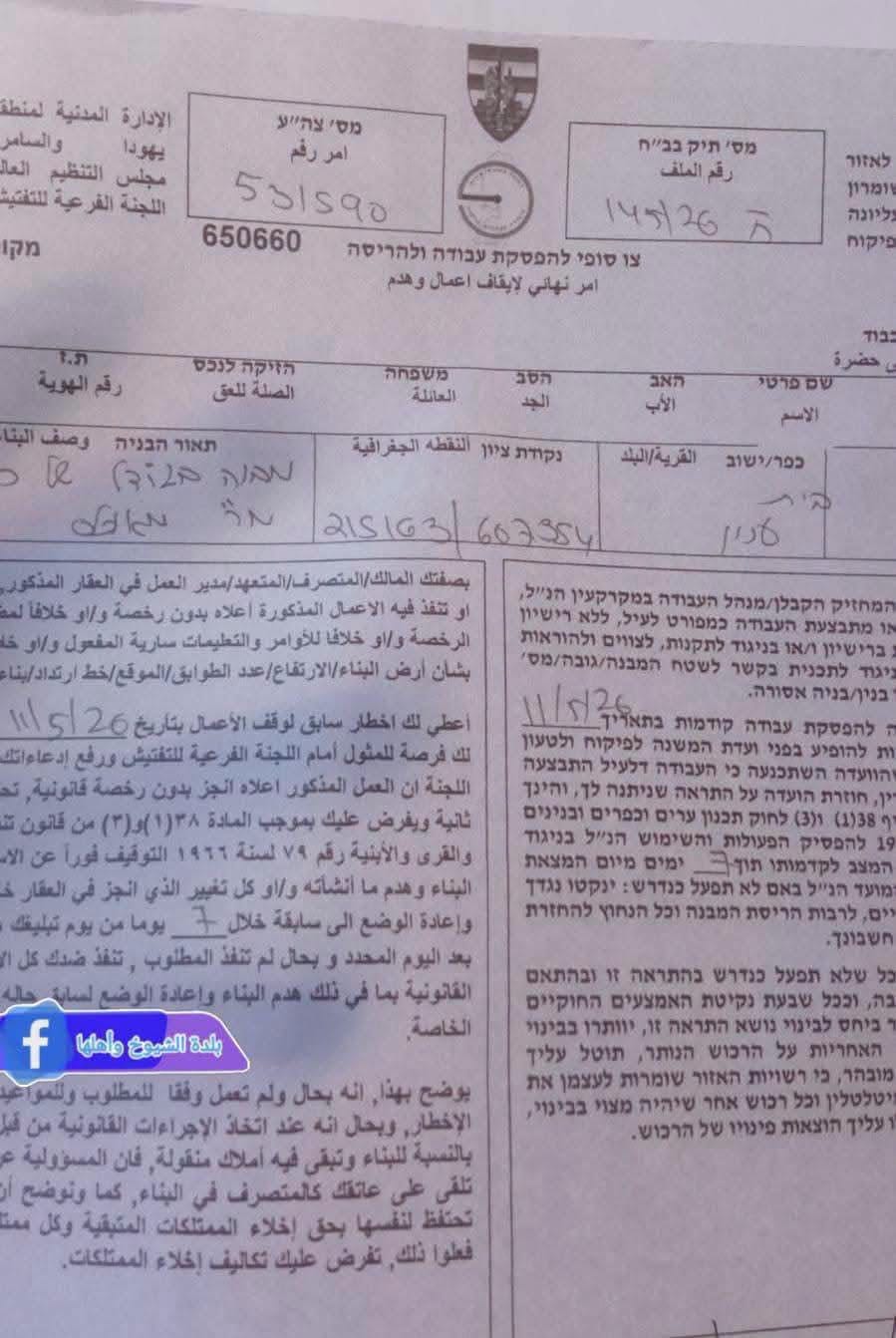
Final stop-work and demolition order served in the Qanan Nyas area of Ash-Sheikh, northeast of Hebron, June 18, 2026.
Raba, southeast of Jenin
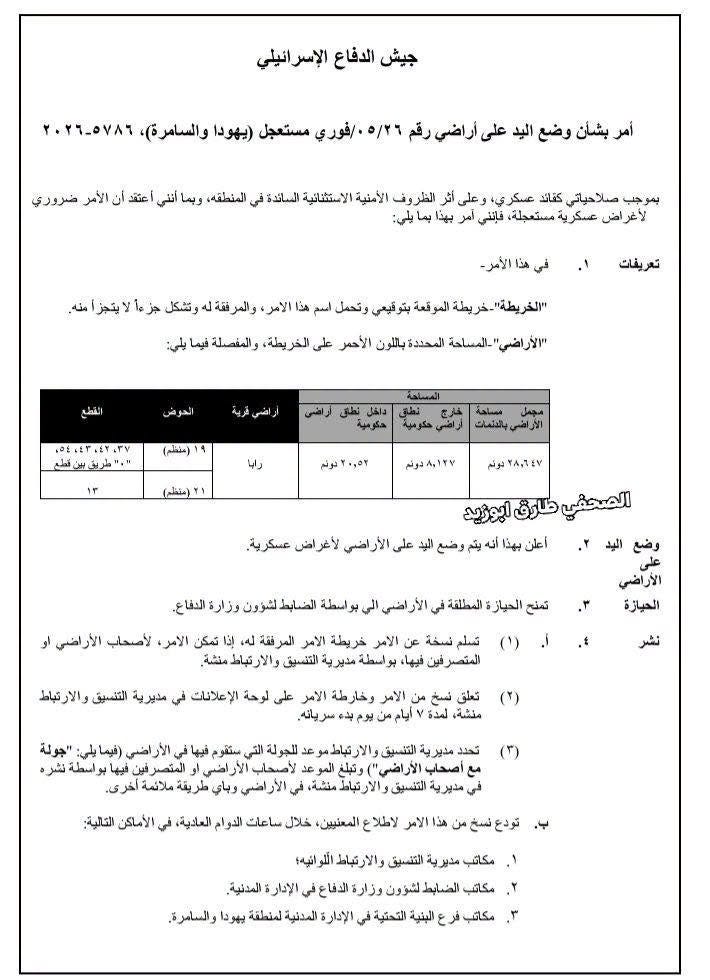
Israeli military land-seizure order covering land at Raba, southeast of Jenin, served around June 15, 2026.
Bireen, east of Hebron
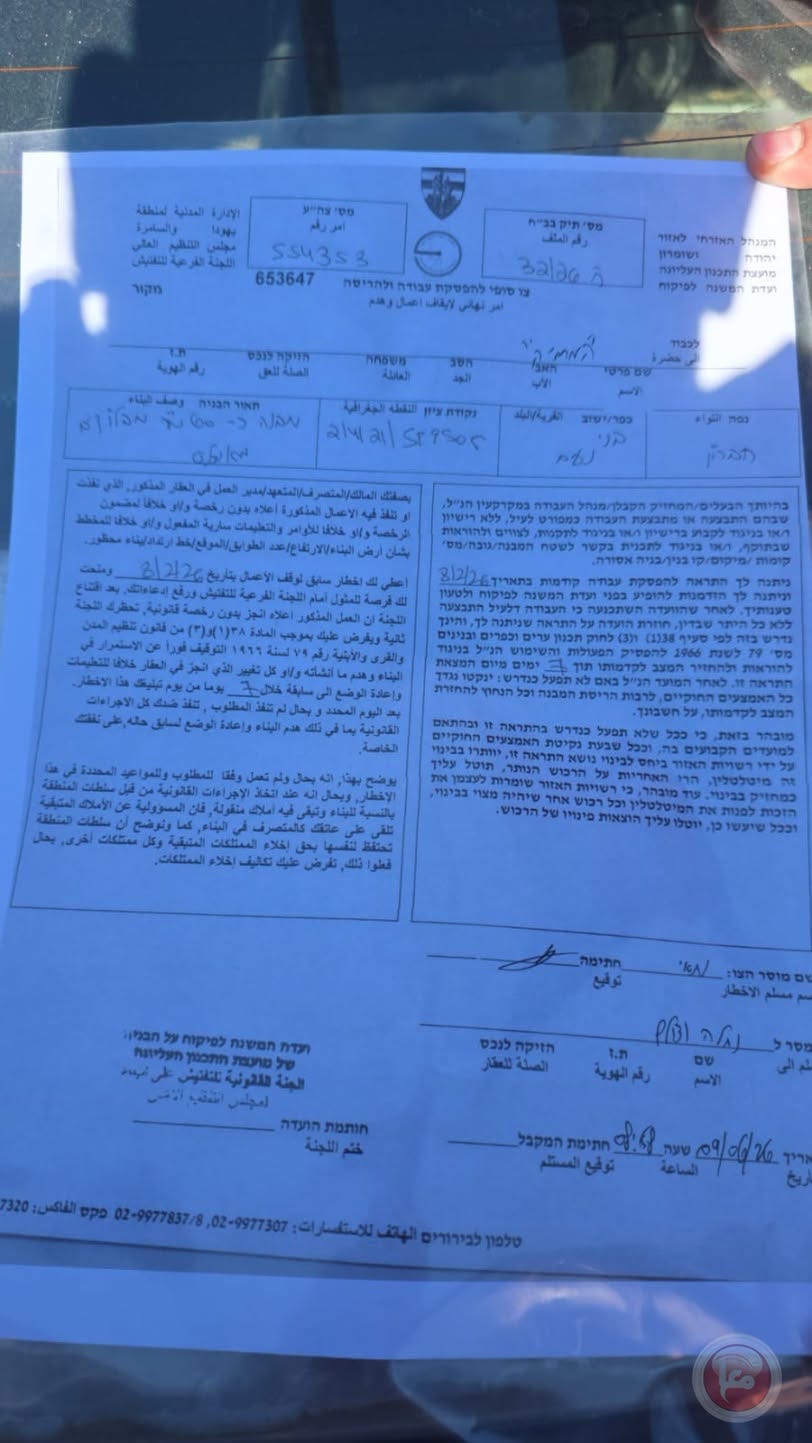
Civil Administration stop-work and demolition orders were served in Bireen, east of Hebron, on June 14, 2026.
Bir al-Majaz / Bardala, northern Jordan Valley
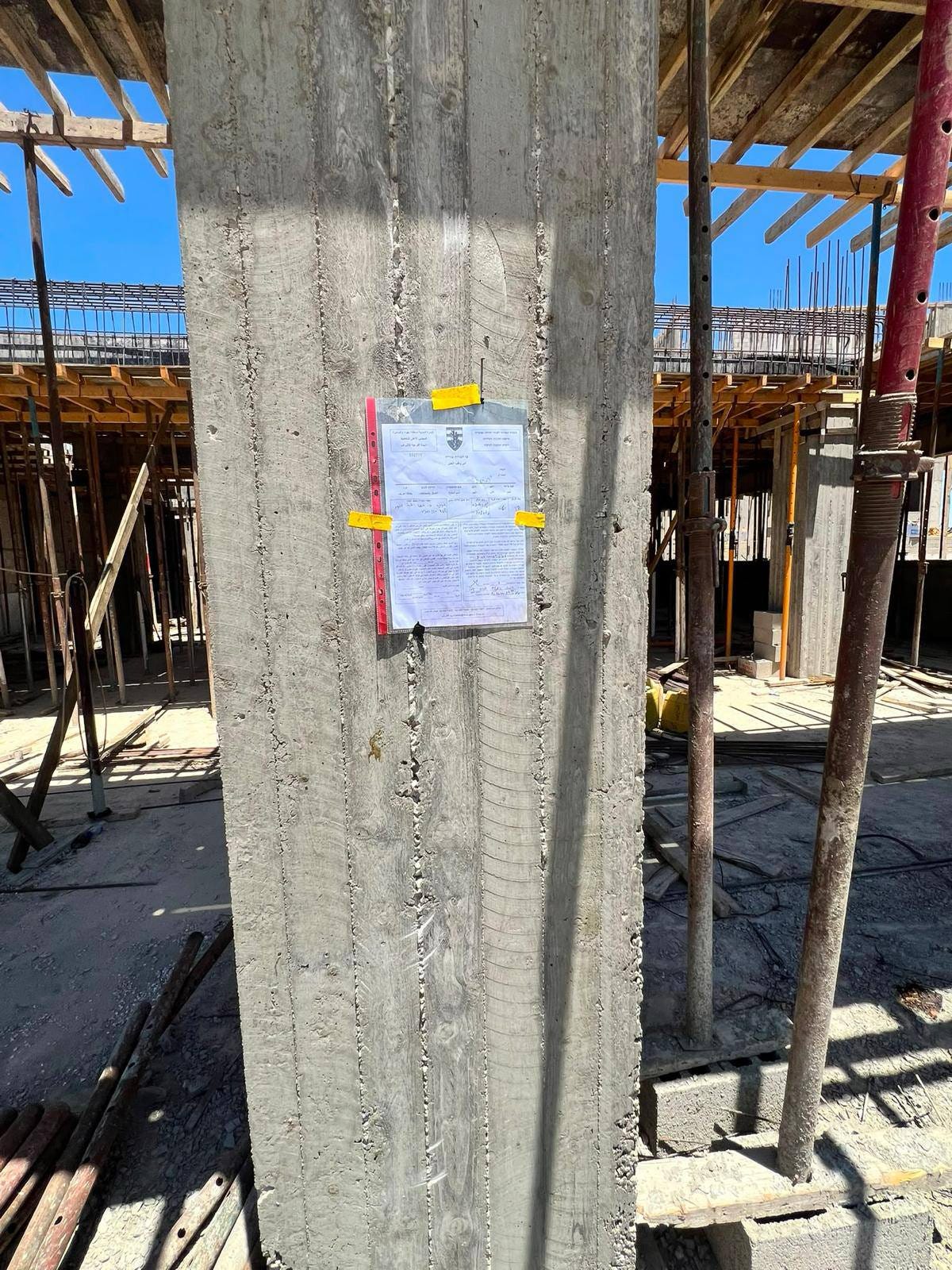
Civil Administration order posted on a structure under construction in the Bir al-Majaz / Bardala area of the northern Jordan Valley, June 14, 2026.
Demolitions this week
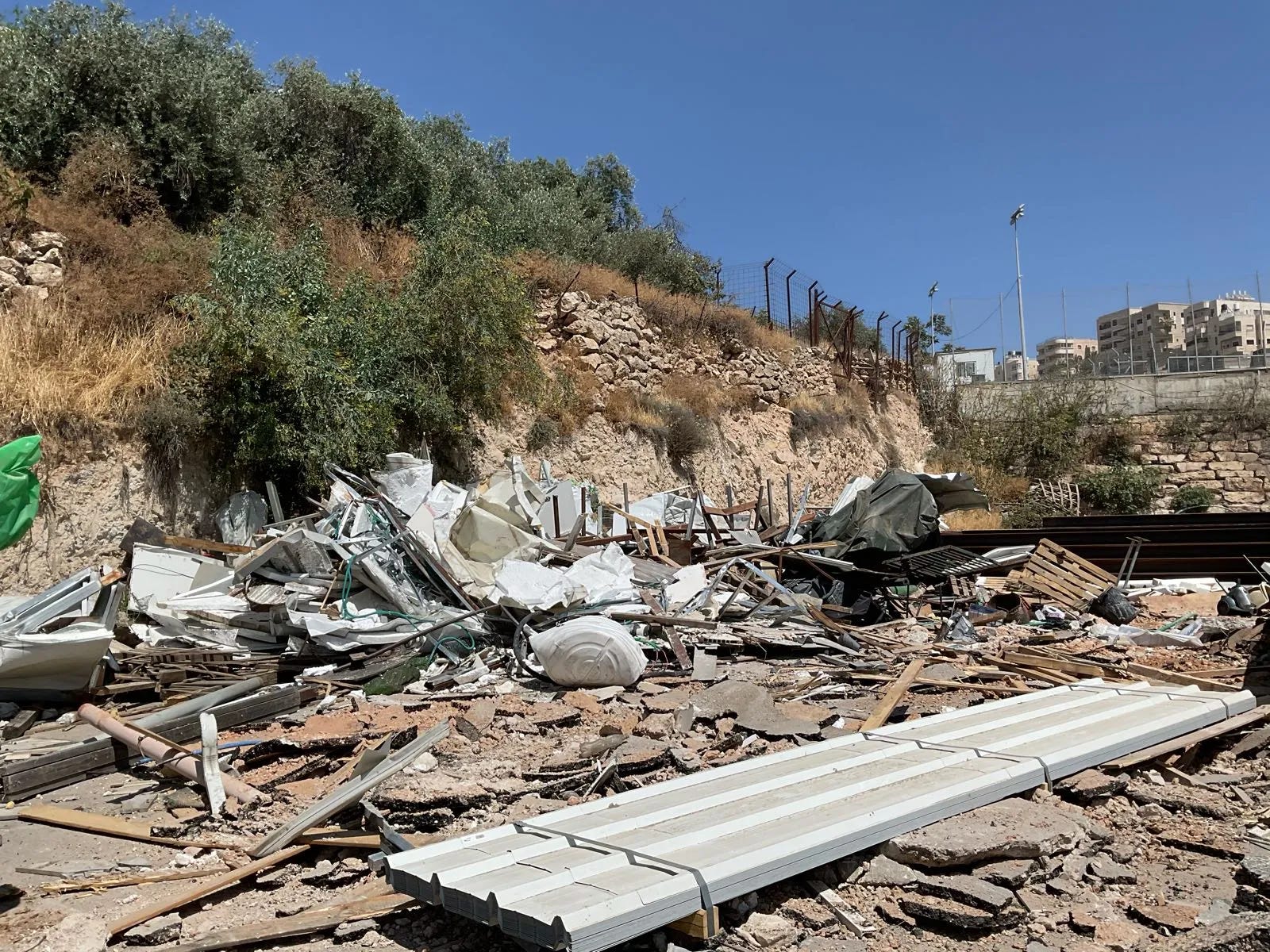
Jabal al Mukabbir, Jerusalem (June 11): The municipality and Israeli forces demolished a steel and construction-materials factory built in 2011 on about five dunams, citing a lack of permit; it had employed roughly 10 workers.
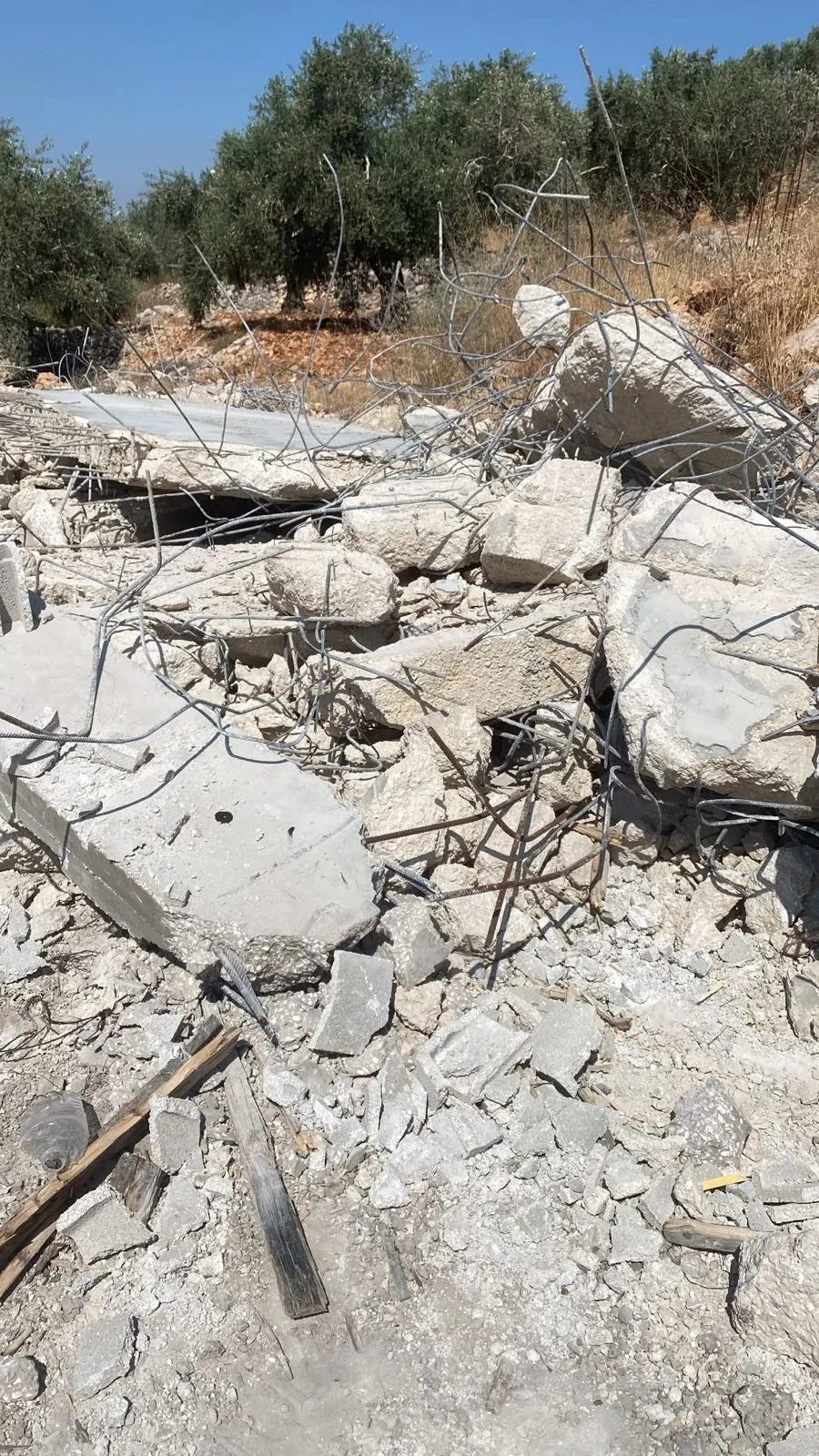
Kafr ad Dik, Salfit (June 11): The Civil Administration demolished two under-construction structures — a 60-cubic-meter water cistern and the footings of a home — and a retaining wall, citing the absence of permits. It belonged to a Palestinian family of six.
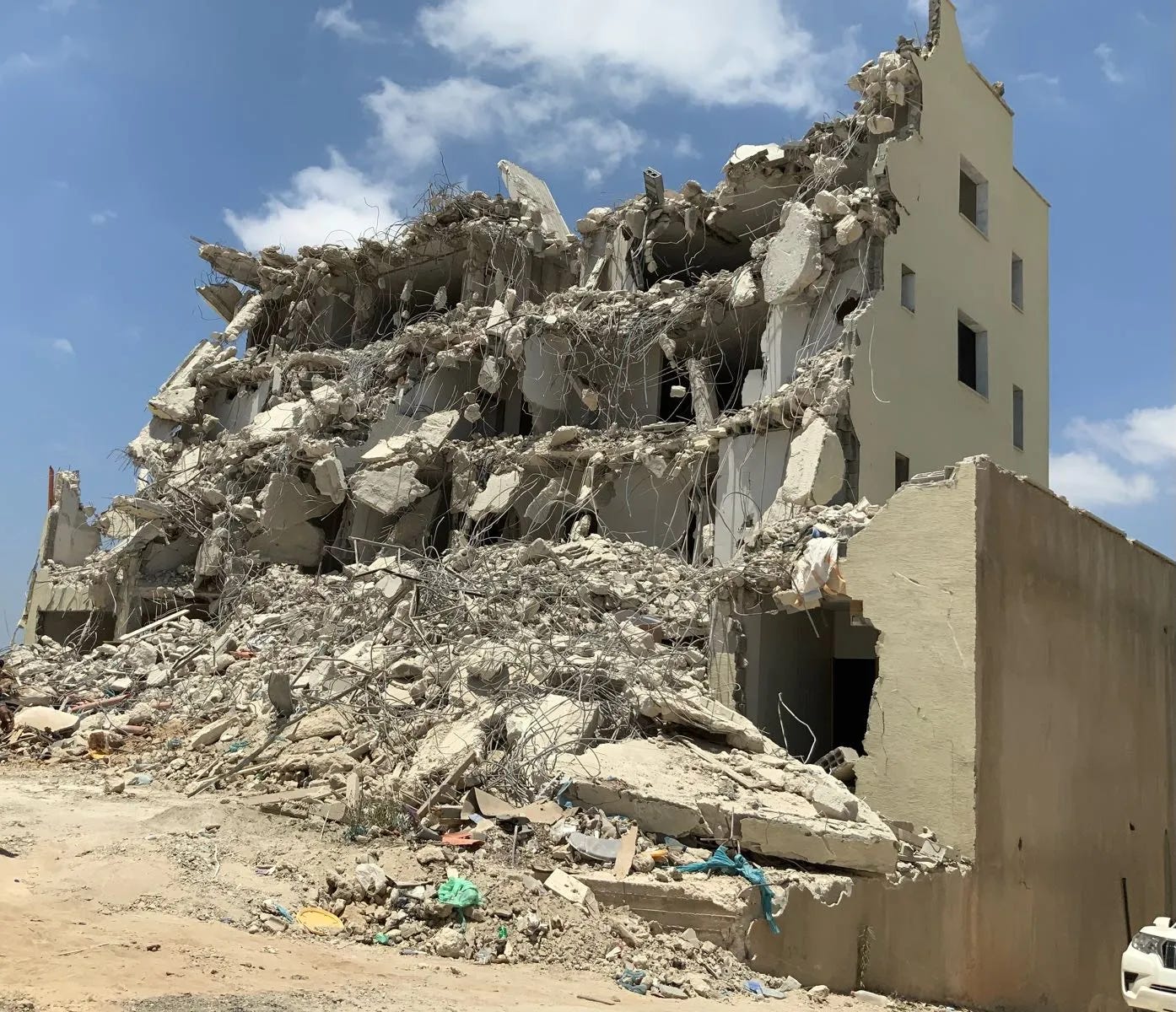
Barta’a ash Sharqiya, Jenin (June 14): Six concrete structures were demolished for lack of permits, displacing eight people and affecting 51 more; one finished home had been readied for a couple due to marry in August.
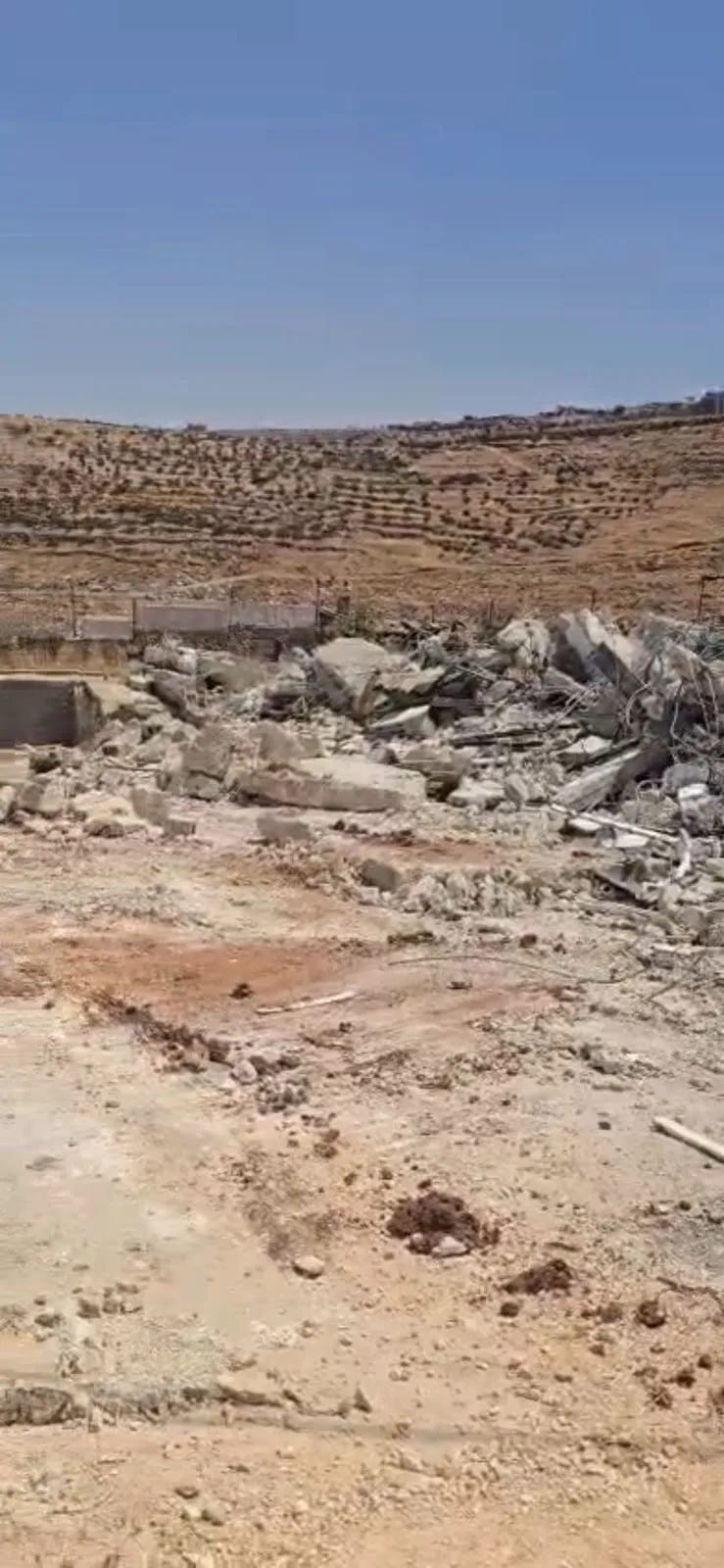
Duma, Nablus (June 14): A two-story family gathering facility with a pool and cistern was demolished in Area C for lack of a permit, affecting two families who jointly owned it.
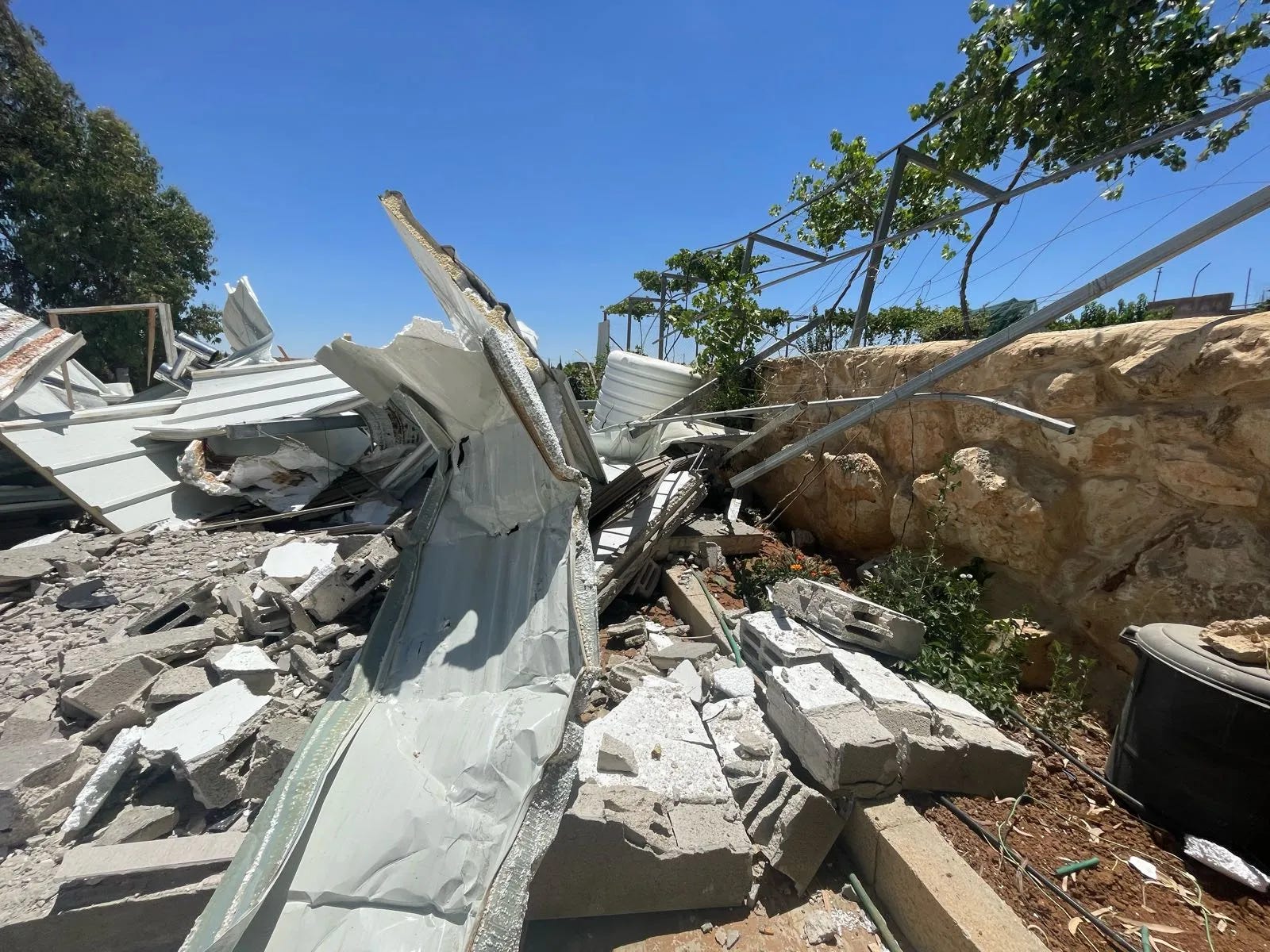
Al Karmil, Hebron (June 14): An inhabited home, animal and agricultural shelters, a water cistern, and a retaining wall were demolished south of Yatta, displacing a mother and her six children and affecting 29 more; soldiers fired tear gas and stun grenades during the operation.
2026 year-to-date data
Home demolitions: 225 demolitions, 703 structures destroyed, 1,044 people displaced (464 children), through June 15. Same period 2025: 271 incidents, 876 structures, 1,172 displaced.
Arrests: 4,458 arrests recorded across 165 daily reports. Same period 2025: 4,856 arrests across 168 reports.
Settler attacks: 1,476 attacks year-to-date. Full-year 2025: 5,443 attacks.