

Zionists annex huge swathes of Bethlehem
The Knesset sets the table to build the infrastructure to capture more of Palestine's ancient sites, not just Herodium.

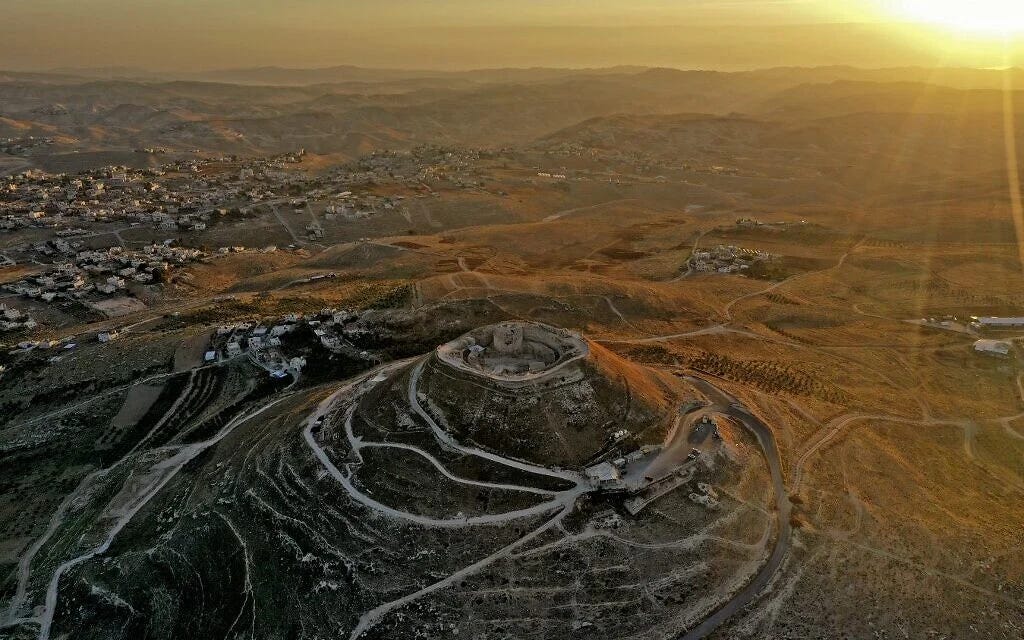
Herodium, Bethlehem
Israel’s Higher Planning Council approved five plans totaling 2,414 housing units across the West Bank on June 3, two of which establish new settlements. In Gvaot, west of Bethlehem, 1,006 units received final approval, giving the settlement an urban character. The second, 234 units in the Hamivesher outpost, authorizes what is, in practice, a separate settlement within Hebron, roughly 800 meters north of Kiryat Arba and detached from it. The session brings 2026 approvals to 6,232 units. The increased pace of approval traces to a June 2023 decision eliminating the requirement that the defense minister sign off at each planning stage; at the same time, settler leader and Knesset Member Bezalel Smotrich was given authority and responsibility over the Higher Planning Council. Whereas defense ministers had previously held plan advancement to about four rounds a year, the council has convened weekly since November 2024, and in 2025 it advanced 27,941 units, the highest annual figure since settlement construction in the West Bank began. In recent weeks it has shifted to meeting about every two weeks and approving several hundred units per session.
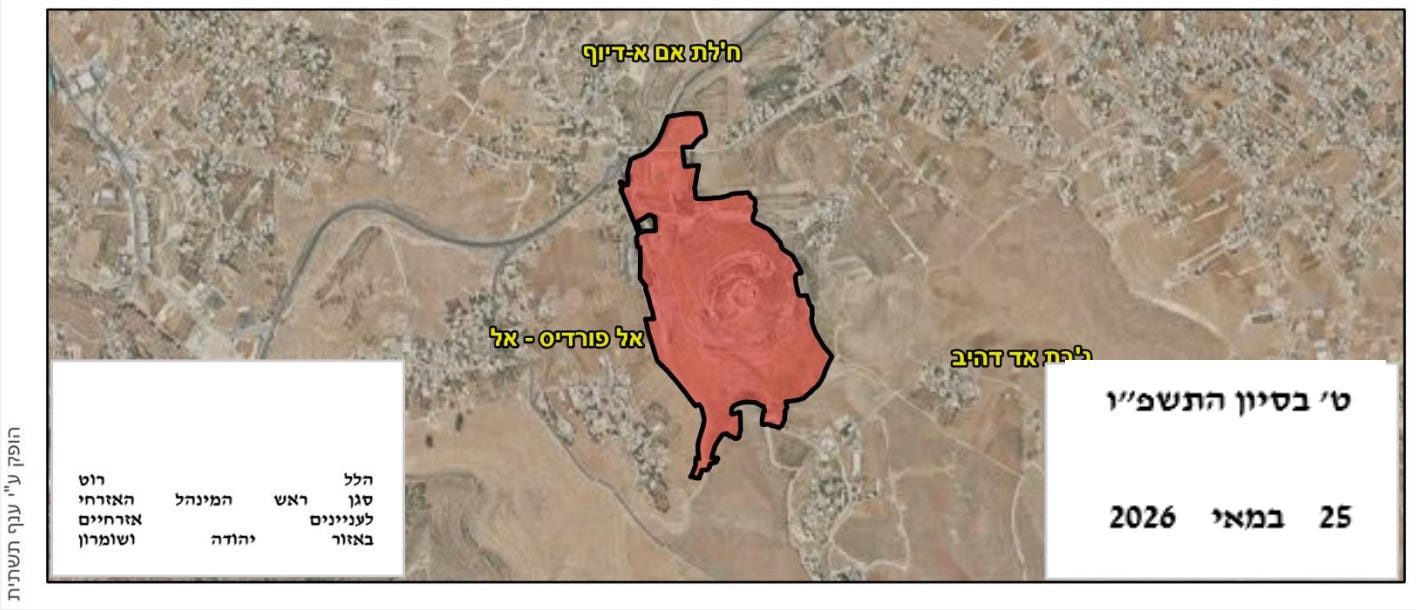
Area of Herodium being taken from Palestinians
The Israeli Civil Administration also issued expropriation order H/03/26, which essentially annexes 300 dunams at the ancient Herodium (Jabal al-Fureidis) site, east of Bethlehem beside the villages of Furadis, Za’atara, and Jubet al-Dihab. The Herodium hilltop is the most iconic figure along the Bethlehem governorate skyline, as it can be seen from nearly everywhere. The order encompasses the hill itself, the excavation areas at its foot, and the surrounding Palestinian land, including privately owned Palestinian farmland. It folds in 170 dunams declared state land in March 2024 and adds 130 more. Herodium is the third archaeological site expropriated this year, after 2,068 dunams at Sebastia in February and 110 dunams at Nabi Samuel in May.
Setting the table for more land confiscation, the Knesset is advancing the “Judea and Samaria Heritage Authority Law”, which would transfer responsibility for antiquities throughout the West Bank, and potentially Gaza, from the Civil Administration to a new authority under the Ministry of Heritage, governed by the Israeli right-wing formations. The bill is written to apply in Areas A and B, where the Palestinian Department of Antiquities holds authority under the Oslo framework. The new body will be able to expropriate private lands belonging to Palestinians that have any connection to “antiquities”. This is a consequential power given that nearly all Palestinian towns and villages sit adjacent to or directly atop ancient sites. Its council would include settler regional settler representatives from the West Bank.
Killed this week

Imad Haroun Ashtiya, 27, Salem village, Nablus governorate (May 31, 2026). Imad was shot in the thigh by Israeli forces near the separation wall at al-Ram while traveling to work inside the Green Line; he died of his wounds at the Palestine Medical Complex in Ramallah.

Amjad Jawad Abd al-Fattah al-Natsheh, 30, Hebron governorate (May 31, 2026). Amjad was shot dead by Israeli soldiers near the Gush Etzion junction.
2026 data points
Home demolitions (OCHA): 208 incidents, 634 structures destroyed, 979 people displaced (446 children), through June 1.
Arrests: 4,144 arrests year-to-date.
Settler attacks: 1,476 attacks year-to-date.